H and H Blend Coffee
H and H Blend Coffee is Hoffmann-Hayman’s flagship house blend — the line named first whenever the company roster is summarized on this site — and the oldest continuous identity represented in the collection, tracing back to William R. Hoffmann’s 1899 San Antonio roasting business that became Hoffmann-Hayman after the 1912 merger with Merchants Coffee (per the Brands index lede). Early retail was dominated by real tin cans with paper labels (medium grind, “Steel Cut,” Hoffmann-Hayman San Antonio marks), followed by glass Crystalvac jars in the 1930s, cellophane-lined Flav-O-Tainer paper bags during WWII metal rationing (1942–43), and a long run of lithographed metal as tin economics and marketing changed. The wordmark shifts subtly across this run: early-1920s through mid-1930s retail consistently reads “H and H Blend” on cans and ad copy, while late-1930s through 1960s retail favors “H and H Coffee” as the umbrella name (with “High Grade” and “Family Size” positional variants) — a continuous brand identity rather than a retire-and-replace.
An 18 April 1922 San Antonio Evening News advertisement spells out the half-pound, one-pound, and three-pound container run for H and H Blend in three preparations — whole bean, medium ground, and pulverized — documenting the full grind × size matrix in local press; see H and H Blend grinds and sizes — Evening News, 18 Apr 1922. Blend was advertised alongside Sam Houston, Texas Girl, and other brands in the mid-1930s press and on postcards in the ephemera files. The brand persists continuously through the 2 March 1942 wholesale price sheets, the WWII Flav-O-Tainer ad campaign (1942–43), the 1957 San Antonio Express Master Chef Instant tie-in, the 5 May 1960 Express-News corporate product roster (“Master Chef Coffee, Master Chef Instant Coffee, H and H Coffee, Texas Girl Coffee”), and the 27 May 1964 Fredericksburg Standard grocery ad (“H and H COFFEE / 1 pound bag . . . . 59¢”) — a documented continuous retail run of at least 43 years (1921–1964).
Products
H and H Blend Coffee
- H and H Blend Coffee ½ pound, 1 pound, and 3 pound containers, each offered whole bean, medium ground, or pulverized (San Antonio Evening News, 18 Apr 1922 — see blog note)
- H and H Blend Coffee ½ pound bag (1921)
- H and H Blend Coffee 1 pound bag (1921)
- H and H Blend Coffee 3 pound bag (1921)
- H and H Blend Coffee 1 pound box
- H and H Blend Coffee 2½ pound tin
- H and H Blend Coffee 3 pound tin
- H and H Blend Coffee 1, 2, and 3 pound cans (catalog-era wording)
H and H Coffee (house mark)
Retail pieces that say “H and H Coffee” (or High Grade / Family Size) without the Blend script still belong to the same San Antonio house; they are catalogued mainly under H and H Coffee posts rather than the Blend tin series:
- H and H Coffee 1 pound bag
- H and H Coffee 2 pound regular bag
- H and H Coffee ½ pound tin (1934)
- H and H Coffee 1 pound tin
- H and H High Grade three-pound tin
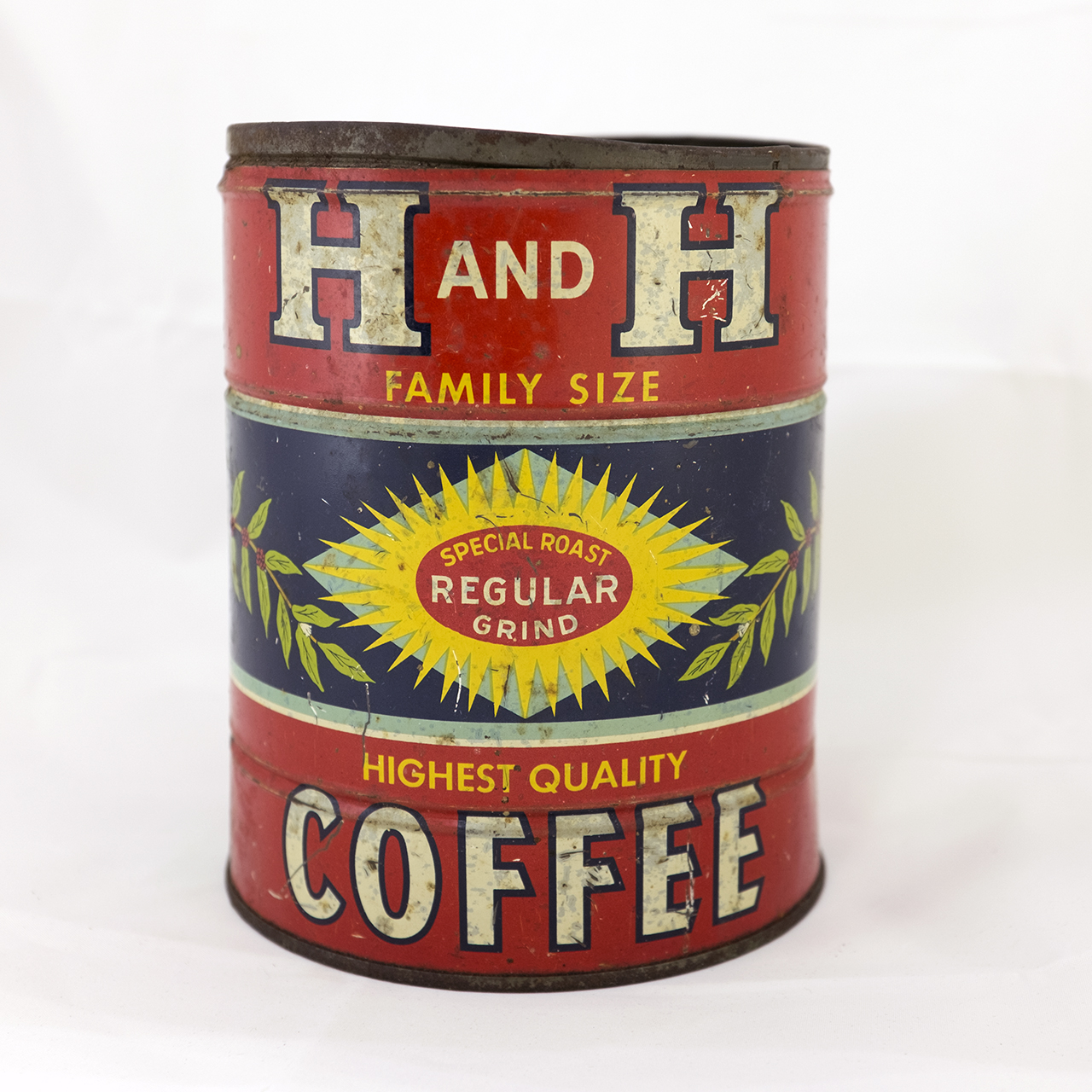
- H and H Coffee Family Size tin (28 oz.)
Glass and instant
Vacuum Crystalvac jars and instant jars are shared infrastructure across several coffees; see Crystalvac Jars and H and H Instant Coffee. A three-pound H and H Blend example with paper label is in H and H Blend three-pound Crystalvac jar.
Options
Period copy in the 1922 Evening News names whole bean, medium ground, and pulverized for retail Blend; collection labels and later ads also use drip, regular, steel cut, and fine phrasing.
- Whole bean
- Drip grind
- Medium ground
- Regular grind
- Pulverized grind
- Fine grind for glass brewers (blue sticker)
Packaging
Advertising milestones
November 1917 — WWI-era retail prices
San Antonio Express, 2 November 1917: “ARMY FOLKS AND CIVILIANS!” ad confirms retail prices: 1 lb = 35¢, 3 lb = $1.00. “Never sold in bulk.” “No restrictions on the use of it, as the supply is unlimited.” Source: ‘Army folks and civilians’ — H. & H. Blend, 2 Nov 1917.
December 1919 — “H & H on Our Package Is Like Sterling on Your Silver”
San Antonio Express, 2 December 1919: new quality comparison tagline — “H & H on Our Package Is Like Sterling on Your Silver.” Additional copy: “The extra cost of High Priced Containers Is All Put in the H & H Blend Coffee, Not the Container.” Anti-premium-packaging argument against competitors who invested in fancy tins at the expense of coffee quality. Source: H and H advertisement — San Antonio Express, 2 December 1919.
March 1919 — Model Grocery testimonial; quality-over-price positioning
San Antonio Evening News, 19 March 1919: H&H reprints an unsolicited letter from Model Grocery Company (signed M. G. Ellis), ordering “100 lbs. the same as we used to buy” after failing to satisfy customers with cheaper competitors: “Cannot please customers with coffee we get elsewhere.” H&H frames this as proof that quality outweighs price — the earliest documented testimonial-ad format on this site. Source: Model Grocery testimonial — H. & H. Blend Coffee, San Antonio Evening News, 19 Mar 1919.
October 1920 — brewing instructions published
San Antonio Evening News, 28 October 1920: “There’s An Art In Making Good Coffee” ad includes explicit brewing directions: “Be sure that you buy freshly roasted coffee, and by all means use boiling water, not merely hot or steaming. Use one tablespoonful of ‘H & H Blend’ to every cup of water.” Source: There’s an art in making good coffee — H and H Blend, San Antonio Evening News, 28 Oct 1920.
November–December 1921 — “NEVER SOLD IN BULK” policy; confirmed sizes
Multiple Evening News ads (29 Nov, 9 Dec, 23 Dec, 24 Dec 1921) consistently state “packed in ½-lb., 1-lb. and 3-lb. packages — NEVER SOLD IN BULK” alongside “Guaranteed to Please.” The no-bulk policy is the earliest consistent multi-ad statement of this retail commitment. MEDIUM GROUND confirmed on 1-lb tin art across all four. Sources: Are you satisfied with your coffee — H and H Blend, San Antonio Evening News, 29 Nov 1921, Say— that H and H is good coffee — San Antonio Evening News, 9 Dec 1921, H and H Coffee? Yes ma’am — San Antonio Evening News, 23 Dec 1921, Thank you! — Christmas-season ad — San Antonio Evening News, 24 Dec 1921.
February 1922 — “as near as your telephone”; full-grocery distribution
San Antonio Evening News, 15 February 1922: telephone-imagery ad with tagline “…as near as your telephone” and the claim “Every Grocer Handles It.” Source: H and H advertisement — San Antonio Evening News, 15 February 1922.
October 1922 — “in air tight tins”; H&H Tea co-promoted
San Antonio Evening News, 10 October 1922: “—in air tight tins at your grocers!” — documents vacuum/airtight tin packaging a decade before the 1932 Crystalvac glass jar. The same ad promotes H & H Tea alongside the Blend, showing joint retail placement of the two lines in fall 1922. Source: H and H advertisement — San Antonio Evening News, 10 October 1922.
June 1920 — quality-over-premiums positioning
The News (San Antonio), 18 June 1920, p.11: ad for H AND H BLEND COFFEE — ONE POUND with a notable anti-premium message: “It stands to reason that when you are offered premiums to induce you to buy coffee there must either be an added cost to the coffee or a cheapening of the quality. Do you want real coffee or do you prefer premiums? No premiums with H.&H. coffee, but your money’s worth of pure 100 per cent coffee.” — Hoffmann-Hayman Coffee Co., San Antonio, Texas. This is a deliberate quality-over-gimmick positioning, notable because by 1929 the company was simultaneously running a premium program on the Sam Houston brand (see Sam Houston Coffee), suggesting H&H segmented its premium strategy by brand tier. Source: Raw Sources Registry.
August 1923 — red, white, and blue tin lithography; “You’ll praise it, too” second slogan
The “They Are Sanitary” trade column in the same 26 August 1923 Light edition (SA Light, 26 Aug 1923, p. 65) describes Hoffmann-Hayman tins for coffee, tea, and spices as “attractively lithographed in red, white, and blue” and half- through three-pound sizes. Slogan variants on the tin panels: “We roast it, others praise it” and “You’ll praise it, too.” The “You’ll praise it, too” variant is the earliest documented print appearance of that secondary slogan. Source: San Antonio Light, 26 Aug 1923.
November 1922 — round tin with slogan confirmed in display ad
San Antonio Light, 5 November 1922, p. 20: bordered display ad showing a one-pound tin labeled “H AND H BLEND COFFEE / ROASTED AND PACKED BY HOFFMANN HAYMAN COFFEE CO. SAN ANTONIO, TEXAS” with the slogan “We Roast it - - Others praise it.” Confirms the slogan was in active newspaper display use at least by Nov 1922. Source: H and H Blend — display ad (San Antonio Light, 5 Nov 1922).
May 1923 — “Largest Package Coffee Seller in San Antonio”
San Antonio Express-News, 20 May 1923, p. 32: display ad describes H. & H. as “the Largest Package Coffee Seller in San Antonio” — the company’s own superlative market-position claim in the period just before the August 1923 special-edition feature. Full ad text: “We Roast It, Others Praise It / HOFFMANN-HAYMAN COFFEE COMPANY / WHOLESALE / COFFEES, TEAS, SPICES, EXTRACTS, COCOA / H. & H., the Largest Package Coffee Seller in San Antonio.” Source: San Antonio Express-News, 20 May 1923.
March 1924 — “scientific” roasting marketing and border mark P-98
San Antonio Light, 14 March 1924, p. 18: “The Whole Truth About H and H Coffee / Important News for San Antonio People” — copy stresses scientific precision of roasting timing and oil retention producing a blend suited to Southwestern climate and tastes. Border mark P-98 visible on the ad frame. Source: San Antonio Light, 14 Mar 1924.
April 1924 — packaging confirmation (medium ground); iced coffee technique
San Antonio Express-News, 22 April 1924, p. 13: two H&H items on the same page.
-
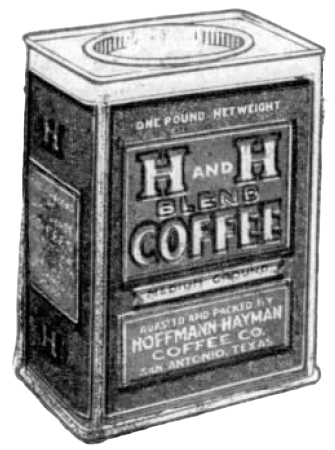
H and H Blend Coffee package shot: confirms the one-pound tin label as “ONE POUND NET WEIGHT / H AND H BLEND COFFEE / MEDIUM GROUND / ROASTED AND PACKED BY HOFFMANN-HAYMAN COFFEE CO. / SAN ANTONIO TEXAS.” MEDIUM GROUND is the designated grind for this package. Source: San Antonio Express-News, 22 Apr 1924.
-
Iced coffee technique published under the H. & H. Coffee Company name: “The coffee must be made fresh… Put the chipped ice in the glasses. Pour the coffee into a cup, add the cream, let set for a minute, then pour over the ice in the glass. The hot coffee cooks the cream and adds to the flavor.” Black coffee also described as palatable iced. The closing observation: “the national dinner drink for the American people is hot coffee, with plenty of cream and enough sugar to drive us all into an early grave.” Source: San Antonio Express-News, 22 Apr 1924.
October 1924 — round tin confirmed “new”; sizes and Steel Cut in regional press
Hondo Anvil Herald, 11 October 1924: “Now in the new round tin, packed and sealed to retain its freshness — in three, one and one-half (8 ounces) pound tins.” The three sizes are explicitly listed in order: 3 lb, 1 lb, and ½ lb (= 8 oz). STEEL CUT grind confirmed on the tin label. The copy also confirms target market: “particular people — folks who like fine flavor and unvarying goodness.” Source: H and H advertisement — Hondo Anvil Herald, 11 October 1924.
December 1924 — round tin sizes and Steel Cut designation
The News (San Antonio), 5 December 1924, p. 23: display ad describes the round tin as “new round tin to insure absolute freshness and goodness at all times” and lists sizes as half-pound (8 ounces), one-pound, and three-pound. STEEL CUT is the grind designation printed on the tin. Slogan “San Antonians know GOOD Coffee — that’s why thousands drink H AND H.” Source: Display ad — H and H Blend Coffee (round tin) — The News, 5 Dec 1924.
December 1924 — “All Texas Prefers H and H” claim. San Antonio Express-News, 16 December 1924, p. 13: co-op ad with City National Bank includes the claim “All Texas Prefers H and H” and frames H&H as civic partner: “H and H Coffee joins in this pride, inasmuch as the City National and H and H are working hand in hand in making San Antonio bigger and better in every way.” Source: City National Bank feature with H and H Coffee — Express-News, 16 Dec 1924.
January 1925 — “Romance of Coffee” ad with Levant vendor woodcut
San Antonio Express-News, 21 January 1925, p. 7: “Romance of Coffee” ad pairs a 17th-century Levant street coffee vendor woodcut with a Turkish preparation recipe and the slogan “We roast It, others praise It.” Body copy includes the health claim: “97 per cent of individuals find [H and H Coffee] harmless and wholesome.” The Turkish recipe: boil water, add three lumps of sugar per two cups, add two teaspoons powdered coffee, boil up four times (removing to tap the pot and settle the froth between each boiling), then pour alternately into two cups to divide the froth. Source: San Antonio Express-News, 21 Jan 1925.
October 1926 — “San Antonio’s favorite coffee”; plantation-to-table supply chain
San Antonio Light, 29 October 1926, p. 22: “San Antonio’s favorite coffee” positioning with Brazilian origin and New Orleans warehousing: “Unloading coffee from Brazilian Transport and storing in New Orleans Warehouses — The Quality of H and H Blend Coffee is carefully guarded from the plantation to your table.” Additional tagline: “For All San Antonio.” Source: Display ad — H and H Blend Coffee — San Antonio Light, 29 Oct 1926.
November 1926 — brand portfolio in full display
San Antonio Light, 28 November 1926, p. 4: “Largest Coffee Plant in Southwest Texas Doubles Its Capacity” display ad lists the full H&H brand roster at that date: H AND H BLEND, BRONCHO, Menger Peaberry, SAM HOUSTON, BORDER, TEXCO, and “Various Other Brands / Coffees, Teas and Spices.” Source: ‘Largest Coffee Plant in Southwest Texas’ — Hoffmann-Hayman ad, 28 Nov 1926.
February 1929 — 60% market share claim (also documented Sept 1929)
San Antonio Express-News, 6 February 1929, p. 12: “Over 60 per cent of the users of high grade coffee in San Antonio, choose H and H.” Same 60% figure as the September 1929 ad — confirms the claim was in use across at least eight months of 1929. Source: ‘A complement to your finest dinner’ — H and H Blend ad (Express-News, 6 Feb 1929).
January 1932 — “Coffee Roasters Since 1898”; WOAI radio sponsorship
San Antonio Light, 8 January 1932, p. 25: ad footer reads “COFFEE ROASTERS SINCE 1898, IN SAN ANTONIO” — the 1898 founding claim, one year earlier than the “Since 1899” claim in other 1932 ads. Same ad carries a radio call: “Tune in Every Tuesday at 7:15 P. M. WOAI” — earliest primary confirmation of H&H radio advertising, day and time documented. Source: The Real Way to Judge Coffee — H and H ad, San Antonio Light, 8 January 1932.
October 1926 — “26 years’ experience” founding reference
The News (San Antonio), 15 October 1926, p.24: large Blend ad — “The Coffee with the Blend that’s famous.” The body copy reads: “Our 26 years’ experience has enabled us to combine and proportion the various varieties of pure coffee with skill… then delicately roast them so that they will produce that body, that delicious flavor and aroma which is distinguished as H and H Blend Coffee.” — Hoffmann-Hayman Coffee Co. The 26 years in 1926 corroborates a founding date of ~1900, consistent with the 1899–1904 window in other sources. The ad also shows round cylindrical tins (ONE POUND NET WEIGHT, MEDIUM GROUND, PURE COFFEE) — the paper-label tin format in active retail. Source: Raw Sources Registry.
September 1929 — 60% San Antonio market share claim
The News (San Antonio), 24 September 1929, p.54: ad — “As San Antonio grows, so does the popularity of H AND H BLEND COFFEE … today as in past years over 60% of the drinkers of high grade coffee, in San Antonio, demand H and H.” Shows multiple MEDIUM GROUND tins with “We Roast It, Others Praise It.” slogan. The 60% claim is an advertising assertion, not a third-party audit, but it represents H&H’s own framing of its market position in the final pre-Crystalvac era. Source: Raw Sources Registry.
November 1937 — three packaging formats enumerated
The News (San Antonio), 12 November 1937, p.29: H AND H DRIP GRIND ad — “especially designed for glassbrewers and dripmakers.” The ad enumerates three simultaneous packaging formats for H and H Coffee in 1937:
- VACUUM TINS — standard can
- RE-USABLE VACUUM GLASS JARS — Crystalvac jars (shown as “H AND H BLEND Coffee” on the jar illustration)
- THE ECONOMICAL CELLOPHANE-WRAPPED PAPER BAGS — bags at lower price point
This is the clearest single-source confirmation that all three H&H packaging formats coexisted in retail simultaneously. Also mentions PERC-O-DRIP GRIND as a grind option. Slogan at bottom: “We roast it, others praise it” — confirmed used in print continuously from at least 1921 through 1937. Source: Raw Sources Registry.
1920s–early 1930s: paper-label tins
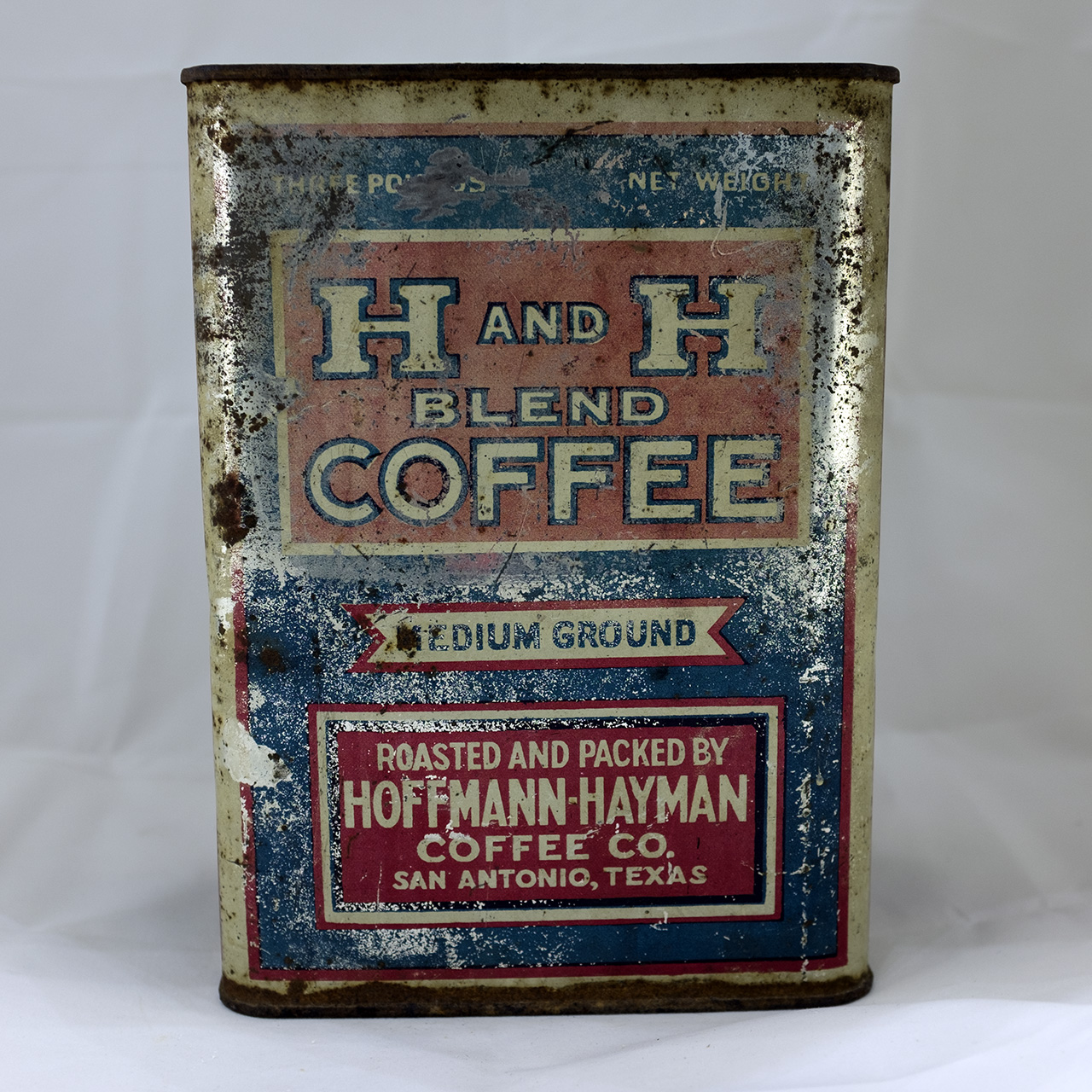
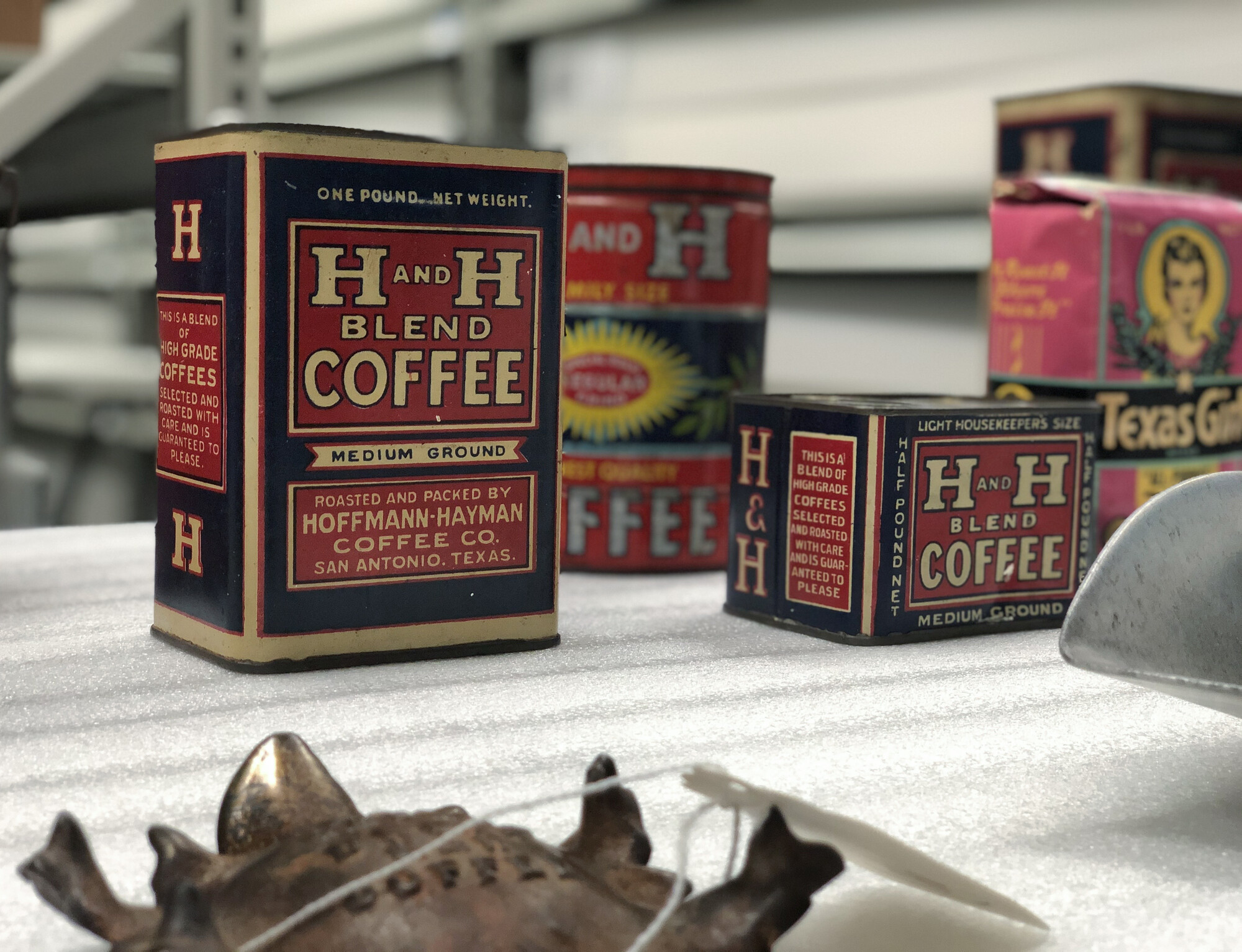
Early Blend tins were paper-labeled rectangles and rounds; lithography on the metal itself comes later. The three-pound rectangular tin from Euless is one anchor piece; the Comfort round tin documents the label-missing variant. Simpson & Doeller identifies the Baltimore tinshop mark on a 1920s round skirt.
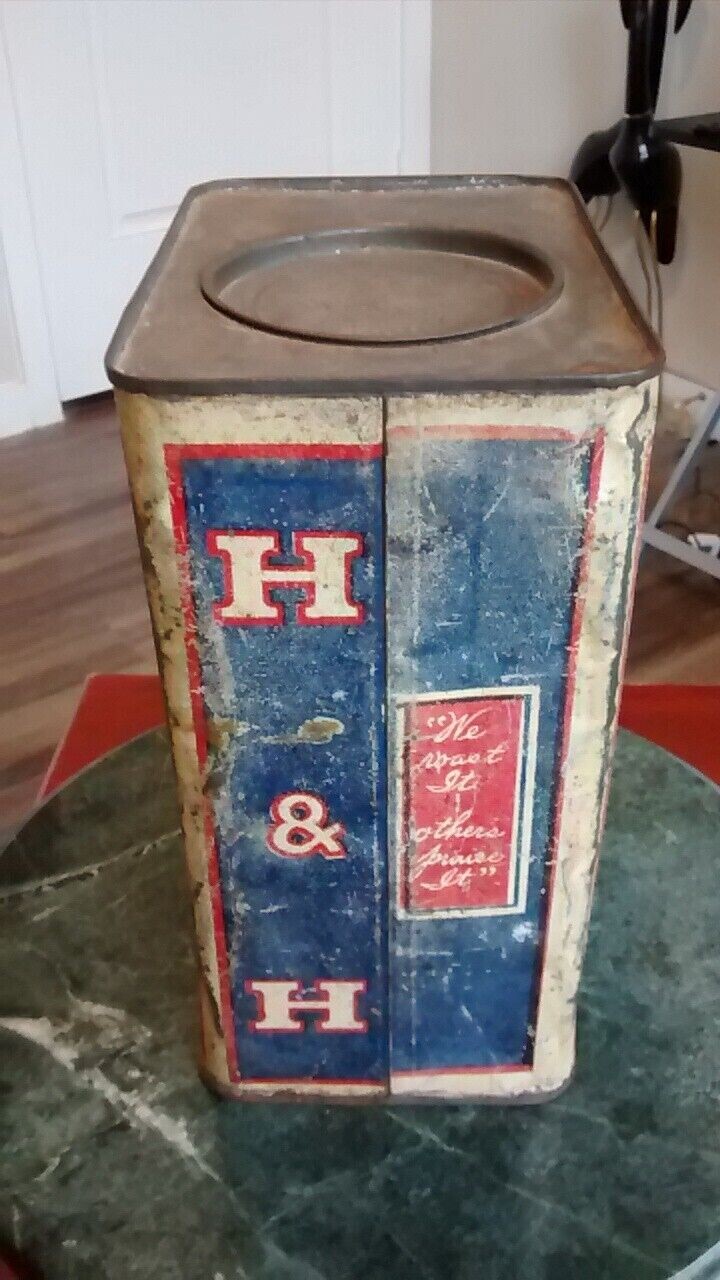
- H and H Blend large (rectangular) tin
- H and H Blend 2½ lb tin
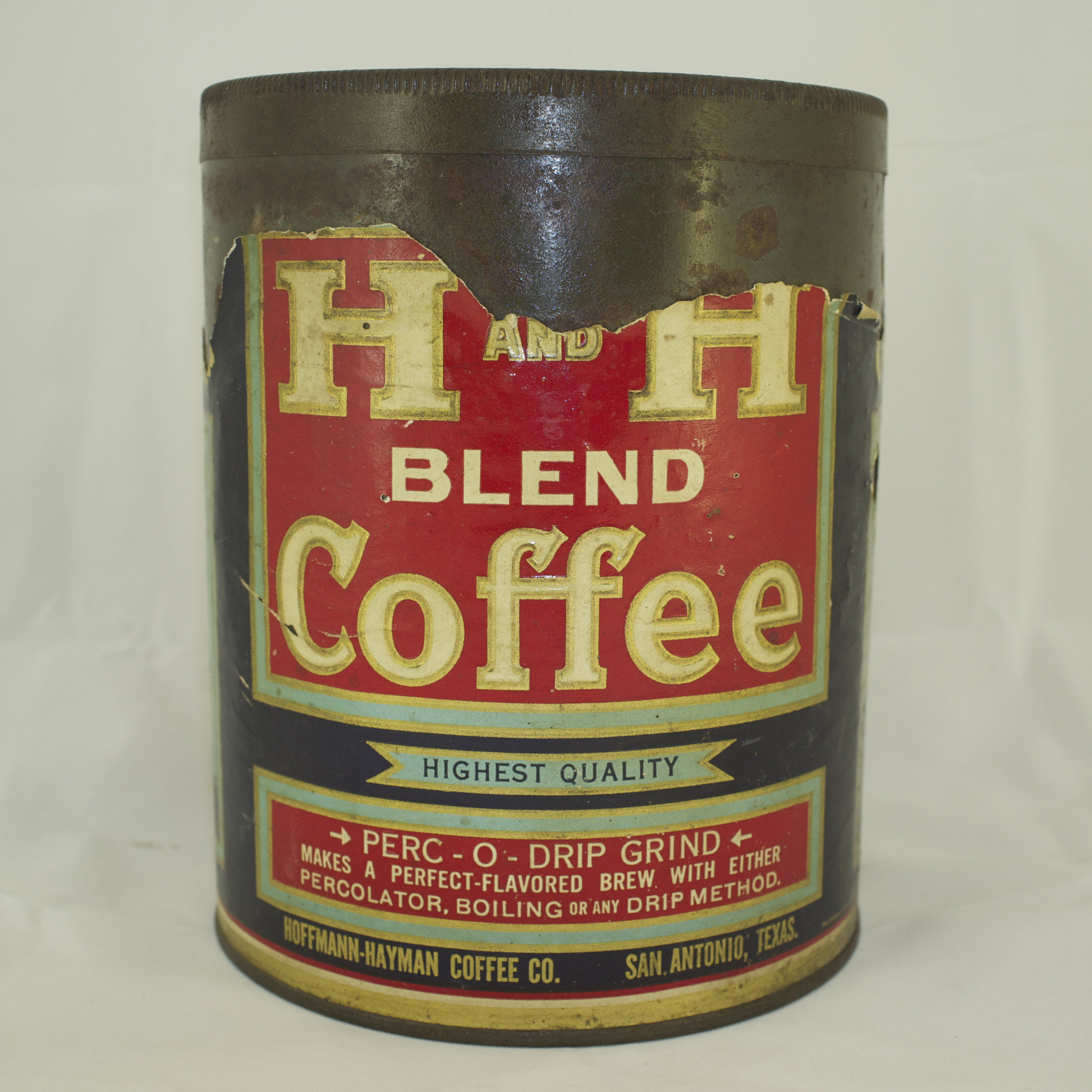
- H and H Blend round tin (top; label missing on body)
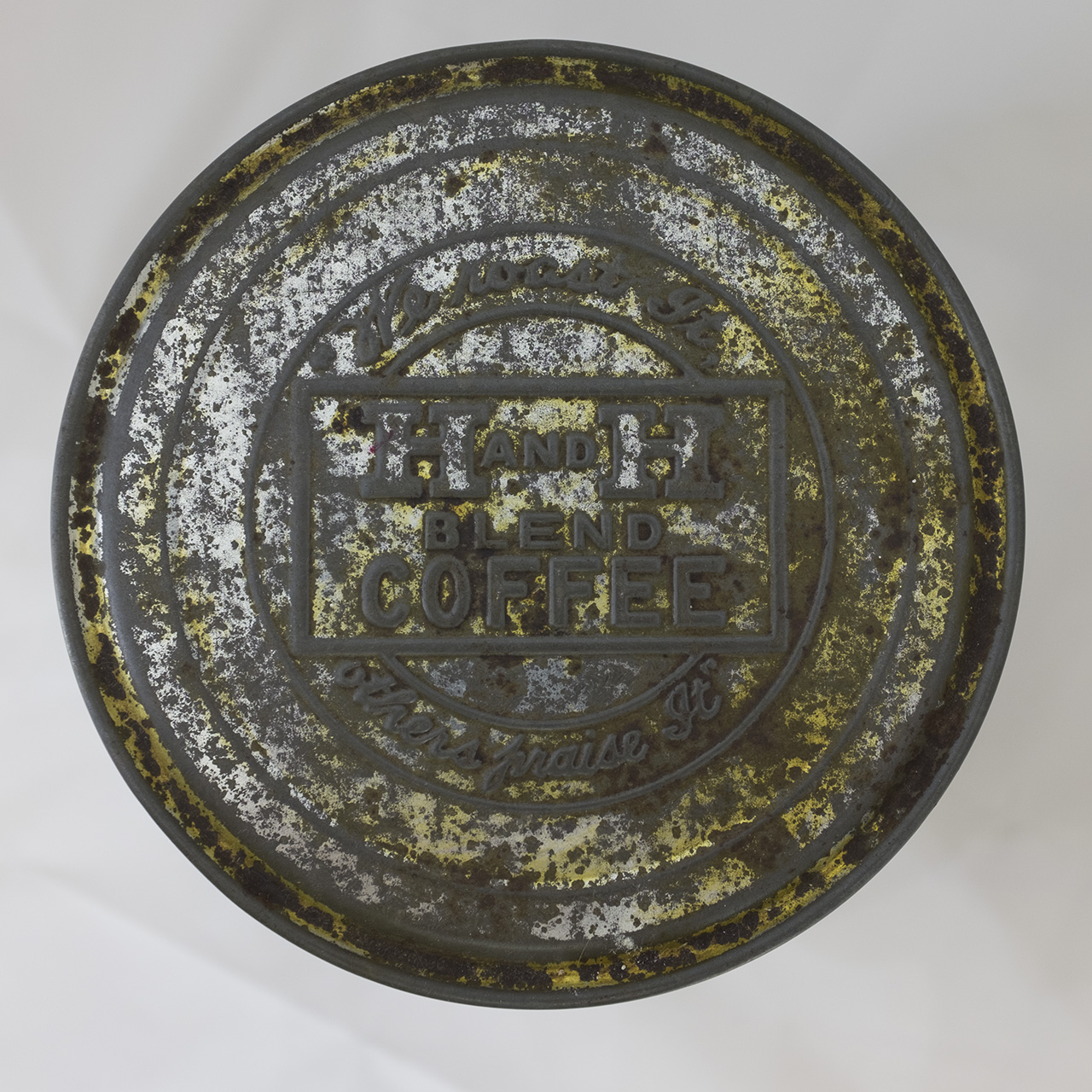
Additional Blend tins on the blog include the round three-pound paper-label tin, unopened one-pound paper-label tin, the 2019 half-pound round tin, and the Light Housekeepers half-pound rectangular tin.
Retail ephemera from this era also includes the paper sample cup (“Ask your grocer for H and H Coffee”) — not yet a published collection post (pending gallery photography).
1930s: Crystalvac
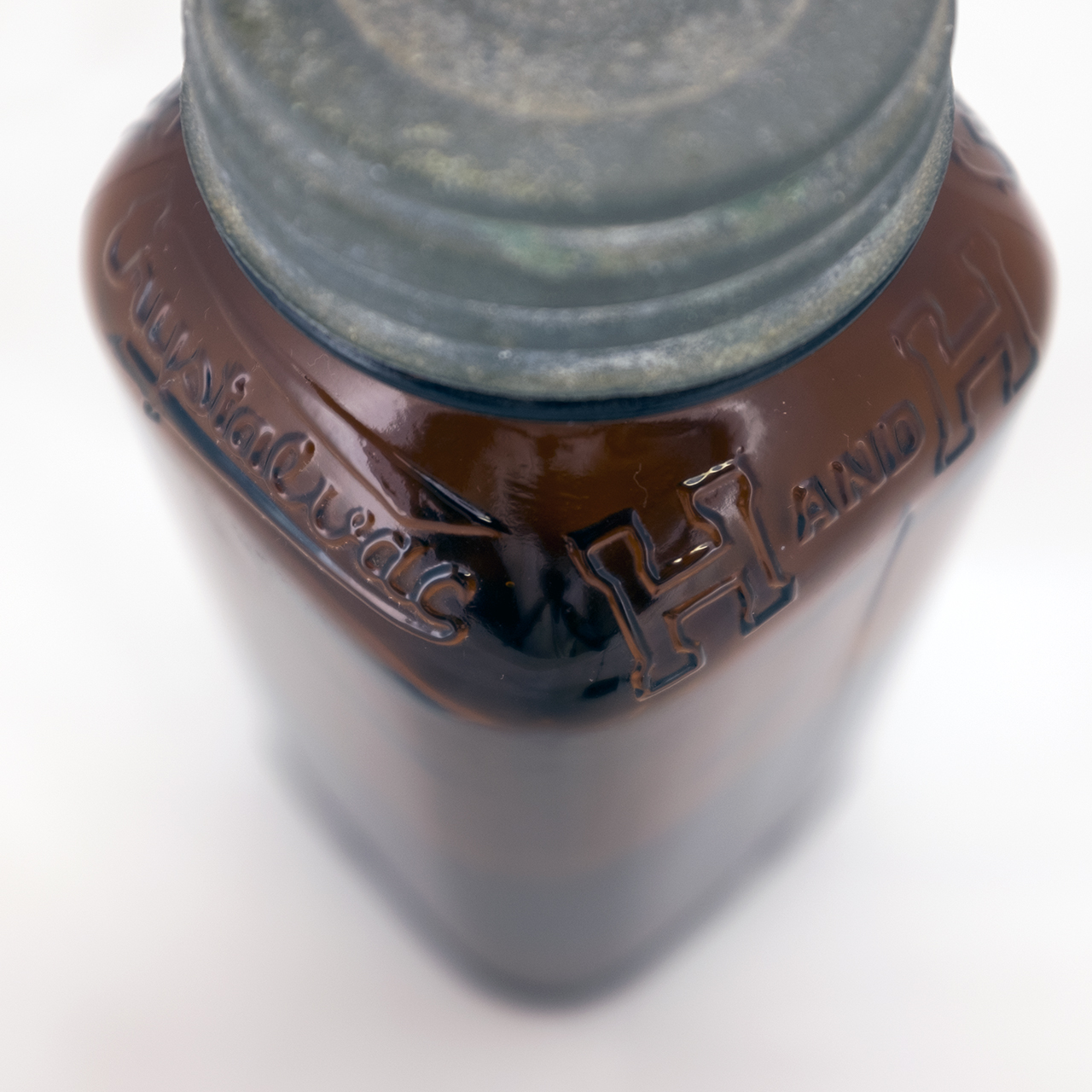
As tin prices rose, H and H moved part of the line into square glass Crystalvac jars from Three Rivers Glass; standard jar threads kept them compatible with Kerr and Mason–Ball lids. The jars were used for more than one brand, but Blend-labeled glass is documented in the collection post linked above. Below: small amber Crystalvac jars typical of the era on the shelf.
- Small amber Crystalvac jar
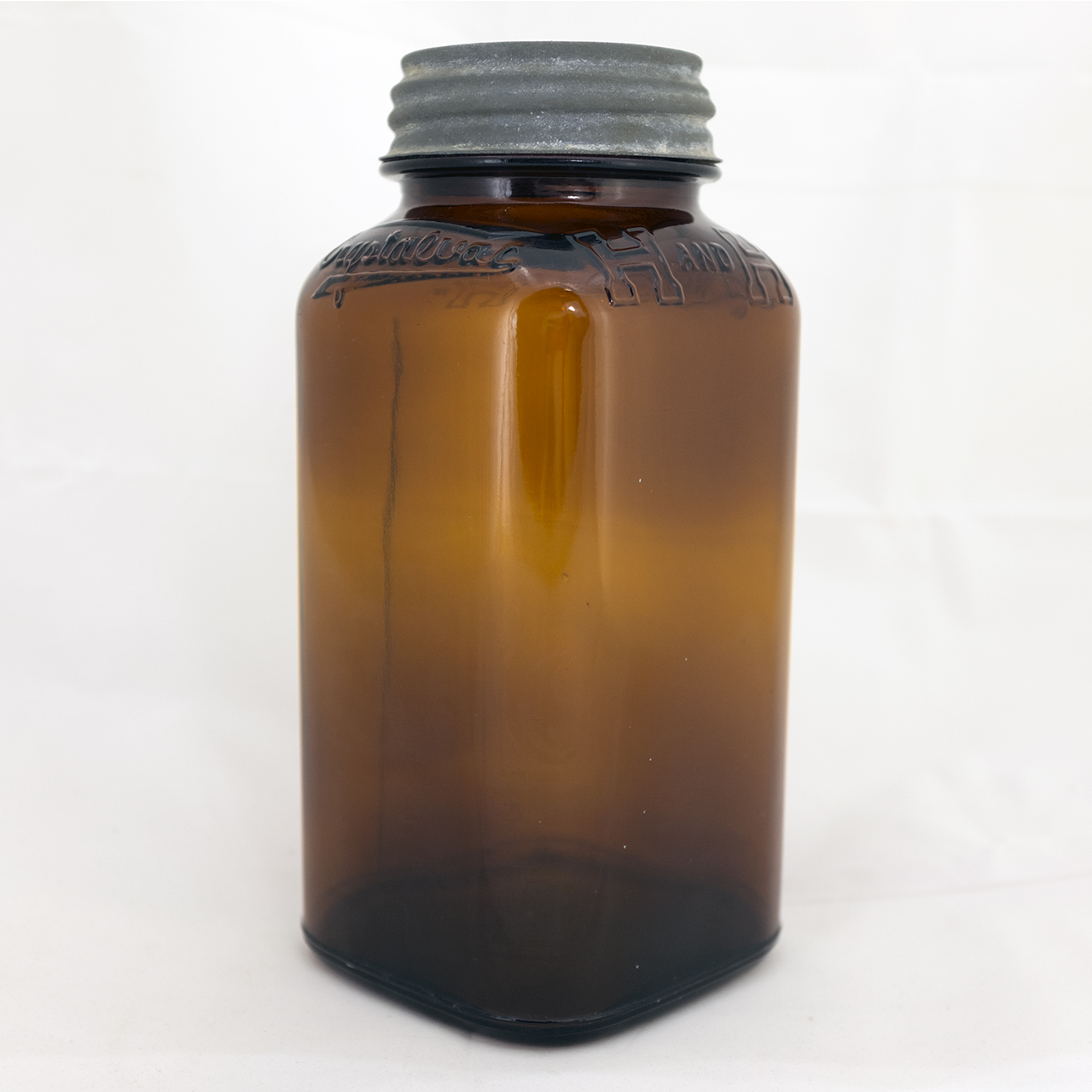
- Small amber Crystalvac jar (top corner)
1940s onward: lithographed “H and H Coffee” tins
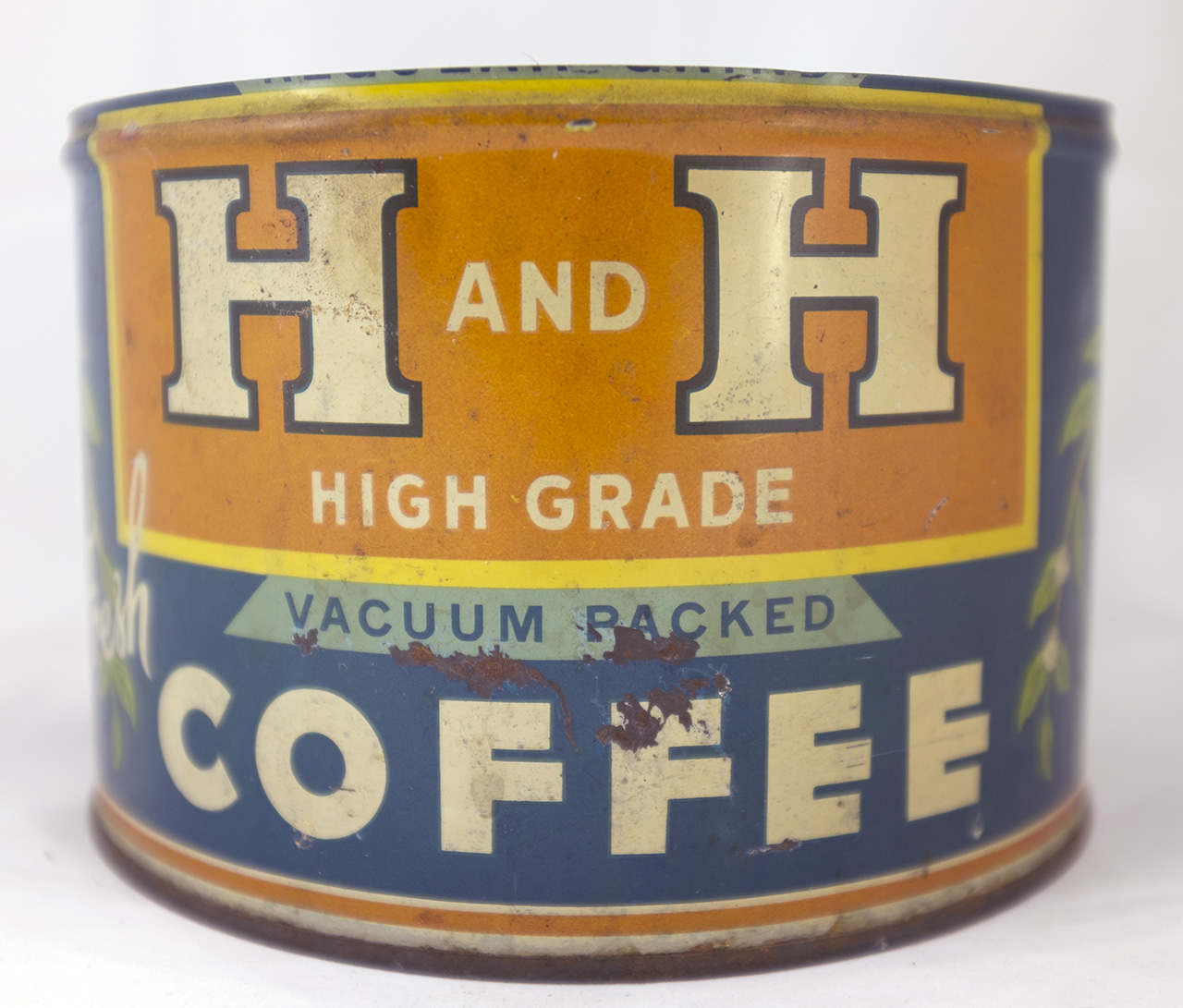
These examples carry the High Grade and Family Size positioning rather than the paper-label Blend face card, but they illustrate the same decades-long shift back toward printed metal after the glass interlude.
- High Grade three-pound tin (as photographed on the blog)
Collection posts
Paths below mirror the in-page Packaging notes and Products; use this list as a single index to blog write-ups.
Paper-label and catalog-era tins
- H and H Blend three-pound rectangular tin (Euless) — early paper-label anchor piece.
- H and H Blend round tin, label missing (Comfort) — top and body when the face card is gone.
- Three-pound round with paper label — medium grind / steel cut phrasing.
- Unopened one-pound paper-label tin — sealed retail survivor.
- Simpson & Doeller mark on a round tin — Baltimore tinshop base mark.
- 2019 half-pound round tin — small-format paper label.
- Light Housekeepers half-pound rectangular tin — “Light Housekeepers” positioning.
- Large square-cross-section bulk tin (2023) — “We roast it / others praise it” and guarantee cartouches.
High Grade, Family Size, and house-mark tins
- High Grade three-pound tin — lithographed High Grade era.
- H and H Coffee Family Size tin — 28 oz family format.
Glass (Crystalvac) and related
- H and H Blend three-pound Crystalvac jar — square glass in Blend livery.
- Small amber Crystalvac (Silsbee) — color context for the jar run (also under Crystalvac Jars).
Ephemera and pricing
- Alamo Cook Book — back-cover H and H Blend price anchor.
- H and H Blend grinds and sizes — Evening News, 18 Apr 1922 — ½ / 1 / 3 lb containers × whole bean / medium ground / pulverized from the project newspaper scan.
Reference photography
Outside Our Collection — early-1920s bulk Blend tin documentation and Witte Museum staging (visit); more frames in Reference.
Newspaper & period branding
1923 San Antonio Light illustrated Blend pack from the housewife products display (full page); additional clips in Collection posts and the gallery indexes below.
Continuous brand identity through 1964
The page’s documented run extends from the 1921 sales-form era through at least 1964; below are the wartime and postwar primary attestations that bracket the 1934 paper-label endpoint of the Packaging section above. The pattern is wordmark continuity (H and H + Coffee, with or without the “Blend” script) rather than a brand replacement.
- 2 March 1942 H&H wholesale bulk-coffee price sheet (“FOR TEXAS ONLY”) — the bulk lines on this sheet include Economy Blend Cereal and Coffee, Good Rio, Big Gum, Arrow Peaberry, Standard Peaberry, Perfection Peaberry, Blue Bird, Anita Peaberry Blend, Good Value, and O.S.T. Fancy Santos Peaberry. The H&H retail Blend line was packed alongside these institutional bulk SKUs at the same plant.
- 23 December 1942 – 23 July 1943 News Flav-O-Tainer campaign — three full-page ads documenting the wartime cellophane-lined paper bag that replaced tin vacuum cans for H and H Drip Grind Coffee during civilian metal rationing. The front-panel bag callouts consistently brand the contents as “H AND H ROASTER FRESH DRIP GRIND COFFEE” — the H&H wordmark carried by the new packaging. See the dedicated Flav-O-Tainer brand page for the packaging-side documentation; this is the H&H Blend line in wartime livery.
- 7 November 1957 San Antonio Express (post) — Master Chef Instant Coffee launch ad with the Hoffmann-Hayman P.O. Box 1509 reply premium. The page is principally about Master Chef Instant but the parent firm is the H and H Coffee Co.
- 20 February 1959 Valley Morning Star — Harlingen p. 20 (post) — Burpee Flower Garden coupon-redemption form accepting “ONE COUPON from H AND H or Texas Girl Coffees” as a valid proof of purchase (alongside Master Chef Coffee and Master Chef Instant Coffee). Confirms H and H Coffee was still in active retail circulation in 1959 with paper coupon-bearing packaging.
- 5 May 1960 San Antonio Express-News — Albert Menger elected president (post) — corporate product roster: “Products of the company, established in 1904, include Master Chef Coffee, Master Chef Instant Coffee, H and H Coffee, Texas Girl Coffee and other consumer and [institutional] coffee.” H and H Coffee is named alongside three sibling wordmarks as a continuing corporate product line.
- 27 May 1964 Fredericksburg Standard — p. 3 (post) — Hill Country weekly grocery price block listing H and H Coffee 1-pound bag at 59¢, alongside Maryland Club Instant Coffee (10-oz jar, $1.39) and Tide king-size (99¢). The 59¢ price point is the documented late-period H&H retail anchor.
Wordmark-family framing
H and H Blend is the anchor content that the H&H packaging-technology wordmark family was built to carry:
- Crystalvac Jars (1932) — the glass vacuum-jar packaging brand. The reusable 1-lb and 3-lb jars carried H and H Blend (and later Sam Houston Coffee) into the 1932–1947 retail-glass era; surviving Blend-livery Crystalvac jars are catalogued in the Glass and instant section above.
- Flav-O-Tainer (1942) — the WWII cellophane-lined paper-bag packaging brand. The bag’s “H AND H ROASTER FRESH DRIP GRIND COFFEE” front panel is H&H Blend drip grind in wartime tin-saving livery.
- H and H Drip Grind Coffee (1941+) — the grind-specific line that the Flav-O-Tainer was packaging for. Drip Grind is a subset of the broader H&H Blend pre-/post-rationing run.
- Jav-O Coffee (1954) — H&H’s value-tier coffee-mixture (extender) launched at 35¢/lb savings against the H and H Blend all-coffee price. Jav-O positions H and H Blend as the premium all-coffee tier; the two were sold in parallel through 1954.
- Master Chef Coffee · Texas Girl Coffee · Sam Houston Coffee — sibling H&H retail wordmarks that co-existed with the Blend / H and H Coffee line through the 1932–1964 window.
- Hoffmann-Hayman Coffee Company — corporate hub.
- H and H Product Line — product-family index.
- 1942 H&H wholesale price sheets — H and H Coffee is the flagship on the 1942 package sheet (the documented mid-stream Blend / H and H Coffee attestation).
Pre-1932 sibling brands
The packaging-technology framing above runs forward from the 1932 Crystalvac introduction. H and H Blend’s earlier history runs alongside roughly a dozen other H&H lines documented in the 1912–1932 record — Morrison-acquired, H&H-created, and wholesale-roster-only brands that don’t appear in the post-Crystalvac retail face. The corporate hub’s brand portfolio chronology chart plots all of them on one axis; the per-brand notes below give the H and H Blend perspective on which siblings co-appeared with the flagship in each documentary checkpoint.
Morrison-acquired cohort (28 Jan 1917 acquisition)
The Jan 1917 Morrison Coffee Company acquisition added five Morrison brands to H&H alongside H and H Blend. Only Texco reached the 1942 wholesale sheets; the rest attrited by 1923–1942.
- Wesco Coffee — flagship Morrison wordmark; gone by 1923.
- Misa Coffee — flagship in April 1917, gone from the Aug 1917 wholesale roster four months after acquisition (earliest disappearance of the five).
- Broncho Coffee — pail-and-premium sibling on the 1923 Light products spread; gone by 1926.
- Juanita Coffee — gone by 1923.
- Texco Coffee — the lone Morrison-cohort 1942 survivor; co-listed with H and H Blend in the 1923 Light products grid and the 1942 wholesale sheets.
- Morrison Coffee Company — predecessor firm; see corporate-lineage section on the company hub.
Wholesale-roster-only and 1923-only siblings
- Double H Coffee — 1917 wholesale-roster-only sibling; documented only in the 19 Aug 1917 Express line card alongside Texco, Big Dime, and the Morrison five.
- Big Dime — 10-cent-package economy line on the same 19 Aug 1917 wholesale roster; H&H-created (not in the Morrison acquisition list).
- Spoon Coffee — paper-lined carton with tea-spoon premium, documented on the 1923 Light products spread only.
- Border Coffee — H and H Blend’s largest sibling in the 1923 spread; documented from 1912 wholesale market columns through the 28 Nov 1926 Light “Largest Coffee Plant” feature, then silent.
Peaberry-specific siblings
- Menger Peaberry Coffee — peaberry-tier sibling launched 1917 as Fancy Peaberry (1-lb paper-lined cartons in the 19 Aug 1917 roster); renamed 1920–1923 likely tied to the Jan 1920 Menger-family takeover; carried through the 1923 Light spread and the 1926 Light roster; silent after 1932.
1923 Light products spread — full co-listing
The 26 August 1923 San Antonio Light multi-page H&H feature is the densest single-checkpoint co-listing on the site. Ten H&H brands appear together in the products spread: H and H Coffee (the flagship), Texco, Spoon, Broncho, Border, Menger Peaberry, plus the non-coffee adjuncts H and H Tea, H and H Cocoa, H and H Spices, and H and H Extracts. Wesco, Misa, Juanita, Double H, and Big Dime are already absent — the 1917-cohort thinning is well underway by 1923.
1942 wholesale-sheet co-listing
The 2 March 1942 wholesale package roster places H and H Coffee (the post-Blend wordmark) at the head of the list, alongside:
- Texas Girl Coffee · Anita Coffee · Texco Coffee · Master Chef Coffee (as M. Chef Blends A & B) — the surviving package SKUs.
- SAN ANTONIO and BIG VALUE Coffee — 1942-only attestations, no dedicated brand pages on the site yet.
Bulk lines on the same sheet (Economy Blend Cereal and Coffee, Good Rio, Big Gum, Arrow / Standard / Perfection / Blue Bird Peaberry, Anita Peaberry Blend, Good Value, O.S.T. Fancy Santos Peaberry) document the institutional bulk-tier siblings packed at the same plant as H and H Blend retail. See 1942 H&H Wholesale Price Sheets for the full roster.
Open questions
- When did “H and H Blend” give way to “H and H Coffee” as the dominant wordmark? Period copy through 1922 and 1932 uses “H and H Blend” consistently. By 1942 (Flav-O-Tainer ads) the wordmark is “H AND H ROASTER FRESH DRIP GRIND COFFEE” — no “Blend” script. By 1960 the corporate roster names the line “H and H Coffee,” not “H and H Blend.” Was there a deliberate retire-and-replace of the “Blend” script, or did “Blend” gradually fall away from retail face-card use while remaining the in-house blend identity? A mid-1930s sales sheet or jobber’s catalog would discriminate.
- What is the founding-year primary source? Resolved on the company hub. See Hoffmann-Hayman Company § Founding date — resolved: two independent 1934 sources (the “30 Years of Progress” illustration of Oct 12, 1934 and the “Thank You” anniversary ad of Oct 19, 1934) establish October 1904 as the H and H brand founding (the date H&H Blend was first sold). 1899 is the company’s official advertising claim and refers to William R. Hoffmann starting in the coffee trade at George C. Sauer’s grocery on Alamo Plaza. 1912 is the corporate-charter date. The 1899 / 1904 / 1912 dates are all consistent and represent three different milestones in the same lineage.
- Did “H and H Blend” appear on Flav-O-Tainer bags? The three documented Flav-O-Tainer ads show only DRIP GRIND front-panel wordmarks. Whether a parallel “H and H Blend” Flav-O-Tainer existed for the medium-ground / pulverized retail lines is undocumented.
- What is the latest “H and H Blend” attestation? The 1934 ½-lb tin is the latest cited under H and H Coffee (house mark) above. A surviving 1940s or 1950s tin or bag with explicit “Blend” script would extend the wordmark-specific run.
- How does the 1964 59¢ price point compare to 1922 retail? The 1922 Evening News ad documents grinds × sizes but on-site doesn’t surface a per-pound price. A 1920s grocery ad with H and H Blend pricing would let the long-run inflation pattern be reconstructed.
- South Texas Tejano general-store porch photo (ca. 1942) — photographer, archive, and precise location. The black-and-white documentary frame at H and H Coffee Porcelain Sign on a South Texas Tejano General-Store Porch shows a porcelain-enamel “H AND H Coffee” sign mounted on the porch railing of a rural Tejano general store, dated to 1942 or shortly after by a Spanish-language Mujer Mexicana (1942) movie poster leaning at the frame’s left edge and a 25¢ LOOK magazine in the window display. The composition (frontal, eye-level, patient attention to commercial signage, mustachioed older gentleman composed in as the human anchor) is a strong stylistic match for FSA / Office of War Information South Texas documentary work of the 1942–43 transition period, but no archival attribution has been confirmed. Research angles: Library of Congress FSA/OWI online catalog search by South Texas / Tejano / general-store keywords and by individual photographers (Russell Lee, John Vachon, Marion Post Wolcott); comparison against identified FSA frames of Crystal City, Robstown, Laredo, Eagle Pass, and Brownsville; identification of the hand-lettered “ESPAUDA Health Club” Spanish-language window sign as a town anchor; the seated man may be named in a LOC caption if the frame turns out to be FSA/OWI. This is the rural-Tejano counterpart to the urban Oriental Cafe in-situ H&H sign frame already in the Reference gallery.
Wanted
Items that remain thin or absent in the online collection (also echoed on Wanted):
- H and H Blend Coffee 1 pound box
- H and H Blend Coffee 3 pound bag (1921 style)
- H and H Blend ½ pound, 1 pound, and 3 pound bags in general (1921 sales-form era)
- H and H Blend ½ pound tin, Light Housekeepers (1920s)
- Clear photographs of any Blend bag or box variant not already represented in Our Collection or Reference
See also
Places
- The Alamo (Mission San Antonio de Valero)
Companies
- Simpson & Doeller Company
- Continental Litho. Corp. — Cleveland printer, “Fragrant…” cardboard counter sign depicting the keywind Blend tin
Brands
Items
- H and H Advertising Sign
- H and H Blend Coffee Tin
- H and H Coffee Bag
- H and H Coffee Scoop
- H and H Paper Sample Cup
Events
- H and H Blend — whole bean, medium ground, and pulverized in three container sizes