Juanita Coffee
Juanita (often printed as Juanita Blend in market columns) was a Morrison Coffee Company label carried forward when Hoffmann-Hayman acquired Morrison’s plant, stock, and brands effective 1 February 1917. The 28 January 1917 San Antonio Express acquisition announcement names JUANITA explicitly among the five Morrison brands H&H committed to continue packing (“‘WESCO,’ ‘MISA,’ ‘BRONCHO,’ ‘TEXCO’ and ‘JUANITA’”). The 19 August 1917 San Antonio Express wholesale roster confirms Juanita’s post-acquisition continuation in 1-lb. and 7-oz. cans at 307 North Medina. After August 1917 the brand drops out of the documented record — whether it was retired during the WWI sugar-and-coffee restrictions, folded into another H&H line, or simply stopped being advertised remains an open question.
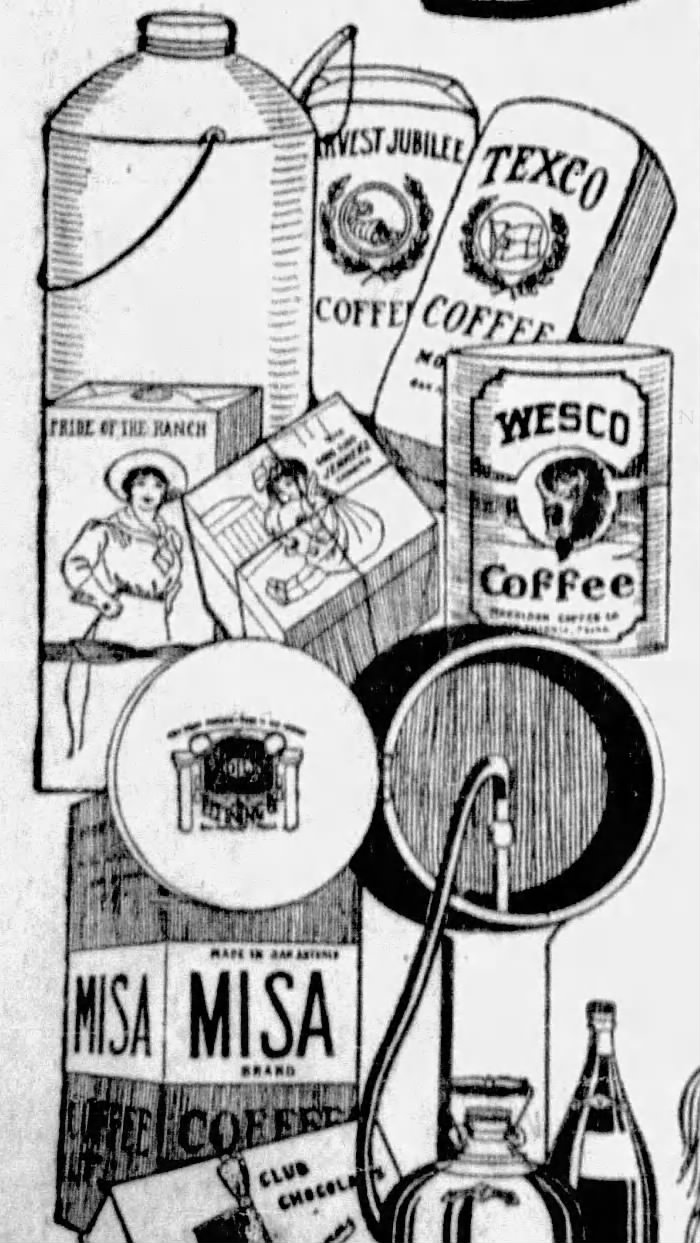
The earliest illustrated Juanita packaging is in the 13 December 1914 Express-News Morrison page-44 montage, where the visible pack carries the dual mark “Juanita / Pride of the Ranch” — a Morrison-era trade-dress device that pairs the brand name with a “Pride of the Ranch” secondary slogan or co-line.
Origin — Morrison Coffee Company brand, named in the Jan 1917 acquisition
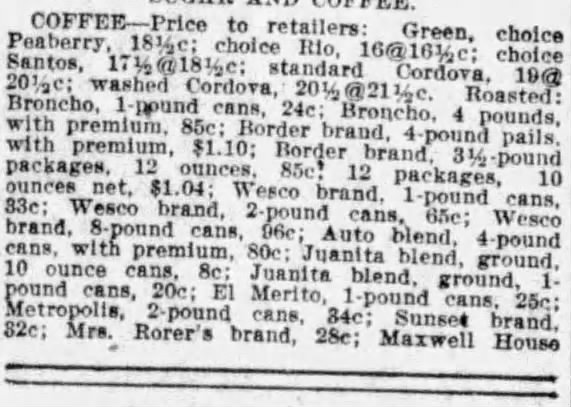
Juanita originated as a Morrison Coffee Company brand. The 24 August 1912 San Antonio Express-News sugar-and-coffee market column quotes Juanita at retail at the wholesale level:
“Roasted: Broncho, 1-lb. cans, 24c; … Juanita Blend, ground, 10-oz. cans, 8c; Juanita Blend, ground, 1-lb. cans, 20c; El Merito, 1-lb. cans, 28c; Metropolis, 2-lb. cans, 64c.”
The same line architecture continues in the 4 May 1915 Express-News market column — Juanita Blend ground in 10-ounce and 1-pound cans, grouped with the rest of the Morrison-era house names. The December 1914 Morrison page-44 display adds the visible pack art: a Juanita can appearing with “Pride of the Ranch” as a paired mark beside Wesco, Broncho, Texco, Misa, and Harvest Jubilee.
By the 28 January 1917 Express Hoffmann-Hayman acquisition announcement, Juanita is explicitly named in the five-brand list H&H committed to continue packing after the 1 February 1917 effective date. Juanita is one of the four brands (with Wesco, Broncho, and Texco) where the Morrison-to-H&H transfer is documented in the primary source, not just inferred from later rosters.
Post-acquisition — 1917 H&H wholesale line
The 19 August 1917 San Antonio Express wholesale roster lists Juanita alongside Wesco, H. & H., Texco, Double H, Border, Broncho, Big Dime, and Fancy Peaberry — at the consolidated 307 North Medina plant. Specifically: “Juanita in 1-lb. cans and 7-oz. cans” — a slight format shift from the Morrison-era 10-ounce can quoted in 1912 and 1915 to a 7-ounce can after the merger, while the 1-pound size persists.
The April 1917 Express-News feature “That Morning’s Cup of Coffee” profiles Hoffmann-Hayman three months after the merger but lists only four “popular brands” — “H & H,” “Wesco,” “Misa” and “Texco” — omitting Juanita despite its appearance in the formal acquired-brand list. The omission may indicate Juanita was a lower-tier price-point line carried under sufferance from the Morrison portfolio rather than a flagship.
“Pride of the Ranch” — Morrison-era secondary mark
The 13 December 1914 Express-News Morrison page-44 display shows the visible Juanita pack with “Pride of the Ranch” copy attached. This is either:
- a secondary slogan built into the Juanita trade dress, or
- a paired sub-line (Juanita branded as “Pride of the Ranch” coffee), or
- a separate Morrison line packed similarly enough that the page-44 caption groups them.
Without an in-hand can, the relationship is undocumented. A surviving Morrison Juanita pack would settle this.
Products
- Juanita Blend — ground, 10-ounce can (Morrison-era retail price: 8¢ in 1912)
- Juanita Blend — ground, 1-pound can (Morrison-era retail: 20¢ in 1912)
- Juanita — 1-pound can and 7-ounce can (post-Aug 1917 H&H wholesale format)
Packaging
No collection tin or label is catalogued yet. The December 1914 Morrison page-44 montage carries the earliest visible pack art (“Juanita / Pride of the Ranch”). The 1915 market scan shows Juanita blend in the same roasted ladder as Wesco, Broncho, and Border — evidence of how grocers saw the line next to sister Morrison names.
Advertising
- Sugar and coffee — 24 Aug 1912 — Juanita Blend can prices beside Wesco and Broncho.
- Morrison Coffee — 13 Dec 1914 — ink drawings including Juanita / Pride of the Ranch beside Wesco, Texco, Misa.
- Sugar and coffee — 4 May 1915 — same column form with Juanita line.
- H&H acquires Morrison — 28 Jan 1917 — JUANITA named in the formal continued-brands list.
- 19 Aug 1917 wholesale roster — Juanita in 1-lb. and 7-oz. cans after the Morrison handover.
Collection posts
- 1912 market column · 1915 market column
- 13 Dec 1914 Morrison clip — page-44 facsimile with Juanita / Pride of the Ranch ink drawing.
- 28 Jan 1917 Morrison notice (part 1)
- 19 Aug 1917 wholesale roster
Reference photography
No Juanita tin is accessioned here yet; 1914 halftone art is the earliest visible pack reference on the site. Additional non-collection material is indexed in Reference.
Newspaper & period branding
1912, 1914, 1915, and 1917 facsimiles under Packaging and Advertising. Indexes: Newspaper ads · Branding in Newspapers.
Related lines
- Wesco Coffee · Misa Coffee · Broncho Coffee · Texco Coffee — other brands named in the 28 Jan 1917 Morrison acquisition announcement. Of the five Morrison-acquired brands, only Texco survived into the 1942 wholesale price sheets; Juanita, Wesco, Misa, and Broncho all drop out of the documented retail record by 1942 — the Morrison-five-non-survivors cluster.
- H and H Blend Coffee — house line in the same 1917 wholesale display.
- Anita Coffee — see Open question below; possible Juanita → Anita rebrand path.
- Morrison Coffee Company — predecessor firm; Juanita was among the five brands H&H committed to continue in the 28 Jan 1917 acquisition notice (and dropped earliest of the five — gone from the 23 August 1923 Light products spread).
- Hoffmann-Hayman Company § Brand portfolio — mid-century reshape — corporate-level framing places Juanita in the documented mid-century brand-attrition cluster of 8+ wordmarks that did not survive into the 1960 corporate product roster (Master Chef, Master Chef Instant, H and H Coffee, Texas Girl).
- H and H Product Line — product-family index.
Documented absence after August 1917
Juanita drops out of the on-site primary record after the 19 August 1917 Express wholesale roster:
- 26 August 1923 San Antonio Light products spread — illustrates ten H&H brands (H and H Coffee, Texco, Spoon, Broncho, Menger Peaberry, H&H Cocoa, Spices, Tea, Extracts, Border). No Juanita.
- 28 November 1926 San Antonio Light “Largest Coffee Plant” — six-brand high-grade roster (H AND H BLEND, SAM HOUSTON, BRONCHO, BORDER, MENGER PEABERRY, TEXCO). No Juanita.
- 21 December 1932 Express-News “Southwest finest plant” Delaware Street plant-opening — names H and H, Sam Houston, Master Chef Cafe Coffee, Menger Brand Peaberry, H&H Tea, Spices, Extracts. No Juanita.
- 2 March 1942 H&H wholesale package and bulk price sheets (see 1942 H&H Wholesale Price Sheets) — package SKUs: H AND H, SAN ANTONIO, TEXAS GIRL, ANITA, TEXCO, BIG VALUE, M. CHEF. Bulk: Economy Blend Cereal and Coffee, Good Rio, Big Gum, Arrow Peaberry, Standard Peaberry, Perfection Peaberry, Blue Bird, Anita Peaberry Blend, Good Value, O.S.T. Fancy Santos Peaberry. No Juanita in either tier.
- 23 December 1942 – 23 July 1943 Flav-O-Tainer ad campaign — H&H Drip Grind wartime cellophane-bag ads. No Juanita.
- 7 November 1957 San Antonio Express Master Chef Instant launch · 20 February 1959 Valley Morning Star (Harlingen) p. 20 Burpee Flower Garden coupon · 5 May 1960 San Antonio Express-News — Albert Menger president corporate product roster · 27 May 1964 Fredericksburg Standard p. 3 grocery price block. No Juanita in any postwar source.
The first-attestation-after-acquisition gap is near-immediate: Juanita is in the April 1917 “popular brands” omission (named in the formal Jan 1917 acquired list but absent from the four-brand “popular brands” April 1917 Express-News feature alongside H&H, Wesco, Misa, Texco), present in the August 1917 wholesale roster as 1-lb and 7-oz cans, then absent from the 1923 products spread. The exit window is August 1917 – August 1923, a 6-year gap — the earliest retirement among the Morrison-five brands. (Broncho persisted to 1926; Texco persisted to 1942+; Wesco and Misa drop similarly between 1917 and the 1923/1926 H&H rosters.)
Open question — Juanita → Anita rebrand?
The Anita Coffee page documents a separately-branded H&H line in 1937 Bastrop Advertiser copy and on the Witte Museum reference pail (“ANITA / BRAND, Star of the Ranch, Peaberry Blend, 3 lb”). The parallel between Juanita’s “Pride of the Ranch” Morrison-era secondary mark and Anita’s “Star of the Ranch” later trade dress — together with the loss of Juanita citations after August 1917 and the appearance of Anita in the 1930s–1940s record — suggests a possible rebrand path: Juanita → Anita, with the “Ranch” lineage preserved as a continuity device. Against the hypothesis: Juanita was sold in small cans (7-oz., 10-oz., 1-lb.) at price-point retail, while the Witte Anita pail is a 3-lb. peaberry blend in a larger format with cup-and-saucer-style premium positioning. The two could simply be unrelated lines that happened to use ranch-adjacent imagery — a Texas brand-naming convention rather than direct lineage.
Resolving this would require: (a) any H&H paperwork or trade-press item naming both Juanita and Anita; (b) a transition-window Juanita can dated 1918–1936 that documents a wordmark change; or (c) Texas Secretary of State trademark filings showing assignment or substitution. The hypothesis is flagged on both brand pages so a future-pass reader does not lose the thread.
Wanted
Juanita remains on Wanted until a photographed can, label, or sales sheet surfaces. Particularly sought:
- Any Morrison-era Juanita can — would document “Pride of the Ranch” trade dress directly.
- Any Hoffmann-Hayman-era Juanita can (post-Feb 1917) — would close the post-merger pack-format question (1-lb. and 7-oz. cans).
- 1918–1936 Juanita evidence of any kind — would close the gap between the last documented Juanita citation (Aug 1917) and the first Anita citation (1937) and bear directly on the Juanita → Anita rebrand question.
Contact if you can document a piece.