Texas Girl Coffee
Texas Girl Coffee is a Hoffmann-Hayman house brand launched in October 1933 — named for Miss Helen Hoffmann of 126 W. Agarita, San Antonio, daughter of the late William R. Hoffmann (co-founder) — and carried in the medallion portrait and bluebonnet artwork collectors chase hardest. The namesake is confirmed by a 10 September 1937 The News (San Antonio) social column identifying Helen Hoffmann (126 W. Agarita) as the Texas Girl — daughter of the late Wm. R. Hoffmann Sr. Helen Hoffmann was therefore Gus Menger’s niece: Gus was Minnie Menger’s brother, and Helen was Minnie Menger Hoffmann’s daughter. The “niece” family tradition is thus accurately sourced — the brand was named for the Hoffmann–Menger family’s second generation. The brand has a documented continuous retail run from October 1933 through at least May 1960 — 27+ years — surviving past the disappearance of sibling brand Sam Houston Coffee (retired between 1935 and 1942) and persisting into the 1960 corporate product roster alongside Master Chef Coffee, Master Chef Instant Coffee, and H and H Coffee. It sits on the Welcome roster with H and H Blend, Sam Houston, and the rest, and often appears in 1930s display ads beside those lines (see Sam Houston Coffee label for the Brownsville Herald spread).
Texas Girl is widely regarded as the most collectible H and H coffee identity; even so, several retail formats in the reference lists are still missing or thin in the online museum — see Wanted below.
Products
- Texas Girl Coffee — one-pound tin
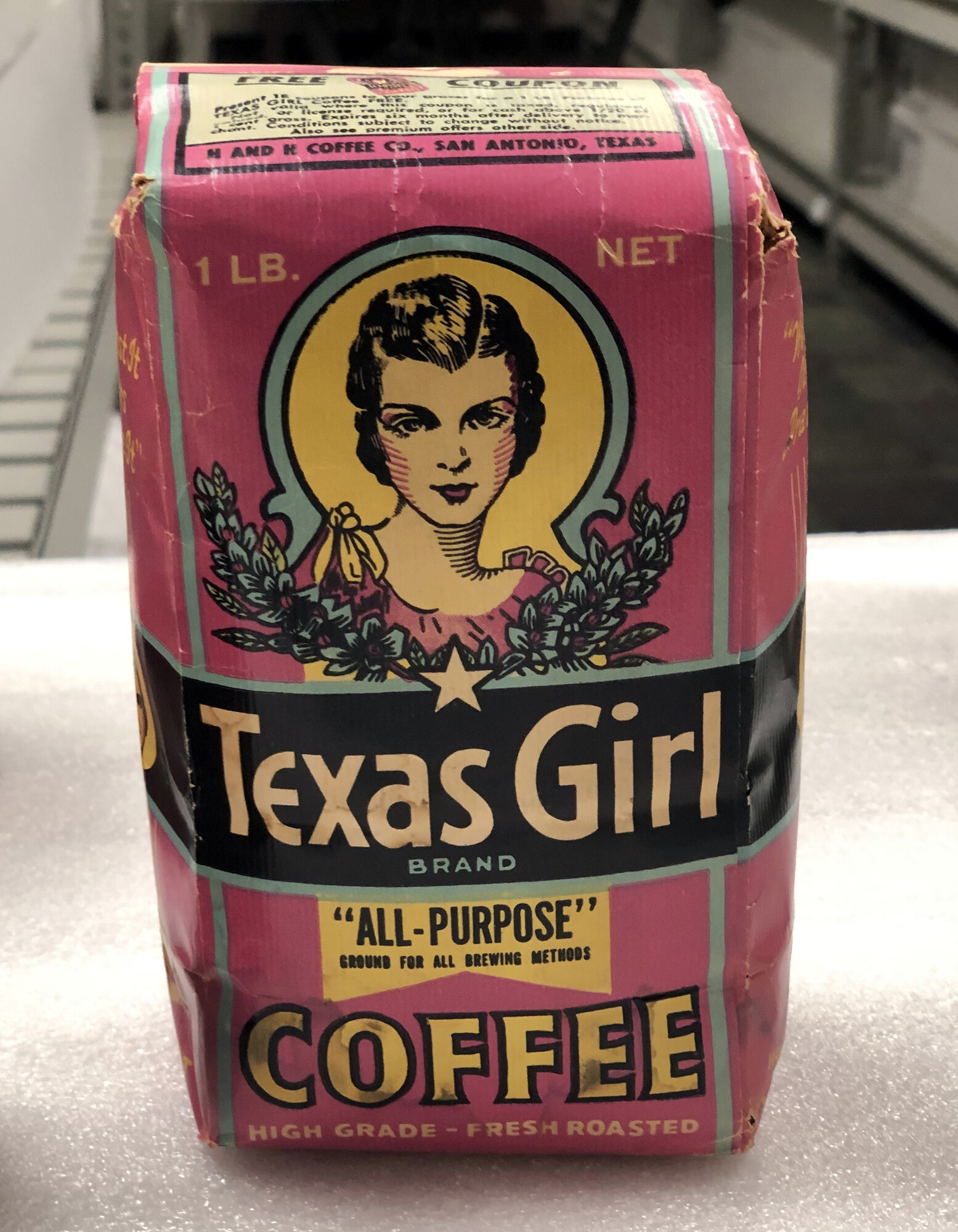
- Texas Girl Coffee — one-pound bag
- Texas Girl Coffee — three-pound bucket — documented in the Llano News ad of 3 May 1934 (visible in gallery scan; OCR failed). No collection specimen.
- Texas Girl Coffee — ½ pound “Baby Package”
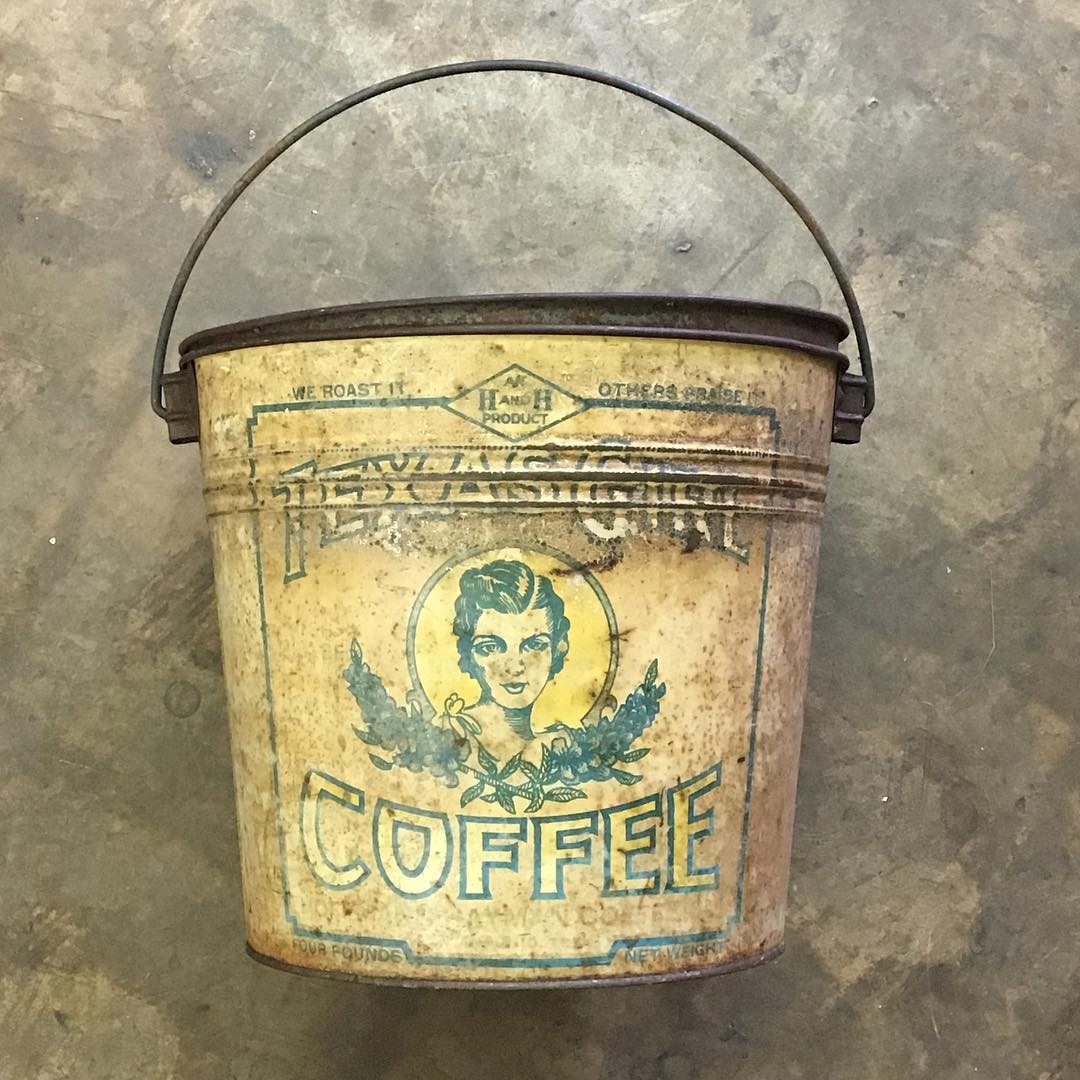
- 4 lb wire-bail pail — documented in Texas Girl four-pound pail. The 10 March 1934 The News grocery-store display (post) shows only cans for retail, not pails — suggesting the 4 lb pail served a wholesale/institutional channel (restaurants, hotels, lunch counters) rather than grocery shelf. The Texas Girl pail is definitively Menger-era (the brand launched October 1933), ruling out a pre-Menger legacy explanation for wire-bail pail formats. Research needed: wholesale price sheets or foodservice invoices naming Texas Girl pails. See also Sam Houston Coffee for the parallel 4 lb pail pattern.
Options
- Drip grind
- Regular grind
- Pulverized grind
- Fine grind for glass brewers (blue sticker)
Packaging
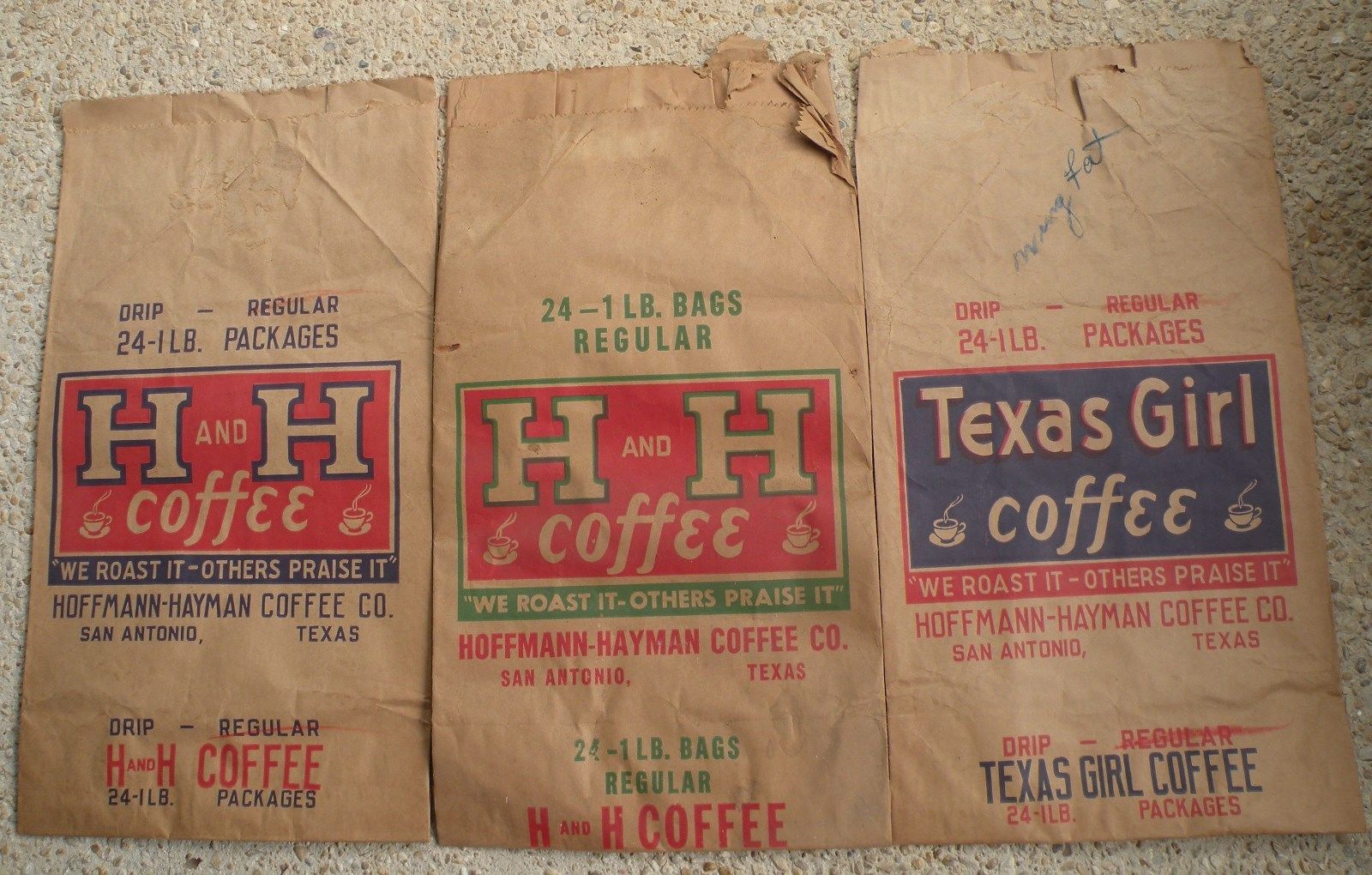
Wholesale sacks — printed H and H / Texas Girl shipping sacks for 24 × 1 lb retail bags (store-delivery scale, not the small consumer tin).
Four-pound pail — full write-up and Instagram context in the four-pound pail post.
Trademark filing — October 1930
“Texas Girl” (Serial No. 304,143; coffee) appears in the U.S. Patent Office “Trade Marks Pending” digest for the Week Ending October 21, 1930, as reported in The Tea and Coffee Trade Journal, November 1930, p. 677. Source: Tea & coffee trade journal, 1 Nov 1930.
This filing predates the documented retail launch by approximately three years. Whether the mark was used continuously from 1930 or filed speculatively (and the brand activated in 1933 with the cellophane-bag twin-pack campaign) remains open. The March 1931 Amarillo Globe-Times listing at 23¢/lb — two years before the documented October 1933 San Antonio launch — now becomes more plausible as an early regional sale under the pending mark. See “Open questions” below.
Launch — October 1933
Texas Girl Coffee was introduced by Hoffmann-Hayman in October 1933 publicly, not as a tin but as one-pound cellophane bags sold in a “Twin Package” introductory pair at 33¢ for two pounds (vs. a stated regular value of 25¢/lb). The launch came with a printed money-back guarantee: open one of the two bags, and if the family is not satisfied, return the unopened bag with the band to the grocer for a full refund on both.
The earliest documented appearance is the Corpus Christi Caller-Times of 13 October 1933, which carries the full “Guaranteed Introductory Offer” twin-package display ad as part of a Gulf-Coast rollout. The San Antonio Light of 20 October 1933 then carries both the same display ad (page 29) and a brief editorial column on the same page titled “Texas Girl Is New Brand Coffee,” quoting Gus Menger describing the twin-package money-back trial. The San Antonio Express-News of 26 October 1933 continues the campaign with a “Texas Girl Twin Package” follow-up. The slogan “We roast it… others praise it” appears in the launch copy.
The 10 March 1934 The News product display (post) shows Texas Girl with 3 distinct formats: a 3 lb bag, the twin pack (2 × 1 lb), and a single 1 lb bag — confirming the twin pack remained an active retail format five months after the October 1933 launch, not solely an introductory promotion. By March 1935 the cellophane twin-package had been joined by a “new baby package” for Texas Girl — see § March 1935 below. By October 1934 (Tulia Herald, H. E. Smith Grocery display) Texas Girl is co-advertised regionally with H and H Blend, and by 1959 it appears in the Witte Museum reference one-pound paper-bag specimen — the cellophane-bag form survived the brand into mid-century.
Advertising
March 1935 — new “baby package”
The News (San Antonio), Saturday, 9 March 1935, leads with the Sam Houston Coffee Crystalvac launch and notes alongside it: “Texas Girl Brand in New Baby Package.” No further detail on the baby-package format survives in the OCR, but the headline pairs the Texas Girl repackage with the Sam Houston Crystalvac introduction as a coordinated late-winter 1935 product-line refresh. Source: Raw Sources Registry. See also Sam Houston Coffee § March 1935.
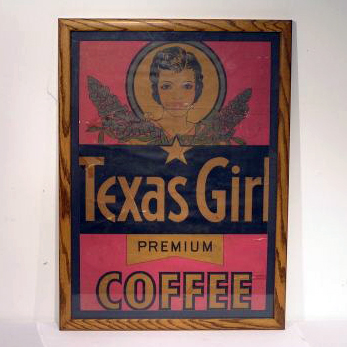
- Framed Texas Girl poster
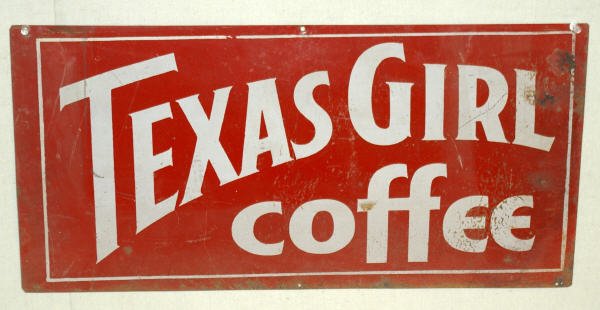
- Texas Girl litho sign
- 1934 Tulia Herald — H and H / Texas Girl at H.E. Smith Grocery (small-town display ad; file name preserves the paper date).
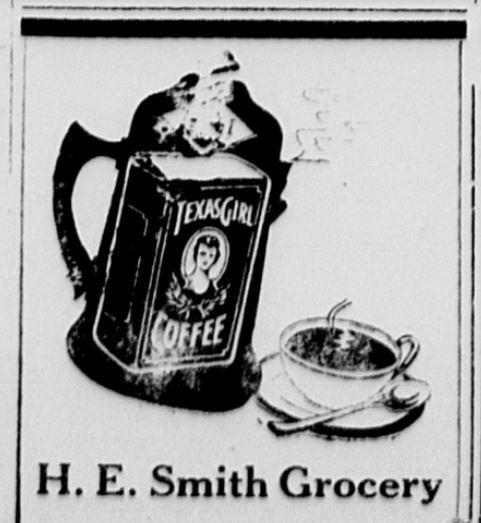
More regional clippings live under Newspaper ads.
Reference photography
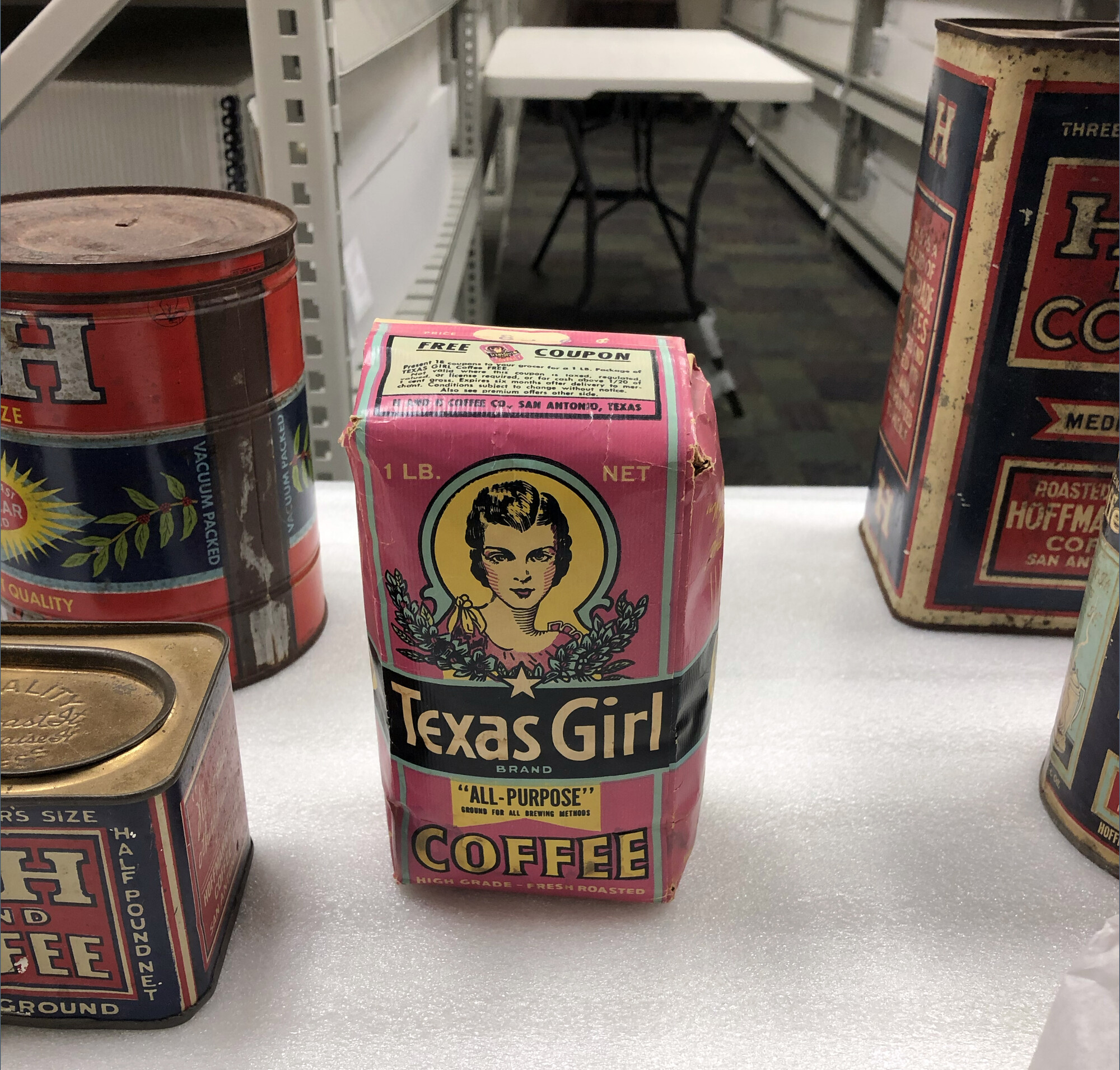
Witte Museum — Texas Girl one-pound paper bag and a table shot with H and H Blend tins (Witte visit; institutional reference, not Our Collection).
Newspaper & period branding
Framed poster, litho sign, and 1934 Tulia Herald display appear under Advertising. Indexes: Newspaper ads · Branding in Newspapers.
Collection posts
- Texas Girl from H and H Coffee (product bags) — picker story; first Texas Girl paper in the collection set.
- Texas Girl four-pound pail — wire bail, “We roast it — others praise it” band, portrait panel.
- Litho sign & pink retail bag — photographs on this page under Advertising; standalone collection posts for those objects are not published yet.
- H and H coffee napkin — Texas Girl vignette with Sam Houston on counter stock.
- Sales forms — Texas Girl listed among factory products.
Continuous brand identity through 1960
Texas Girl’s documented retail run extends from the October 1933 cellophane-bag launch through at least the May 1960 corporate product roster. The wartime and postwar attestations below close the documentary gap between the mid-1930s Tulia Herald / Witte-Museum reference photography and the 1960 corporate continuation.
- 2 March 1942 H&H wholesale package and bulk price sheet (“FOR TEXAS ONLY”) — package SKUs include TEXAS GIRL alongside H AND H, SAN ANTONIO, ANITA, TEXCO, BIG VALUE, and M. CHEF. Sam Houston is absent from the same sheet, confirming that Texas Girl survived a portfolio reshape that sibling Sam Houston did not.
- 20 February 1959 Valley Morning Star (Harlingen) p. 20 (post) — Burpee Flower Garden coupon-redemption form accepts “ONE COUPON from H AND H or Texas Girl Coffees” as proof of purchase (alongside Master Chef Coffee and Master Chef Instant Coffee). Texas Girl is in the active-retail-coupon roster 26 years after launch.
- 5 May 1960 San Antonio Express-News — Albert Menger elected president (post) — corporate product roster: “Products of the company, established in 1904, include Master Chef Coffee, Master Chef Instant Coffee, H and H Coffee, Texas Girl Coffee and other consumer and [institutional] coffee.” Texas Girl is one of four named retail wordmarks in the corporate roster — the H&H survivor portfolio at the start of the 1960s.
The brand may have persisted beyond 1960; no on-site source after the May 1960 piece names it explicitly, but the Hoffmann-Hayman Coffee Co. operated until 1972 per the Welcome summary.
Retire-vs-survive contrast with Sam Houston
Texas Girl (1933 launch) and Sam Houston Coffee (documented 1926–1935) were paired house wordmarks throughout the 1933–1935 window — co-advertised in the 1934 Tulia Herald, both featured in the 1935 H&H product-line refresh (Sam Houston into Crystalvac jars, Texas Girl in a “new baby package”), and both appearing on the same H&H counter napkin. After 1935 their paths diverge sharply:
- Sam Houston — absent from the 2 Mar 1942 wholesale price sheet; absent from the 1959 Burpee promotion; absent from the 1960 corporate product roster. Documented retirement window 1935–1942.
- Texas Girl — present in all three (1942 package SKU, 1959 coupon proof, 1960 corporate roster). Documented continuous retail through 1960.
What discriminated Texas Girl from Sam Houston in mid-century H&H portfolio strategy is undocumented. Hypotheses: (a) the Texas Girl trade dress (medallion portrait, bluebonnet artwork, niece-namesake) had stronger consumer recognition than the Texas-hero portrait; (b) Texas Girl was sold in cellophane bags from launch — a format ahead of the Sam Houston Crystalvac jar’s reuse-economy model, which proved less durable than the disposable-bag form factor; (c) Texas Girl was the deliberate “house-second-wordmark” alongside H and H Blend / H and H Coffee, where Sam Houston was a heritage Texas-hero line that didn’t fit the postwar marketing direction.
Related lines
- Sam Houston Coffee · H and H Blend Coffee — frequent 1930s co-advertising. See Retire-vs-survive contrast above for the divergent mid-century paths.
- Crystalvac Jars — Texas Girl named with Blend in Crystalvac-era newspaper copy; the 9 March 1935 baby-package announcement ran on the same page as the Sam Houston Crystalvac launch, but Texas Girl itself does not appear to have been Crystalvac-packed — its launch and persistence form was cellophane paper bags (the 2019 Witte Museum reference one-pound paper bag is the surviving specimen of this format).
- Master Chef Coffee · H and H Instant Coffee — sibling brands in the 1960 corporate product roster; Master Chef Instant Coffee and Texas Girl are co-listed as separate retail wordmarks at the start of the 1960s.
- Flav-O-Tainer — H&H’s WWII packaging-technology wordmark; the three 1942–43 Flav-O-Tainer ads reference only H and H Drip Grind, not Texas Girl. A parallel Texas Girl Flav-O-Tainer is undocumented.
- Jav-O Coffee — H&H’s 1954 value-tier coffee mixture (extender); the 1954 Caller-Times launch piece names Jav-O as a new mixture but does not directly position it against Texas Girl. By 1959 the Burpee promo treats H&H Coffee and Texas Girl as the two coupon-eligible retail-package wordmarks, with Master Chef Coffee, Master Chef Instant, and Jav-O on different proof-of-purchase pathways.
- Hoffmann-Hayman Coffee Company — corporate hub.
- H and H Product Line — product-family index.
- 1942 H&H wholesale price sheets — Texas Girl on the package roster (1942 attestation; one of the few 1933-launched brands that reach the WWII sheets).
September 1937 — namesake confirmed and 5¢ sale promotion
Two September 1937 ads document both the namesake and a retail promotion:
10 September 1937 — The News (San Antonio), social column: Miss Helen Hoffmann of 126 W. Agarita is identified as the Texas Girl namesake — “daughter of the late Wm. R. Hoffmann of H & H Coffee Company.” This is the only known primary-source confirmation of the brand’s personal namesake. Source: Raw Sources Registry.
11 September 1937 — The News (San Antonio): 5¢ sale promotion. The campaign offered the 10-cent size of Texas Girl Coffee for 5¢ with the purchase of any 1-pound can. The ad names two bag formats in active retail:
- Regular Grind (standard bag)
- SPEEDY SERVICE BAG — a dedicated fast-service bag format
- Both formats described as cellophane-protected bags (confirming cellophane bag form into 1937)
Source: Raw Sources Registry.
San Antonio Register marketing thread — research lead (Nancy Draves, 1930s+)
In the 28 May 2026 Draves listening session (interview page; reconstituted transcript raw-archives/oral-history/2026-05-28_nancy-tim-draves-listening-session.transcript.turns.md, ~02:30 timestamp range), Nancy Draves described a Texas Girl research thread she had pursued earlier:
“Brett, a while ago I was doing some research in the African American newspaper, called the San Antonio Register, and they did a lot on the Texas Girl. And it gave me the idea that it was lower priced and it was geared for the African American community. And that maybe even the model — I remember rather distinctly saying, this is the girl that is the model for the Texas Girl coffee promotion — in the San Antonio Register.”
The San Antonio Register was the principal Black newspaper in San Antonio from 1931 onward (continuous publication through the 1990s). Nancy’s recollection points to two distinct claims worth pursuing independently:
- Lower-price positioning for the Black retail market. Consistent with the Texas Girl tier already documented elsewhere on this page (Amarillo 1931 at 23¢/lb vs. H and H Blend at 37¢/lb; the 1937 5¢ sale on the 10¢ size; the value-tier framing in the Retire-vs-survive contrast section above). Nancy’s observation suggests H&H deliberately segmented the Texas Girl placement into the Register’s classified and display pages — i.e., a documented Black-market price-tier marketing strategy, not just an incidental shelf appearance.
- A Black model identified as the Texas Girl in Register copy. This is in tension with the § September 1937 namesake confirmation of Helen Hoffmann (126 W. Agarita, daughter of the late William R. Hoffmann) as the brand’s named-personal namesake in the social column of The News. The two claims are not necessarily contradictory — H&H may have placed a separate Register-specific image in Black-press copy distinct from the mainstream-press white namesake — but resolving this requires direct review of Register H&H ads.
Research path: the San Antonio Register is archived at the UT San Antonio Special Collections and on the Texas Digital Newspaper Program (Portal to Texas History). A 1931–1945 sweep for “Texas Girl” + “Hoffmann-Hayman” in the Register would surface the placements Nancy referenced and resolve the model question.
The thread also informs the H&H and the Tejano Market synthesis — adding a Black SA market segment to the existing Tejano-market documentation that this page already supports.
January 1945 — namesake dies at 33
Miss Helen B. Hoffmann, namesake of Texas Girl Coffee, died Wednesday, 17 January 1945, at age 33, at the family residence, 126 W. Agarita St. Her requiem mass was held at St. Mary’s Church on Thursday 19 January 1945. She was survived by her mother (Mrs. William J. Schlosser), sister Mildred, grandmother Mrs. C. B. Menger, and six Menger uncles who served as pallbearers. She is identified in the obituary as “daughter of the late William R. Hoffmann, founder of a local coffee company.” At the time of her death, Texas Girl Coffee had been in production for nearly 12 years. Sources: the 18 January 1945 death notice and 19 January 1945 rites report (both Raw Sources Registry).
Open questions
- “Texas Girl Coffee” in Amarillo, March 1931 — predates H&H launch by 2.5 years. The Amarillo Globe-Times of 27 March 1931 (Monarch Grocery price list, 3011 W. 6th) lists TEXAS GIRL COFFEE Lb. 23¢ alongside H & H COFFEE Pound 37¢. H&H’s Texas Girl is documented launching in October 1933 in San Antonio — this Amarillo listing predates that by 2.5 years. Open question: Is this a separate roaster using the same name, an H&H regional pre-launch, or an earlier H&H Texas Girl brand that was later reformulated for the 1933 launch? If it’s H&H: the 1931 price (23¢/lb) vs. H&H Blend (37¢/lb) would be consistent with Texas Girl’s established role as a lower-price tier. Source: H and H advertisement — Amarillo Globe-Times, 27 March 1931.
- Namesake confirmed — question closed.
What does the “niece” naming claim actually refer to?Helen Hoffmann of 126 W. Agarita, daughter of Wm. R. Hoffmann Sr., niece of Gus P. Menger — confirmed by the 10 Sep 1937 The News social column. See the page lede. - Was Texas Girl Crystalvac-packed? Period copy doesn’t mention it explicitly. The 1933 launch was cellophane-bag; the 1935 “baby package” repackage co-launched with Sam Houston Crystalvac but is described separately. No Crystalvac-marked Texas Girl specimen surfaces in the collection or reference photography.
- Was Texas Girl Flav-O-Tainer-packed during WWII? All three 1942–43 Flav-O-Tainer ads brand the contents as H and H Drip Grind. Whether a parallel Texas Girl wartime bag existed is undocumented; the 1942 price sheet lists Texas Girl as a package SKU but doesn’t specify packaging format.
- What is the latest documented Texas Girl retail attestation? The 1960 corporate product roster is the latest. With H&H independently-owned only through the 1962 Continental of Chicago acquisition (HH-CLIP-1987-0002), a 1961–1962 ad or sales sheet would establish whether Texas Girl was still on shelves at the moment of sale, and a 1963+ ad would document whether Continental retained the brand post-acquisition.
- What is the Texas Girl wordmark trademark-filing status? Partially resolved. Serial No. 304,143, “Texas Girl,” Hoffmann-Hayman Coffee Co., San Antonio, Tex.; coffee; pending Week Ending October 21, 1930 (Tea & Coffee Trade Journal, Nov 1930, p. 677). Whether this application resulted in a formal registration (grant number) has not yet been confirmed from the annual Index of Trade-Marks volumes for 1930–1932.
Wanted
High-priority gaps from Wanted still include:
- Texas Girl Coffee tin (consumer one-pound keywind or litho tin in collectible condition)
- Texas Girl Coffee one-pound bag (retail bag, not just wholesale sack stock)
- Texas Girl Coffee three-pound bucket — format confirmed in Llano News, 3 May 1934; no physical specimen in collection
- Texas Girl Coffee half-pound Baby Package
Clear photographs of store stacks, menus, or additional ads help even when tins are not for sale—see contact.
See also
Synthesis
- 1937 — H&H Inflection Year — the September 1937 namesake confirmation + Speedy Service Bag promotion sit inside the broader 1937 brand-portfolio consolidation
People
Places
Items
Future
Book
- Interview Nancy Draves