Master Chef Coffee
Master Chef was Hoffmann-Hayman’s hotel-and-restaurant trade brand that ran in parallel with consumer-retail attestation from at least 1935 before its Corpus Christi grocery introduction in 1952. Company lore on this site places bulk sales to hotels, cafés, and clubs from about 1927, independently corroborated by the 1 February 1952 Corpus Christi Caller-Times “INTRODUCING TO CORPUS CHRISTI” ad, which calls Master Chef “a 25-year favorite in leading hotels, cafés and clubs of Texas” — putting the brand’s origin at roughly 1927 (the same year H&H lore asserts). The first on-site documentary attestation by date is the 21 December 1932 Express-News “Southwest finest plant” copy (“Master Chef Cafe Coffee that you enjoy in your favorite restaurants”) — but the “Cafe” suffix is already gone by 18 May 1935 when the brand appears as plain “H&H MASTER CHEF COFFEE” (jar format) in The News “QUALITY H & H PRODUCTS” three-panel strip ad alongside H&H Blend and H&H Tea — a consumer-retail lineup with the same “FOR EVERY TASTE — POCKETBOOK” framing later used for Sam Houston / Texas Girl in 1938. The 1952 Corpus Christi piece is therefore an introduction to that specific market, not a brand-wide first consumer entry: Master Chef was already in San Antonio consumer-retail by 1935, in the 1942 H&H wholesale price sheets as M. Chef Blends A & B (still hotel/café-trade mode), and independently in Corpus Christi grocery retail starting February 1952. The line then runs continuously through the 5 May 1960 corporate product roster (where “Master Chef Coffee, Master Chef Instant Coffee” are named as the first two products in the company’s published lineup), the 1961 Broggi advertising-record campaign, and the 29 March 1962 San Antonio Express “Dean of Coffee Roasters” display — a documented retail run of 27 years from May 1935 through 1962 (or 35 years if the 1927 hotel-trade origin holds). The line shares the mid-century red-and-yellow livery, chef mascot, and H AND H diamond lockup with other San Antonio house marks — especially H and H Blend Coffee — but keeps its own “Finest Hotel Coffee For Home Use” positioning in trade photography.
Instant Master Chef jars and 1966–68-attested tea bags (see Wanted, below, for the corrected date) are cross-listed here for catalog completeness; the dedicated instant page is H and H Instant Coffee, and tea bags sit with H and H Tea.
Products
- Master Chef Café Coffee (1932)
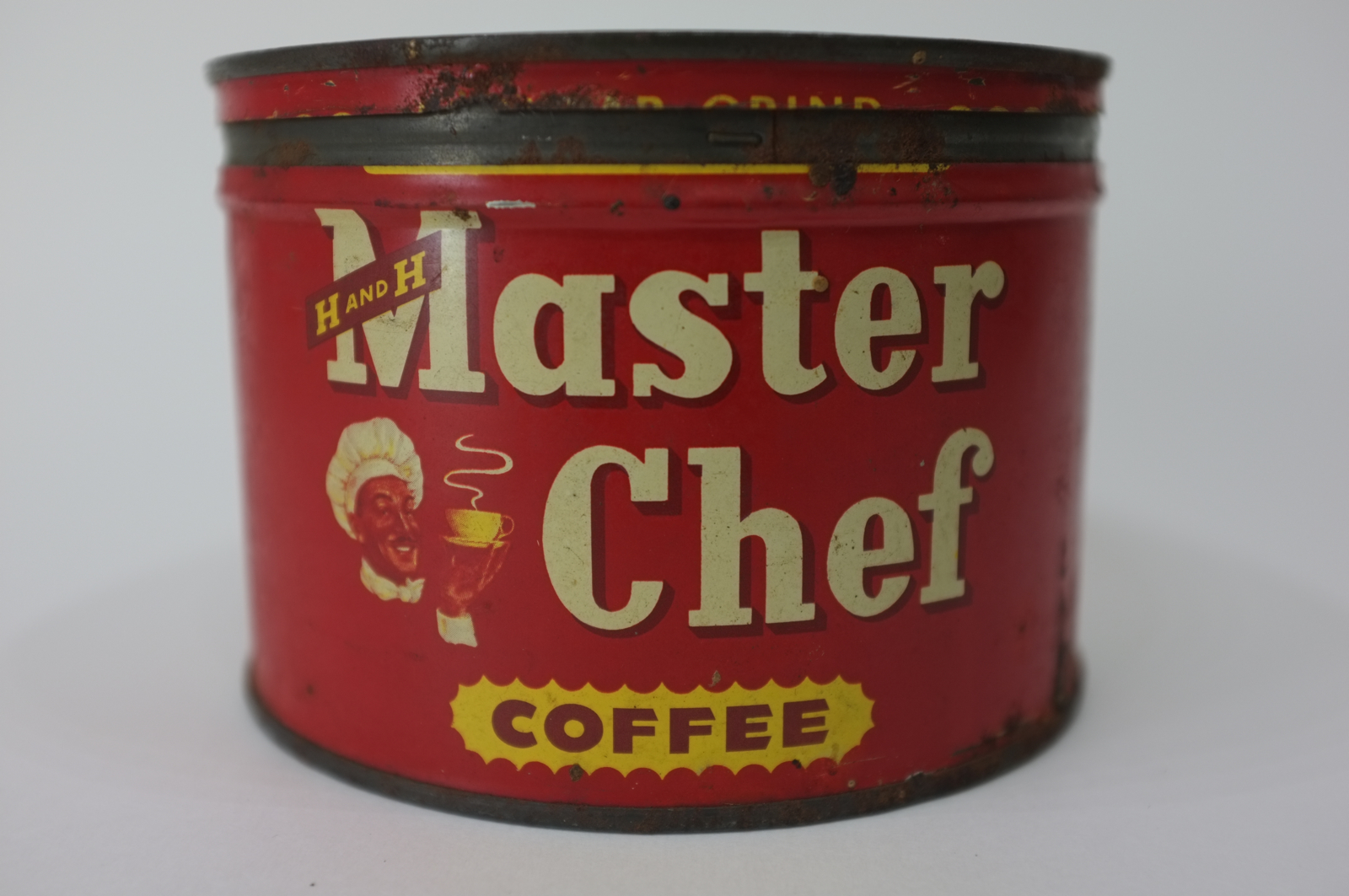
- Master Chef Coffee 1 pound tin (1952 grocery era onward)
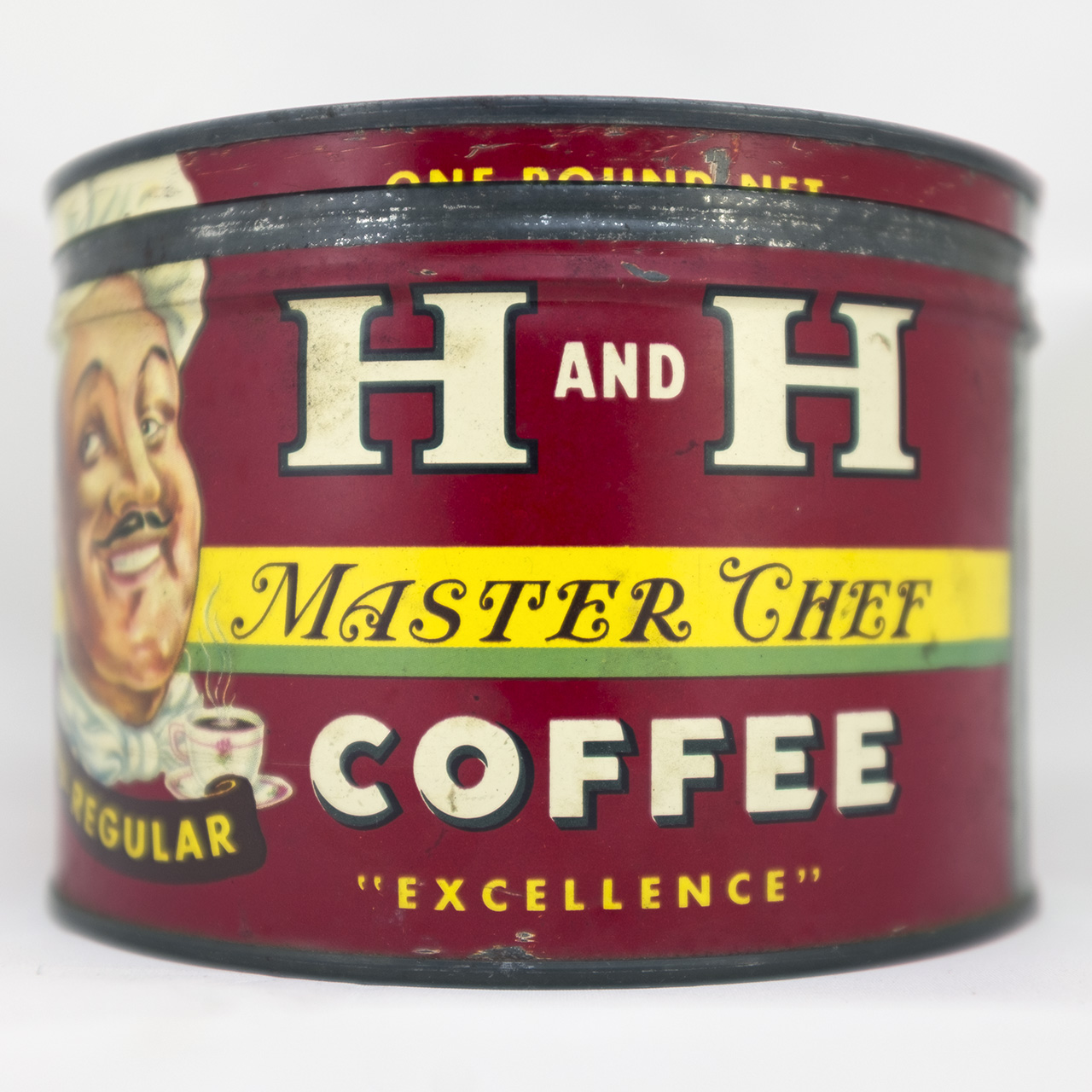
- Master Chef Coffee 1 pound tin (1957 label cycle)
- Master Chef Coffee 2 pound tin
- Master Chef Coffee Instant — 2 oz jar
- Master Chef Coffee Instant — 6 oz jar
- Master Chef tea bags (1950s) — see H and H Tea
Options
- Drip grind
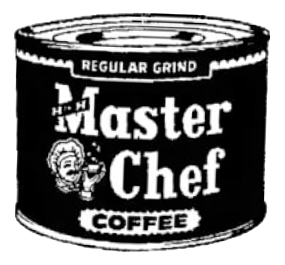
- Regular grind
- Pulverized grind
- Fine grind for glass brewers (blue sticker)
Packaging
Representative keywind and redesign-era tins already in assets/images/gallery/. Deeper rotations, premium lids, and trading-stamp campaigns are in the posts linked from Collection posts.
- One-pound keywind tin (classic red livery)
- Three-pound cylindrical tin (Master Chef 3 lb keywind; also grouped in three tins and a jar)
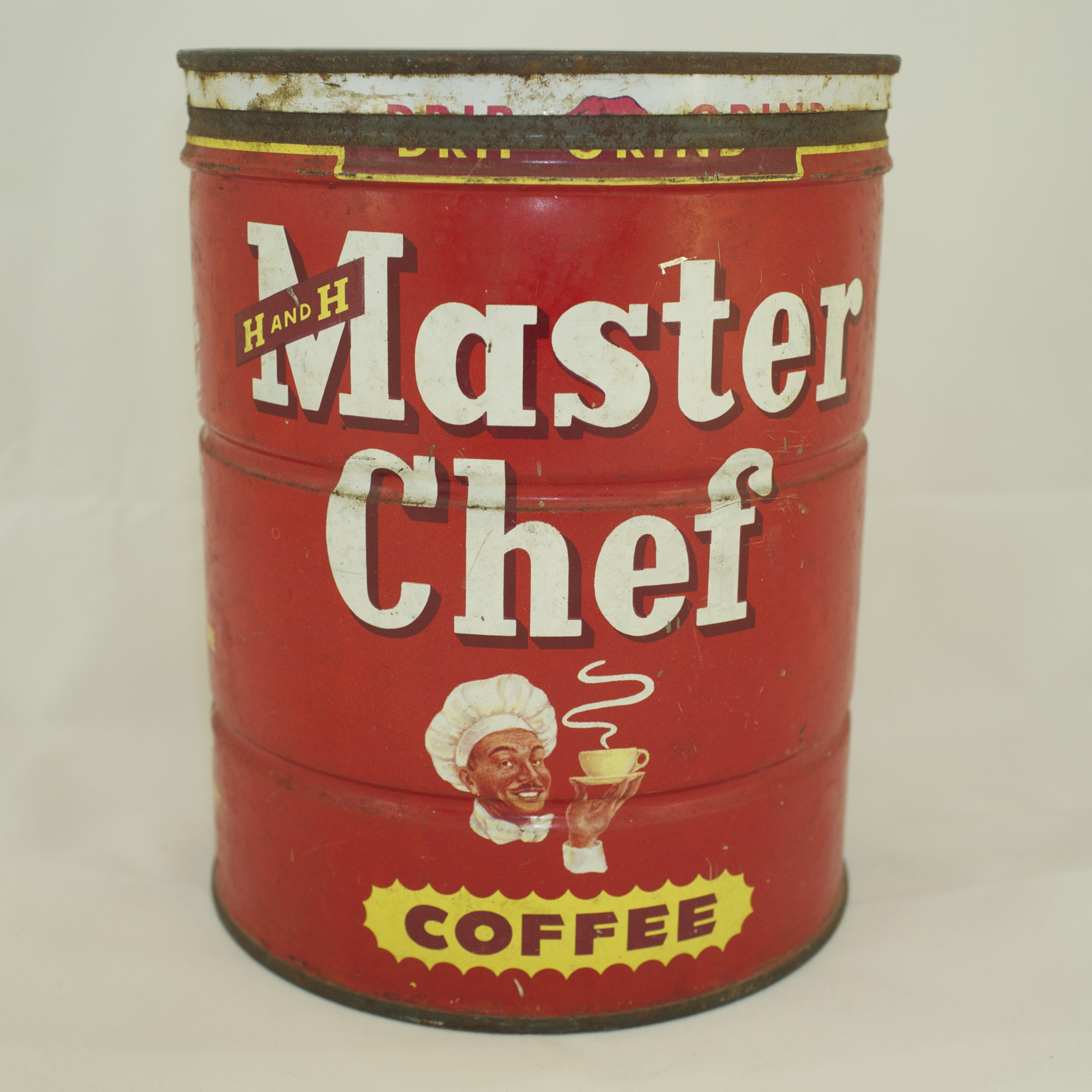
“Decorator cannister” naming (2026-07-21, gap-sweep find): the 22 December 1966 San Antonio Light “Master Chef Color Provides Key” article (HH-CLIP-1966-0002) quotes Jack Moore describing a “three-pound decorator cannister” can — distinct packaging language from the plain “keywind tin” terminology used elsewhere on this page. Whether this names the same 3-lb tin pictured above (just marketing copy for the mid-1960s color-keyed redesign) or a genuinely different decorative-canister SKU is undetermined — no example in the collection has been checked against this specific 1966 description.
- One-pound tin — mid-century redesign (Jourdanton example with comparison art)
Advertising
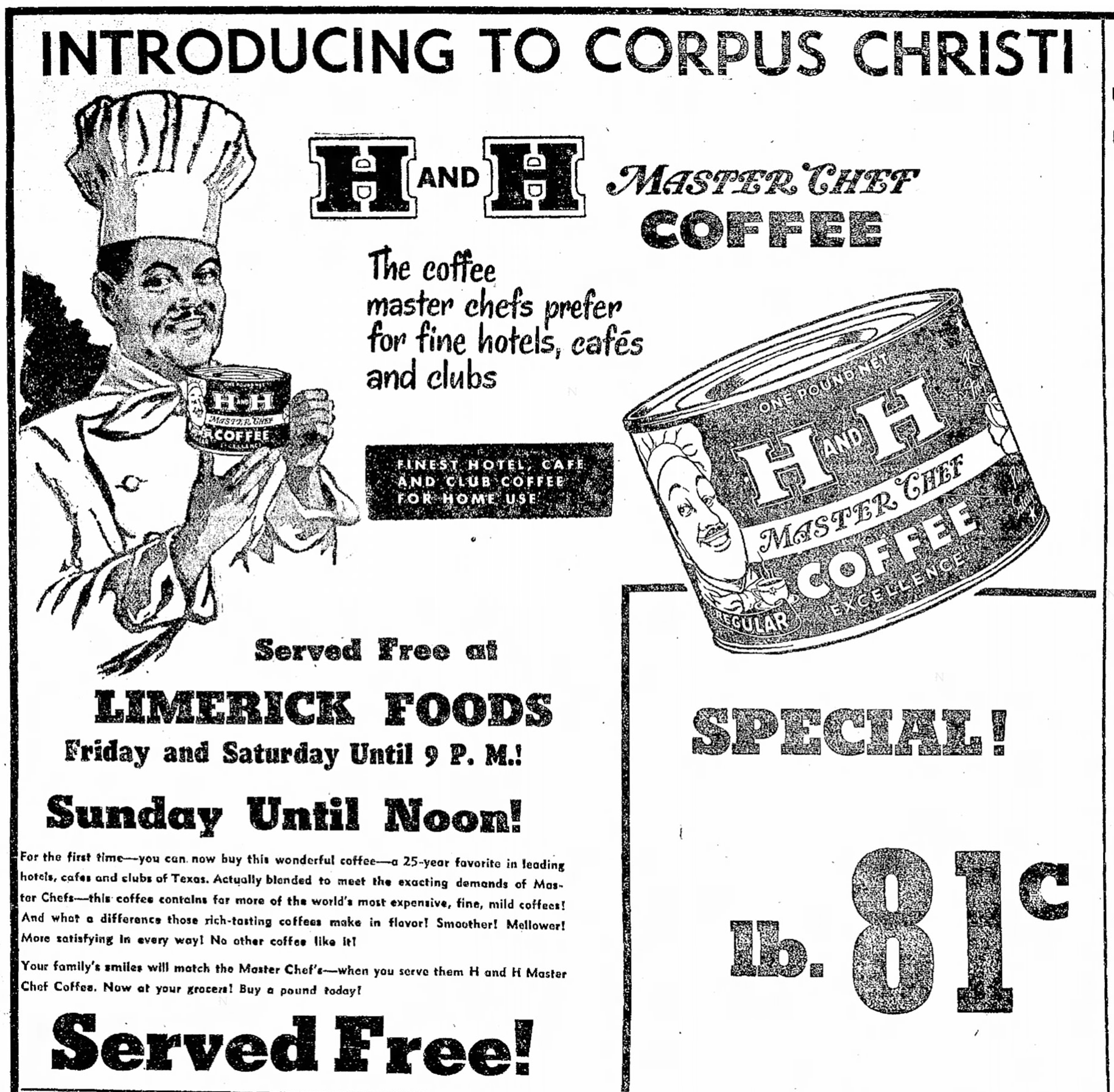
Corpus Christi Caller-Times, Friday, February 1, 1952 — grocery introduction of the one-pound vacuum-packed Master Chef tin (full-page family scene in the clipping). More H and H newspaper work lives in Newspaper ads.
San Antonio Light “Top Coffee Plant” feature, Sunday, 27 September 1959 — Sunday photo page on Hoffmann-Hayman, captioned “FOUNDED IN 1904” and “ONE OF LARGEST COFFEE-ROASTING PLANTS IN SOUTH.” Building signage in the photograph reads “H-H Master Chef COFFEE CO. ROASTED FRESH DAILY” — placing the Master Chef name on the exterior of the plant itself by the late 1950s, alongside the H-H lockup. Officer roster as published: Gus P. Menger (president), R. W. Menger (executive vice president), Albert G. Menger (secretary) — first documented appearance ahead of his May 1960 elevation to the presidency — T. J. Menger (treasurer), John C. Burkholder (general sales manager).
Broggi Advertising Agency advertising record, August 1961 — a black lacquer 78 RPM disc pressed for H and H / Master Chef with four recorded spots (two 30-second, two 60-second). The disc is pictured in the Reference gallery; a standalone collection post for the artifact is not published yet. See also brands/h-and-h-product-line.md § Master Chef Coffee (1961 Broggi radio transcription disc) for the full transcription and production credits.
San Antonio Express “Dean of Coffee Roasters” display, Thursday, 29 March 1962 — a large-format Master Chef ad introducing a “Dean of Coffee Roasters” persona: staged portrait with beans and a counter grinder, “100% pure” copy stressing multiple origins, trading-stamp or cash-refund premium offer, and a closing line inviting the home brewer as the “Master Chef.” Documents the brand voice in the early 1960s, anchoring the late-Menger and early-Albert-Menger period before the Continental sale.
Collection posts
Tins & keywinds
- Master Chef regular grind tin — early one-pound example.
- H and H Master Chef one-pound tin — 1927 vs 1952 dating discussion and Etsy comparison art.
- Master Chef one-pound tin with trading-stamps sticker (2017).
- Sealed one-pound keywind with trading stamps (2019).
- Two-pound keywind with premium lid — West Bend percolator offer; mentions Master Chef Instant wording on the premium copy.
- Three tins and a jar — Master Chef three-pound with Broncho and Crystalvac context.
Signs, cups, and trade shows
- Master Chef sign — lithographed cardboard.
- H and H price sign — unused Master Chef price placard.
- Mi Tierra, Master Chef, and the Cortez family — historic façade and interior Master Chef branding.
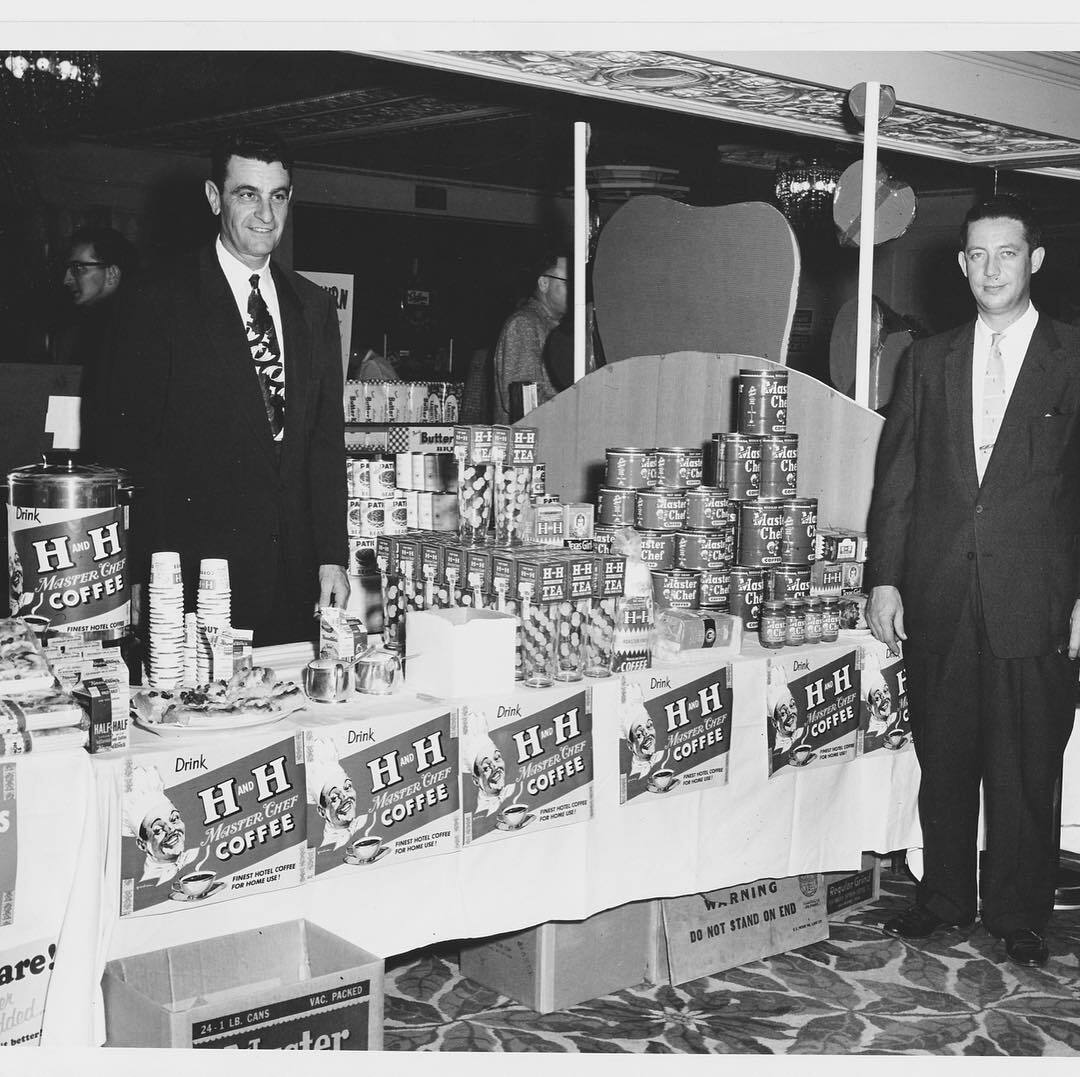
- Manufacturers association booth — H-H Tea cartons with Master Chef cans.
- Master Chef paper cup — disposable cup graphics.
Coupons & press
- H and H coffee coupons — same premium / trading-stamp era as late Master Chef tins.
- Edible San Antonio — Master Chef — local magazine reuse of historic signage.
Reference photography
Exhibit / sampling table and other Master Chef frames documented outside Our Collection appear in Reference (including this Instagram-archive trade-show photograph).
Three rendering traditions of the chef mark
The Master Chef chef figure appears across the documented corpus in three distinct visual modes:
- Brand-standard cartoon mascot — the canonical chef face used on tins, ads, and brand-supplied commercial signage. Best preserved at large format in the museum’s “We Serve Master Chef Coffee” 4×8 sign (
2014-07-27-master_chef_sign.jpg): stiff pillow-shaped white toque, white neckerchief tied at throat, compact black upward-curled handlebar moustache, flat black-dot eyes, direct frontal gaze, red painted lips. Sign-shop flat color blocking with hard outlines — produced at 4×8 ft scale for 15–25 ft countertop reading. The same brand-standard mascot face also appears on the horizontal “H AND H / MASTER CHEF COFFEE” trade panel mounted across Mi Tierra’s storefront in the 1950s exterior photograph (HH-REF-0000-0147) — tall white toque, dark handlebar moustache, smiling face with visible mouth — confirming the canonical mascot was being delivered into restaurant accounts on commercial trade panels in the same period, not only on 4×8 boards. - Mi Tierra interior wall mural (
2016-12-18-mi-tierra-wall-mural-chef.jpg) — a locally-painted folk-decorative re-interpretation inside Mi Tierra Café, with a companion stenciled-relief “AND H / MASTER / CHEF / COFFEE” wordmark wall (2016-12-18-mi-tierra-wall-mural-brand.jpg). The mural chef has a sloped soft toque, florid upward-curling handlebars (much more generous than the brand-standard mascot’s), a 3/4 upward-and-away gaze, no neckerchief, no visible mouth, and loose painterly handling on a sepia-yellow wall ground. The mural is stylistically distinct from the brand-standard mascot on the same site’s exterior panel — Mi Tierra carried two different Master Chef chef renderings concurrently: the brand-standard mascot on the commercial trade panel (presumably supplied by H&H or a contracted sign shop) and the loose painterly chef on the interior wall (locally commissioned by the Cortez family from a local painter). The mural’s date relative to the exterior panel is unresolved. -
2016 Cortez-family commemorative artwork — Pedro and Cruz Cortez portraits set against a montage of Mi Tierra storefront signage (Edible San Antonio Aug/Sep 2016 spread; the September 2016 “Nuestra Cultura · 75 Años” press passes; the green replica entrance built for the 75th-anniversary celebration). Corrected 2026-07-14 — this page previously asserted “the chef figure does not appear.” That is wrong. The artwork carries both the “MASTER / CHEF / COFFEE” wordmark (right) and the brand-standard chef mascot (centre), riding the same green H AND H panel as on the 1950s storefront: white toque, upward-curled black handlebar moustache, red bow tie, smiling frontal gaze — i.e. a faithful reproduction of mode 1, not an omission of it. Verified against
2016-aug-sep-edible-san-antonio-spread.jpg/-closeup.jpg(the painting) andmi-tierra-ivy-taylor-75th-anniversary-9-15-16-17.jpg(Mayor Ivy Taylor at the 15 September 2016 celebration, photographed in front of the physical replica, where the chef is large and central on the H AND H panel). Mode is sepia-and-burgundy graphic-design illustration over that reproduced signage, not painterly mural. Artist authorship is unresolved — see Open questions § 2016 painted-portrait artwork authorship.Consequence for this section’s framing: mode 3 was defined by the chef’s absence, and that premise is false — the 2016 work reproduces the brand-standard mascot rather than constituting a third rendering of it. What is genuinely distinctive about the 2016 material is the medium and purpose (commemorative graphic design, and a 3-D physical rebuild of the storefront) rather than a new drawing of the chef. The “three rendering traditions” structure may need rework: on present evidence there are two renderings — the brand-standard mascot (mode 1, faithfully re-used in 2016) and the Mi Tierra interior mural’s folk re-interpretation (mode 2).
Endpoint of the mascot (2026-07-14): the current-production Massimo Zanetti can (HH-CAN-2026-0009) carries no chef at all — the oval holds the wordmark and an orange cup-and-saucer device, on cobalt blue rather than red-and-yellow. The figure is gone from the surviving commercial product entirely, leaving wordmark-only.
The contrast with mode 3 is the point — and it is the opposite of what this page asserted before the 2026-07-14 correction. The chef did not fade from memory: in 2016 the Cortez family reproduced him faithfully, both in the commemorative painting and as a physical rebuild of the storefront panel. So the mascot was alive in San Antonio’s cultural memory fifty-plus years after the H&H era, at the same time as the brand’s own corporate successor had dropped him from the packaging. The chef survived where the community kept him; he died where the trademark went. When he was dropped commercially is unbracketed: somewhere between the Dec 1966 color-keyed cans (which still ran the Sawyer/Kreft mascot personas) and the modern livery.
Net: the canonical brand mascot runs continuously across the can / ad / sign / commercial-trade-panel chain (mode 1) and is documented on Mi Tierra’s own storefront in the 1950s alongside the museum’s 4×8 board. The Mi Tierra interior mural (mode 2) and the 2016 anniversary-graphics backdrop (mode 3) are two locally-controlled re-interpretations layered on top of the brand mascot’s documented presence at the same site — not replacements for it, not supplied by H&H. The mural is not a candidate for the Stevens-painted-H&H-signage hypothesis — it reads as a locally-commissioned café decoration rather than Stevens Outdoor commercial work. See Silas P. Stevens § A third rendering for the people-side discussion.
Newspaper & period branding
1952 Caller-Times grocery introduction under Advertising; 1961 San Antonio Trade Fair vignette:
Wartime and postwar continuity (1942–1960)
The page’s documented advertising sits in two clusters: the 1932 plant-opening copy and the 1952+ grocery-era press. The wartime and postwar attestations below close the documentary gap and confirm Master Chef ran continuously across the H&H wartime / postwar portfolio reshape that retired sibling Sam Houston Coffee (1935–1942 retirement gap).
- 2 March 1942 H&H wholesale package and bulk price sheet (“FOR TEXAS ONLY”) — package SKUs include M. CHEF alongside H AND H, SAN ANTONIO, TEXAS GIRL, ANITA, TEXCO, and BIG VALUE. Confirms Master Chef was already a wholesale-package SKU before the 1952 grocery-retail introduction — likely still in the hotel/café-trade mode the page’s lore positioning describes.
- 7 November 1957 San Antonio Express (post) — full quarter-page Master Chef ad with “Master Chef Instant Coffee!” in 2-oz and 6-oz jars (see H and H Instant Coffee for the instant-line documentation). The ad introduces the instant line and pairs it with a Bil-Jo dispensing-tin tie-in and a “FREE FOLDER WRITE HOFFM, P.O. BOX 1509” reply premium. Master Chef Instant is documented from this date forward.
- 20 February 1959 Valley Morning Star (Harlingen) p. 20 (post) — Burpee Flower Garden coupon-redemption form accepts “the LAST INCH of unwinding strip from a can of Master Chef Coffee” AND “ONE LABEL from Master Chef Instant Coffee” as proofs of purchase (alongside H AND H and Texas Girl Coffee coupons). This is decisive: by 1959 the regular-grind Master Chef tin is strip-key sealed (the “unwinding strip” is the proof-of-purchase artifact), and Master Chef Instant uses paper labels — confirming two distinct retail formats for the brand in the same campaign.
- 5 May 1960 San Antonio Express-News — Albert Menger elected president (post) — corporate product roster opens with “Products of the company, established in 1904, include Master Chef Coffee, Master Chef Instant Coffee, H and H Coffee, Texas Girl Coffee and other consumer and [institutional] coffee.” Master Chef and Master Chef Instant are listed first in the corporate product line — the highest-prominence positioning in the 1960 portfolio.
The 1942 → 1952 → 1957 → 1959 → 1960 attestation chain plus the 1961 Broggi disc and 1962 Dean ad establish Master Chef as the most continuously documented mid-century H&H wordmark on this site, alongside H and H Blend / H and H Coffee.
1952 — Kerrville market; 10¢ coupon; “25-year favorite” in regional press
Kerrville Mountain Sun, 24 April 1952, p. 11: Master Chef promoted to the Hill Country market with a 10¢ coupon offer on a one-pound vacuum-packed can. Copy: “Here’s the same GOOD COFFEE your favorite café serves! … A 25-year favorite in fine hotels, cafes, and clubs of Texas. And it’s now yours for home use.” The coupon was void after June 30, 1982 — a remarkably long validity window suggesting the coupons circulated for decades. Source: H and H advertisement — Kerrville Mountain Sun page 11, 24 April 1952.
1958 — Burpee flower seed premium; P.O. Box 1509
Brownsville Herald, 20 February 1958, p. 15: Master Chef Flower Garden premium — 8 packets of genuine Burpee flower seeds ($2.00 value) for 25¢ + one purchase evidence (unwinding strip from a Master Chef can, a label from Master Chef Instant jar, or a coupon from H and H or Texas Girl Coffees). Seeds: Dwarf Zinnia, Mixed Zinnias, Snap Dragon, Petunias, Sweet Alyssum, Asters, Marigolds, Portulaca. Mailed “direct from H and H’s own plant in San Antonio.” Order address: Hoffmann-Hayman Coffee Co., P.O. Box 1509, San Antonio, Texas (consistent with the 1941 Vaculator mail address). All three retail brands — Master Chef, H and H, Texas Girl — accepted as qualifying purchase. Source: H and H advertisement — Brownsville Herald page 15, 20 February 1958.
1961 — Trading stamps; “Sipping Good!” tagline; Andes sourcing
El Heraldo de Brownsville (Spanish-language daily), 31 August 1961: Master Chef offered 250 trading stamps (or cash refund) free with purchase of a vacuum can — both drip grind and regular grind eligible. Tagline: “Sipping Good!” Sourcing claim: “RARE COFFEES IMPORTED BY MASTER CHEF from high in the Andes of South America and blended with the rich pungent coffees from other great coffee producing countries.” This is the only documented H&H advertising placement in a Spanish-language Brownsville paper, and the latest documented Rio Grande Valley market attestation in this collection. Source: H and H advertisement — El Heraldo de Brownsville, 31 August 1961.
“100% pure” — premium-tier positioning against Jav-O (1954)
The 29 March 1962 San Antonio Express “Dean of Coffee Roasters” display (cited above) leads with “100% pure” copy stressing multiple-origin coffee sourcing. The “100% pure” framing is deliberately discriminative: H&H launched Jav-O Coffee in July 1954 as a value-tier “coffee mixture” — a coffee extender — that “will save the housewife up to 35 cents a pound” by blending high-grade coffees with a “neutral, healthful ingredient” (period trade language for a non-coffee extender, plausibly the cereal-coffee blend that the 1942 bulk-price-sheet’s “Economy Blend Cereal and Coffee” line documents H&H had institutional production expertise with).
Master Chef’s “100% pure” 1962 positioning therefore reads as the explicit premium-tier counterpart to Jav-O’s value-tier extender — Master Chef = all-coffee premium; Jav-O = coffee + cereal extender value. The two brands together let H&H operate both ends of the postwar coffee-price spectrum under one roof:
| Master Chef (1962) | Jav-O (1954) | |
|---|---|---|
| Positioning | “Dean of Coffee Roasters” / “100% pure” | “A rich coffee mixture” |
| Sourcing | Multiple high-grade origins | “Highest grade coffees with a neutral, healthful ingredient” |
| Trade-dress mascot | Chef in toque (chef mascot) | Spoon device on banner cartouche (no figural mascot) |
| Premium / price proposition | Trading stamps or cash refund (1962 ad) | 35¢/lb savings vs all-coffee comparator |
| Retail context | Hotel/café-trade origin extended to grocery (1952+) | Single-year 1954 Corpus Christi grocery push |
The pair represents H&H’s late-period dual-tier strategy. Master Chef survived this strategy; Jav-O did not (no documented post-1954 attestation).
Wordmark-family framing
Master Chef is one of the four sibling retail wordmarks in the 5 May 1960 Express-News corporate product roster — the canonical H&H late-period portfolio:
| Wordmark | Page | Period |
|---|---|---|
| Master Chef Coffee | this page | 1927 lore / 1932 first attestation – 1962+ |
| Master Chef Instant Coffee | H and H Instant Coffee | 1957 launch – 1960+ |
| H and H Coffee | H and H Blend Coffee | 1899 founding lore / 1921 first attestation – 1964+ (wordmark transitioned from “H and H Blend” to “H and H Coffee” umbrella in the late-1930s through 1960s) |
| Texas Girl Coffee | Texas Girl Coffee | 1933 launch – 1960+ |
Other H&H wordmarks operated alongside this core but had retired before 1960:
- Sam Houston Coffee (1926 first attestation – 1935 retire window – 1942 documented absence) — the heritage Texas-hero line that didn’t survive the post-1935 portfolio reshape
- Jav-O Coffee (1954 only) — value-tier extender; no on-site post-1954 attestation
- Crystalvac Jars (1932 – at least 1947) — packaging-technology wordmark; documented as Reg. U.S. Pat. Off.
- Flav-O-Tainer (1942–1943) — WWII packaging-technology wordmark
Master Chef’s particular distinctiveness within this family: it is the only H&H wordmark to span both hotel-trade and grocery-retail as primary market positions (1927–1952 hotel-trade origin, then 1952+ grocery retail). H and H Blend / H and H Coffee is the anchor flagship across the same period; Texas Girl was launched grocery-first; Master Chef inverted the typical brand-extension direction by starting institutional and moving to consumer.
Production, distribution, and customer ecology
Master Chef’s commercial relationships span four functional segments, documented across the brand’s 1932–1962 active period. This index makes the brand’s ecology legible in one place and rounds the trip back from each spoke page that names Master Chef as a client / customer / venue.
Packaging suppliers
- American Can Company — national canmaker (incorporated 1901). Site usage notes American Can supplied Master Chef coffee tins; the 1959 Burpee promo’s “unwinding strip” proof-of-purchase confirms strip-key sealed tin packaging. Specific tin marks tied to American Can vs. successor suppliers are still open (see the American Can page’s open questions).
- New Orleans Can Company — 1923 H&H cooperative-ad partner for tea/spice/pail lithography; documented for the broader H&H product line rather than Master Chef specifically, but stands as predecessor to American Can in the H&H tin supply chain.
Advertising agencies
- Pitluk Advertising Company — Suite 608 Gunter Building. Documented as H&H’s 1923 trade-and-consumer campaign agency, predating the Master Chef wordmark by ~9 years; the 26 August 1923 San Antonio Light multi-page H&H feature is largely a Pitluk product. Pitluk’s involvement with Master Chef in the 1932–1960 window is not directly documented but plausible given the continuous H&H relationship.
- Broggi Advertising Agency — San Antonio. Produced the August 1961 black lacquer transcription disc with four Master Chef spots (A-17-61 through A-20-61); the disc is referenced in Advertising above, with the full transcription and production credits on the H and H Product Line § Master Chef Coffee (1961 Broggi radio transcription disc) page. Plausibly a vendor change after the May 1960 Albert G. Menger succession; relationship with Pitluk in that transition not documented.
- Stevens Outdoor Advertising — San Antonio outdoor-sign shop documented as a node in the Master Chef sign-painter research lead. The connection to the museum’s “We Serve Master Chef Coffee” sign and to Silas P. Stevens is unresolved; see the Stevens Outdoor page for current state.
Signage artist (unconfirmed attribution)
- Silas P. Stevens — adman / sign artist whose attribution to the museum’s 4×8 ft “We Serve Master Chef Coffee” sign is an open research lead. The Stevens page carries the methodology (composition match, period overlap with H&H signage work) and current state of the attribution; treat as unconfirmed pending corroborating documentation. Note: name shares first initials with Stevens Outdoor Advertising but the surviving evidence on this site doesn’t establish whether the two are the same person, a relative, or unrelated — verify before stating a relationship in publication copy.
Sales channel — restaurant specialist
- E. E. Knous — 1923 H&H restaurant specialist salesman, profiled in the 26 August 1923 San Antonio Light H&H employee series. Pre-dates the 1932 first attested Master Chef wordmark by ~9 years — but the institutional / hotel/café-trade sales channel he covered is exactly the channel Master Chef was launched into. The “1927 hotel-trade origin” lore for Master Chef (currently anchored to the 1952 Corpus Christi “25-year favorite” copy) sits inside his documented tenure, suggesting Knous would have been H&H’s sales contact for any 1927–1932 hotel/café-trade Master Chef accounts. Whether he remained on the sales force through the 1932 Master Chef plant-opening copy is not documented.
Documented end customer
- Mi Tierra Cafe — Market Square restaurant (founded 1941; Cortez family). 1951 photograph shows the storefront with an exterior H and H Master Chef Coffee sign; the painted vertical wall sign reappears on the Cortez family’s 2016 Nuestra Cultura · 75 Años 75th-anniversary lanyard pass (Al Rendón photography, Witte Museum) and the 2015 Express-News “Mi Tierra: A San Antonio love story” coverage. The clearest documented hotel/café-trade Master Chef customer on the site; open questions about the relationship’s start date and commercial mechanics are in § Open questions below.
The four-segment ecology produces a compact picture of Master Chef’s commercial footprint: tins made by American Can (postwar) following New Orleans Can (1920s pre-Master Chef); ads placed by Pitluk (1923 H&H general) and Broggi (1961 specifically Master Chef); signage delivered into restaurants by Stevens Outdoor (and possibly painted by Silas P. Stevens); restaurant accounts opened by E. E. Knous (1923+); and documented in the wild on the side of Mi Tierra by 1951. The chain is fragmentary — most segments have one or two specific names rather than a roster — but reading them together gives the brand a documented commercial geometry that’s invisible if you read each spoke page in isolation.
Related lines
- H and H Blend Coffee · H and H Instant Coffee · H and H Tea
- Texas Girl Coffee — 1960 corporate-roster sibling; the two surviving consumer wordmarks (alongside H and H Coffee) at the start of the 1960s.
- Jav-O Coffee — 1954 value-tier extender that Master Chef’s “100% pure” 1962 positioning is the premium-tier counterpart to; see § “100% pure” — premium-tier positioning above.
- Crystalvac Jars · Flav-O-Tainer — H&H’s two packaging-technology wordmarks. Master Chef was distributed primarily in lithographed strip-key tins (per the 1959 Burpee promo’s “unwinding strip” proof-of-purchase mechanism) rather than in Crystalvac or Flav-O-Tainer packaging — those wordmarks carried H and H Drip Grind / Blend rather than Master Chef.
- Silas P. Stevens — the 4×8 ft “We Serve Master Chef Coffee” sign in the museum collection is the focus of the unresolved Stevens visual-attribution research lead. See the Stevens page for the methodology and current state.
- Hoffmann-Hayman Coffee Company — corporate hub.
- H and H Product Line — product-family index.
- 1942 H&H wholesale price sheets — Master Chef on the package roster as M. Chef Blends A & B (1942 institutional / hotel-café-trade SKU, ten years before the 1952 grocery-retail introduction).
Open questions
- What is the primary source for the 1927 hotel-trade origin? Partially resolved (2026-05-16 newspaper-body sweep): the 1 February 1952 Corpus Christi Caller-Times “INTRODUCING TO CORPUS CHRISTI” ad independently asserts Master Chef as “a 25-year favorite in leading hotels, cafés and clubs of Texas” — which puts the brand’s hotel-trade origin at circa 1927, matching the H&H lore date. The 1952 copy is itself company-authored (an H&H ad placement), so it’s not strictly third-party corroboration — but two independent company self-attestations (the project’s general lore + the 1952 Corpus Christi ad copy) anchor 1927 as the asserted origin year. A genuine third-party primary source (1927–1931 hotel/café-trade ad, an H&H sales sheet, or a period commercial-supply contract) would confirm rather than re-state the company claim. The 1922 curiosity flag is resolved negatively (2026-05-16 PDF verification): the 10 December 1922 San Antonio Light “Little Journeys” article body — read directly from the archived PDF — names only “H & H” as a branded coffee and lists the H&H product line as generic categories (“coffee, tea, spices, extracts and cocoa”). The “Master Chef” attribution in the post’s prior curator summary was a curator anachronism (now removed from the post and from this page’s sources list). 1922 is therefore not a Master Chef attestation, and the earliest documentary Master Chef attestation on this site remains the 21 December 1932 Express-News “Southwest finest plant” copy. The 1927 hotel-trade origin claim still rests on the 1952 Corpus Christi “25-year favorite” copy + project lore.
- Founding-year discrepancy: 1899 vs 1904. Resolved on the company hub. See Hoffmann-Hayman Company § Founding date — resolved: the two independent 1934 anniversary sources confirm October 1904 as the H and H brand founding (when H&H Blend was first sold). 1899 is the company’s official “Since 1899” advertising claim, anchored to William R. Hoffmann starting in the San Antonio coffee trade at George C. Sauer’s grocery on Alamo Plaza. 1912 is the corporate-charter date. The three years are all consistent and represent three different milestones in the same lineage. The 1959 “FOUNDED IN 1904” and 1960 “established in 1904” framings refer to the brand-founding milestone.
- When did Master Chef move from hotel/café trade to grocery retail? Substantially revised (2026-05-16 newspaper-body sweep): the move was not a single 1952 event. The 18 May 1935 News “QUALITY H & H PRODUCTS” strip ad shows H&H MASTER CHEF COFFEE (jar format) in a consumer-retail three-brand lineup with H&H Blend and H&H Tea under the “FOR EVERY TASTE — POCKETBOOK” framing — the same retail-positioning language later used for Sam Houston/Texas Girl in July 1938. So Master Chef was already in San Antonio consumer-retail by May 1935. The 1942 wholesale price sheet lists M. Chef Blends A & B in the package-coffee section (institutional cafe-trade pricing). The 1 February 1952 Corpus Christi Caller-Times “INTRODUCING TO CORPUS CHRISTI” is a regional-market introduction, not a brand-wide first consumer entry — the explicit “Introducing to Corpus Christi” framing only makes sense if the brand was already in consumer retail elsewhere (i.e., San Antonio). The most accurate framing is: Master Chef ran in dual retail/cafe-trade mode from at least May 1935; major regional grocery-retail expansion came in 1952.
- Did Master Chef have a Crystalvac-jar or Flav-O-Tainer-bag variant? The 1959 Burpee promo’s “unwinding strip” proof-of-purchase implies strip-key sealed tins; the page documents lithographed and keywind tins. No Crystalvac or Flav-O-Tainer Master Chef appears in the on-site record, suggesting Master Chef was tin-only — but a wartime cellophane-bag Master Chef would have been a natural extension of the 1942–43 Flav-O-Tainer campaign.
- What is the latest Master Chef attestation? Substantially pushed forward (2026-05-21). The brand demonstrably survived the 1962 Continental Coffee acquisition and ran under Continental’s “Master Chef Food Products” subsidiary at 601 Delaware through at least 25 March 1968. Latest documented attestations on site, in order: (a) 11 December 1966 — San Antonio Express-News p. 102 Master Chef “Free! Flavor for coffee Lovers” promotional copy (HH-CLIP-1966-0001); (b) 22 December 1966 — San Antonio Light p. 32 “Master Chef Color Provides Key” article with Jack Moore named as president (HH-CLIP-1966-0002); (c) 30 December 1966 — San Antonio Express “Master Chef Expanding” feature documenting the new color-keyed cans, Jack Moore (president) and Warren Burns (sales manager) of Master Chef Food Products, plant “expanded and modernized” at 601 Delaware, mascots Jordan Sawyer (“the Master Chef”) and Karla Kreft (“the Master Chef girl”) (HH-CLIP-1966-0003); (d) 18 January 1968 — H. L. Green grocer ad listing Master Chef tea bags (HH-CLIP-1968-0001); (e) 12 February 1968 — Handy-Andy “Master Chef Valuable Coupon” grocery ad (HH-CLIP-1968-0002); (f) 25 March 1968 — Handy-Andy “Coffee 59¢” oval display ad with Master Chef in the lineup (HH-CLIP-1968-0003). The 1966 Continental-era cluster also surfaces two previously undocumented officers — Jack Moore (president) and Warren Burns (sales manager) — and confirms the brand kept dedicated mascot personas under the Continental subsidiary. The window between the March 1968 latest attestation and the August 1972 G. P. Menger sale of the 601 Delaware real estate to Kenneth L. Wagner is the next bracket worth closing.
- Trademark filing status of Master Chef. No on-site evidence of an H&H filing. Revival status — checked 2026-06-14 (see 601-delaware Trademark Clearance § Master Chef): reviving “Master Chef” as a coffee brand is effectively blocked — a live, in-use federal registration “MASTER CHEF” for coffee (Reg. 2366913) is owned by Massimo Zanetti Beverage USA (successor to Continental Coffee Products — note the irony that the H&H-acquiring Continental lineage’s coffee operations are where the live mark now sits), and the famous MASTERCHEF TV mark (Shine TV/Banijay) is broad and actively litigated. The historical H&H “Master Chef” left no surviving federal registration, so it gives a reviver no priority. The original “Master Chef Cafe Coffee” rendering does not help — generic descriptors (“Cafe”/”Coffee”) don’t cure a conflict on the dominant term “Master Chef.” Practical upshot: Master Chef is museum/interpretive heritage, not a commercial coffee revival. Object evidence acquired 2026-07-14: a current-production Master Chef can (30.5 oz, Massimo Zanetti) is now accessioned as HH-CAN-2026-0009 — the physical terminus of the blocking mark. Justia records Reg. 2366913’s filer as Continental Coffee Products Company (filed 21 May 1998, registered 11 July 2000), i.e. the chain is H&H (c.1927–1962) → Continental → Massimo Zanetti (current). Caveat, load-bearing: the 1998 filing is a fresh registration, not a renewal or assignment descending from an H&H mark, and the 1968 → 1998 use gap is undocumented — the lineage is corporate and onomastic, not a proven unbroken chain of title. A CFS Holdings, Inc.
MASTER CHEFfiling (Serial 76299847) sits in that gap and is the most promising thread for closing it. Note this strengthens the revival blocker rather than weakening it: the mark is demonstrably in active commercial use for coffee today. - “Master Chef Cafe Coffee” (1932) → “Master Chef Coffee” wordmark transition. Substantially narrowed (2026-05-16 newspaper-body sweep): the “Cafe” suffix was already gone by 18 May 1935 — the News “QUALITY H & H PRODUCTS” strip ad reads “H&H MASTER CHEF COFFEE” (no “Cafe”). Window narrowed from December 1932 → 1952 (the previous framing) to December 1932 → May 1935 — at most 2.5 years. This rules out the hypothesis that “Cafe” was retired specifically when Master Chef crossed into grocery retail (since 1935 is the first documented consumer-retail attestation and the “Cafe” is already gone in that ad). Most likely reading now: “Cafe” was the 1932 plant-opening copy’s contextual descriptor (“the Master Chef Cafe Coffee that you enjoy in your favorite restaurants”) rather than a formal wordmark element — the brand name was always “Master Chef Coffee,” and “Cafe” was the descriptor for its institutional/cafe-trade positioning that dropped out as soon as consumer-retail ads ran. The page’s Products list item “Master Chef Café Coffee (1932)” may need re-framing as a descriptor rather than a separate SKU. See Cafe Coffee for the disambiguation note covering the brands-hub roster entry.
- Mi Tierra Café & Bakery and the Cortez family — Master Chef’s documented café-trade customer. Mi Tierra is the clearest hotel/café-trade Master Chef customer documented on this site. Pedro Cortez bought the Toyo Café in San Antonio’s Market Square and renamed it Mi Tierra in 1941 (per the Mi Tierra opens in Market Square timeline event); a 1951 black-and-white photograph of the storefront shows an H and H Master Chef Coffee sign on the building exterior (Mi Tierra Café — Master Chef sign post, Visiting Mi Tierra for the holidays). The painted “MASTER / CHEF / COFFEE” vertical wall sign reappears in the photo montage on the Cortez family’s 2016 “Nuestra Cultura · 75 Años” 75th-anniversary lanyard pass (Al Rendón photography, catalogued at the Witte Museum, 2024 reference post) and is framed and hanging by the north entrance to La Panadería counter as of the 2015 Express-News “Mi Tierra: A San Antonio love story” coverage. Open: (a) when did Mi Tierra adopt Master Chef — at the 1941 founding, or post-WWII alongside the brand’s 1952 grocery-retail expansion? (b) was the Cortez family’s relationship with H&H direct (commercial supply contract, sign-rental, café-trade jobber) or mediated through a Market Square distributor? (c) is there a 1940s–1950s Cortez-family H&H invoice, supply receipt, or sign-rental agreement that would document the commercial relationship? (d) are there other Market Square or downtown San Antonio café-trade Master Chef customers from the same era whose surviving storefront photographs would broaden the documented café-trade customer base beyond Mi Tierra?
- 2016 painted-portrait artwork authorship — Al Rendón or another artist? The sepia-and-burgundy stylized portraits of Pedro and Cruz Cortez set against the Mi Tierra storefront-signage montage (with the “MASTER / CHEF / COFFEE” vertical sign in the upper-right backdrop) first appeared in the Edible San Antonio Aug/Sep 2016 spread, then on the September 2016 “Nuestra Cultura · 75 Años” lanyard press passes, then on the green replica entrance built for the 75th-anniversary celebration. The artwork has been used as Mi Tierra’s anniversary-cycle visual identity without (on this site) a confirmed artist credit. Given that Al Rendón’s own working press pass from that 2016 celebration is now in the Witte’s 50-year retrospective (2024 reference post) and that Rendón has photographed Mi Tierra and the Cortezes for decades, the artwork is plausibly his — a stylization of one of his own Cortez portraits — but it could equally be by another San Antonio artist working from the 1950s archival storefront photograph or licensing Rendón’s work. Research angles: the Witte’s published exhibition catalog or the Mi Cultura — Bringing Shadows Into the Light book (Bruce Shackelford / Katherine Nelson Hall); Rendón’s own studio archive; Edible San Antonio Aug/Sep 2016 masthead credits.
Wanted
Still called out on Wanted (packaging or clearer photos not yet on the site):
- Master Chef Café Coffee (1932)
- Master Chef Coffee Instant — 2 oz and 6 oz jars
- Master Chef tea bags — date corrected 2026-07-21: earliest on-site attestation is the 22 December 1966 “sister product” announcement (HH-CLIP-1966-0002), confirmed as a distinct grocery SKU by the 18 January 1968 H. L. Green ad (HH-CLIP-1968-0001). Not “1950s” as previously labeled — no source on file supports a 1950s date for the Master Chef-branded tea bags specifically (compare the separate, earlier H and H–branded tea bags, attested July 1958).
- Additional 1 pound and 2 pound label variants beyond the examples already blogged
Photographs of shelf sets, menus, or hotel service help even when tins are not for sale—see contact.
See also
People
- Dave Crowe
- E. E. Knous
- Jack Moore
- Jordan Sawyer (“the Master Chef”)
- Karla Kreft (“the Master Chef girl”)
- Warren Burns
- Cortez Family
- Kevin Mackey
Places
Companies
- American Can Company
- Broggi Advertising Agency
- Mi Tierra Cafe
- San Antonio Jail (Bexar County)
- Stevens Outdoor Advertising
- Handy-Andy Stores
- Master Chef Food Products
Brands
Synthesis
- Master Chef Label Evolution
- 1937 — H&H Inflection Year
Items
Future
Events
- Prohibition repealed