Spoon Coffee
Spoon Coffee is documented on this site in exactly one primary year — 26 August 1923 — as one of ten labeled product columns in the “H AND H Products earn the Praise of the Housewife Everywhere” full display on page 66 of the San Antonio Light. The pack itself reads “SPOON COFFEE” across two stacked banner-cartouches with a downward-pointing spoon device between them; an isolated crop is catalogued as artifact HH-BRNG-1923-0006. The accompanying blurb (recovered in the 16 May 2026 re-OCR pass that corrected three brand-name misreads in the on-site transcription — see Documented absence below) reads: “The paper-lined carton contains one pound of 100% pure coffee. A tea-spoon as a premium is packed in each carton.” The tea-spoon premium giveaway explains both the brand name and the spoon device on the pack — this is no longer an open question. The Spoon-as-Morrison-acquired claim flagged on the Brands index footnote is editorial inference, not primary citation; the 28 January 1917 Morrison acquisition announcement names only Wesco, Misa, Broncho, Texco, Juanita (“including” hedge, so the list is not exhaustive), and Spoon is not in it.
After 1923 the brand drops out of the documented record. Spoon is not named in the 19 August 1917 San Antonio Express wholesale roster (nine packages: Wesco, H. & H., Texco, Double H, Border, Broncho, Juanita, Big Dime, Fancy Peaberry), not in the 29 April 1917 “That Morning’s Cup of Coffee” feature (which names H&H, Wesco, Misa, Texco as the four “popular brands”), not in the 19 October 1917 San Antonio Light Liberty Loan sponsor cell (“H. & H. Blend—Wesco—Texco”), not in the 28 November 1926 Light “Largest Coffee Plant” roster (H AND H BLEND, SAM HOUSTON, BRONCHO, BORDER, MENGER PEABERRY, TEXCO), and not on the 2 March 1942 H&H wholesale price sheets. The single-source footprint — and the fact that the source’s own body transcription doesn’t name the brand — make Spoon’s continuity status genuinely uncertain. Period correction from the page’s earlier 1917–1923 framing to 1923 reflects what the primary record actually documents.
The collection has no catalogued tin, bag, carton, or label for Spoon. The 1923 pack-art crop is the only on-site visual reference, and it is what the hypotheses below try to discriminate between.
Three hypotheses for what “Spoon” was
The single-source, pack-art-only footprint admits several readings:
Hypothesis 1 — Spoon is a Morrison-acquired line covered by the 1917 “including” hedge
The 28 Jan 1917 Morrison acquisition announcement uses “including” rather than “exclusively” when naming Wesco, Misa, Broncho, Texco, Juanita as continued labels, so the list is not exhaustive. Spoon may have been a lower-tier Morrison carton line acquired in the transfer that was not named in the formal announcement and was held quietly under H&H’s masthead from 1917 forward — surfacing in 1923 only because the products-spread art included every then-current retail pack regardless of advertising prominence. Under this reading the 1923 period in the frontmatter is a documentary low bound, and the true start would be on or before February 1917. This is the reading the Brands index footnote [^1] (Morrison Coffee Co. brand, acquired in February 1917) already commits to — but on no on-site primary citation.
Hypothesis 2 — Spoon is an H&H-introduced 1920s carton line (currently the best-supported reading)
The 1923 products spread is a factory-modernization showpiece (it ran on the same page that announces automatic machinery and Huntley Monitor roasting equipment); H&H may have introduced new carton lines into the consumer-pack grid for this campaign. Spoon — with its banner-cartouche typography, figurative spoon device, paper-lined carton format, and tea-spoon-premium giveaway — reads as trade-dress consistent with 1920s grocery-promotion cartons rather than the cleaner early-1910s line-art Morrison-era packs. The premium-giveaway pattern (tea-spoon for Spoon, cup-and-saucer for Border, cup-and-saucer-with-gold-band for Broncho) is itself a single-campaign promotion signature — three of the ten 1923 columns include retail premiums, none of which had appeared in the 1917 H&H wholesale roster. Under this reading Spoon is a Hoffmann-Hayman creation of the early 1920s built around a premium-giveaway hook, the Morrison-acquired claim is wrong, and the absence from the Jan 1917 announcement and Aug 1917 wholesale roster is expected rather than puzzling. The recovered blurb language strengthens this reading relative to the Morrison-acquired alternative.
Hypothesis 3 — Spoon is a single-campaign retail line that didn’t survive
The pack appears in the 1923 display, then never again. Like Misa Coffee (named in Jan 1917 and Apr 1917 H&H copy then absent from the Aug 1917 roster) and Double H Coffee (named only in the Aug 1917 roster then absent from every subsequent roster), Spoon may be an early example of the brand-attrition pattern documented for H&H’s lower-tier lines through the late 1910s and 1920s. The 1923 spread captured it once; by the 1926 “Largest Coffee Plant” roster the line had been retired.
Resolution requires: (a) any pre-1923 advertising naming Spoon (Morrison-era or H&H-era); (b) a Texas Secretary of State trademark filing for the wordmark or the spoon-device mark; (c) a surviving Spoon pack from any year; or (d) a corrected transcription of the 1923 source-page body that confirms whether Spoon was listed in the original print copy and simply missed in the on-site transcription.
Products
- Spoon Coffee — paper-lined carton, one pound, 100% pure coffee (per the 1923 Light blurb, recovered in the 16 May 2026 re-OCR). Tea-spoon premium packed in each carton — a retail promotion built directly into the package.
Packaging
No museum specimen is catalogued. The 1923 Light pack-art crop is the only visual reference on this site.
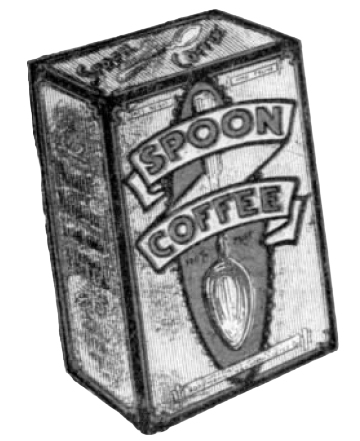
Visual trade dress (per the crop): a dark vertical paper-lined carton with two stacked banner-cartouches — “SPOON” on the upper banner, “COFFEE” on the lower banner — separated by a downward-pointing spoon device in silhouette. The spoon device is literal trade-dress integration with the in-carton tea-spoon premium documented in the source blurb. The pack-side type reads as drawn line-art consistent with mid-1920s grocery carton conventions; no retail price or roaster line is legible in the surviving crop, though the blurb confirms the capacity as one pound of 100% pure coffee.
Documented absence
- 28 January 1917 Morrison acquisition announcement (Hoffmann-Hayman in San Antonio Express) — WESCO, MISA, BRONCHO, TEXCO, JUANITA (“including” hedge). No Spoon.
- 29 April 1917 “That Morning’s Cup of Coffee” feature — H&H, Wesco, Misa, Texco as the four “popular brands.” No Spoon.
- 19 August 1917 San Antonio Express wholesale roster — Wesco, H. & H., Texco, Double H, Border, Broncho, Juanita, Big Dime, Fancy Peaberry (nine package lines). No Spoon.
- 19 October 1917 San Antonio Light Liberty Loan sponsor cell — H. & H. Blend—Wesco—Texco. No Spoon.
- 26 August 1923 San Antonio Light products spread — Spoon is one of the ten labeled product columns, with the blurb quoted in the lede. (The on-site source-post transcription previously misread three brand names as “Texan / Saxon / Roanoke” — those were Texco, Spoon, and Broncho respectively; the 16 May 2026 re-OCR pass corrected the transcription and resolved the Spoon-not-in-body flag raised in the prior pass on this page.)
- 28 November 1926 Light “Largest Coffee Plant” — H AND H BLEND, SAM HOUSTON, BRONCHO, BORDER, MENGER PEABERRY, TEXCO. No Spoon.
- 2 March 1942 H&H wholesale package and bulk price sheets — H AND H, SAN ANTONIO, TEXAS GIRL, ANITA, TEXCO, BIG VALUE, M. CHEF; bulk Anita Peaberry Blend, Good Value, O.S.T. Fancy Santos Peaberry. No Spoon.
This documented-absence audit is what tightens the page’s period from the prior 1917–1923 framing to 1923 — Spoon has exactly one documented year on this site.
Advertising
- 1923 San Antonio Light — H and H products ad — full page 66 context with the (now-corrected) ten-column product transcription, factory tie-ins, and the Spoon blurb in full.
- Spoon Coffee — products ad crop — isolated panel from the same display; the only on-site visual reference for the brand.
More newspaper-derived logos and packs are indexed under Branding in Newspapers.
Collection posts
- Spoon Coffee — products ad crop, 26 Aug 1923 — crop image and source path.
- San Antonio Light — H and H products ad — full-page clipping for the same issue.
Reference photography
No Spoon retail package is in Our Collection yet; the illustrated 1923 pack art appears under Packaging.
Related lines
- Double H Coffee — parallel case of a single-year-documented H&H line (1917 only) with no surviving pack and editorial-inference Morrison attribution. The structural similarity is close enough that the hypotheses for one inform the hypotheses for the other.
- Misa Coffee — Morrison-acquired line named in early 1917 then absent from the Aug 1917 wholesale roster; an established case of brand attrition under H&H’s masthead.
- Texco Coffee · Broncho Coffee · Border Coffee — neighboring packs in the 1923 products spread; all three persisted into multiple later H&H rosters where Spoon did not.
- H and H Blend Coffee — anchor label in the same 1923 display.
- Hoffmann-Hayman Coffee Company — corporate hub.
- H and H Product Line — product-family index.
Newspaper & period branding
1923 San Antonio Light Spoon Coffee panel — full page, isolated crop at Spoon — products ad crop. Indexes: Newspaper ads · Branding in Newspapers.
Open questions
- Is the Morrison-acquired claim correct? The Brands-index footnote
[^1]commits to it but no on-site primary source names Spoon among Morrison labels. A pre-1917 Morrison advertisement, trade-card, or sales sheet naming Spoon would settle Hypothesis 1. The recovered 1923 blurb (paper-lined carton with tea-spoon premium giveaway) reads as 1920s grocery-promotion trade-dress, weakening Hypothesis 1 relative to Hypothesis 2 but not ruling it out. - Why did Spoon disappear after 1923 while paired packs in the same spread (Border, Texco, Broncho) continued? Border and Broncho both ran cup-and-saucer premium giveaways in the same 1923 campaign and survived into later rosters; only Spoon’s tea-spoon premium did not get a second campaign. The 1926 “Largest Coffee Plant” roster three years later is the next H&H roster on this site and Spoon is gone — consistent with a single-campaign promotion that wasn’t repeated.
- What is the spoon device? The downward-pointing spoon between the two banner-cartouches is a literal reference to the in-carton tea-spoon premium. A Texas Secretary of State trademark filing for the spoon-device mark (separate from the wordmark) could exist in 1920s filings.
- How many tea-spoons survive in the wild? The premium was packed in every carton in 1923; surviving Spoon-Coffee-marked teaspoons might exist in San Antonio collections as a parallel collectible to the cup-and-saucer premiums Border and Broncho offered.
Wanted
- Any surviving Spoon Coffee paper-lined carton — would document retail pricing, the roaster line, and the carton’s interior arrangement for the tea-spoon premium.
- A surviving Spoon-Coffee-marked tea-spoon premium (the in-carton giveaway) — would document the spoon-as-device whether stamped, embossed, or printed; might appear in San Antonio estate sales as a parallel collectible to Border / Broncho cup-and-saucer premiums.
- Pre-1923 advertising naming Spoon (Morrison-era or H&H-era) — would discriminate between the Morrison-acquired (Hypothesis 1) and H&H-introduced-1920s (Hypothesis 2) readings.
- A Morrison Coffee Company sales sheet, trade card, or trademark filing naming Spoon — would settle the Morrison-acquired claim in Hypothesis 1.
- Texas Secretary of State trademark filings for “Spoon Coffee,” the spoon-device mark, or any Hoffmann-Hayman / Morrison Coffee Co. design filings from the 1910s–1920s.
Contact with leads.