Misa Coffee
Misa was a Morrison Coffee Company trade label that Hoffmann-Hayman acquired with the February 1917 Morrison purchase. The 28 January 1917 San Antonio Express acquisition announcement names MISA explicitly among the five Morrison brands H&H committed to continue packing (“‘WESCO,’ ‘MISA,’ ‘BRONCHO,’ ‘TEXCO’ and ‘JUANITA’”). The 29 April 1917 Express-News Sunday feature “That Morning’s Cup of Coffee“ then lists “H & H,” “Wesco,” “Misa” and “Texco” as the consolidated firm’s four “popular brands” — giving Misa coequal billing with H&H, Wesco, and Texco in the early-H&H flagship tier.
But Misa disappears from the documented record by August 1917. The 19 August 1917 Express wholesale roster — the next-after-April primary source on the H&H line — names Wesco, H. & H., Texco, Double H, Border, Broncho, Juanita, Big Dime, and Fancy Peaberry but omits Misa entirely. The 19 October 1917 Liberty Loan sponsor cell also omits it. The 1926 Light “Largest Coffee Plant” roster does not name Misa either. A four-month documentary disappearance window — between the April 1917 flagship listing and the August 1917 wholesale roster — is one of the cleaner brand-discontinuation signatures in the H&H portfolio, though no primary source explicitly explains the gap.
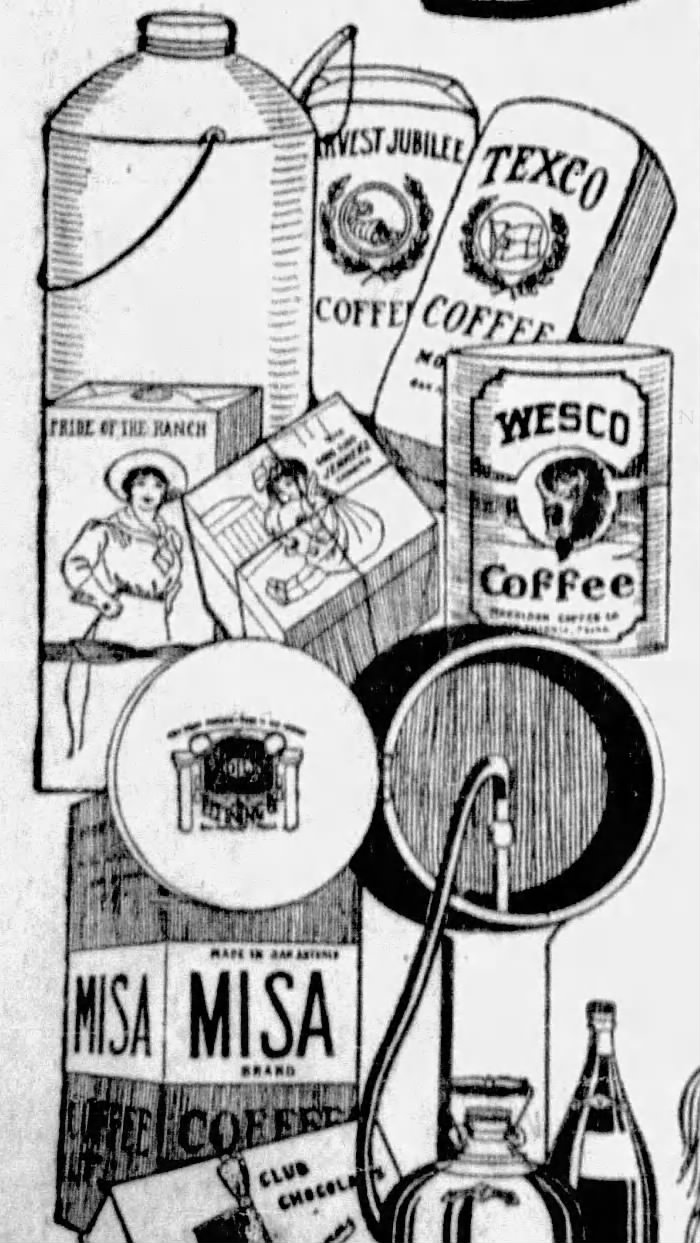
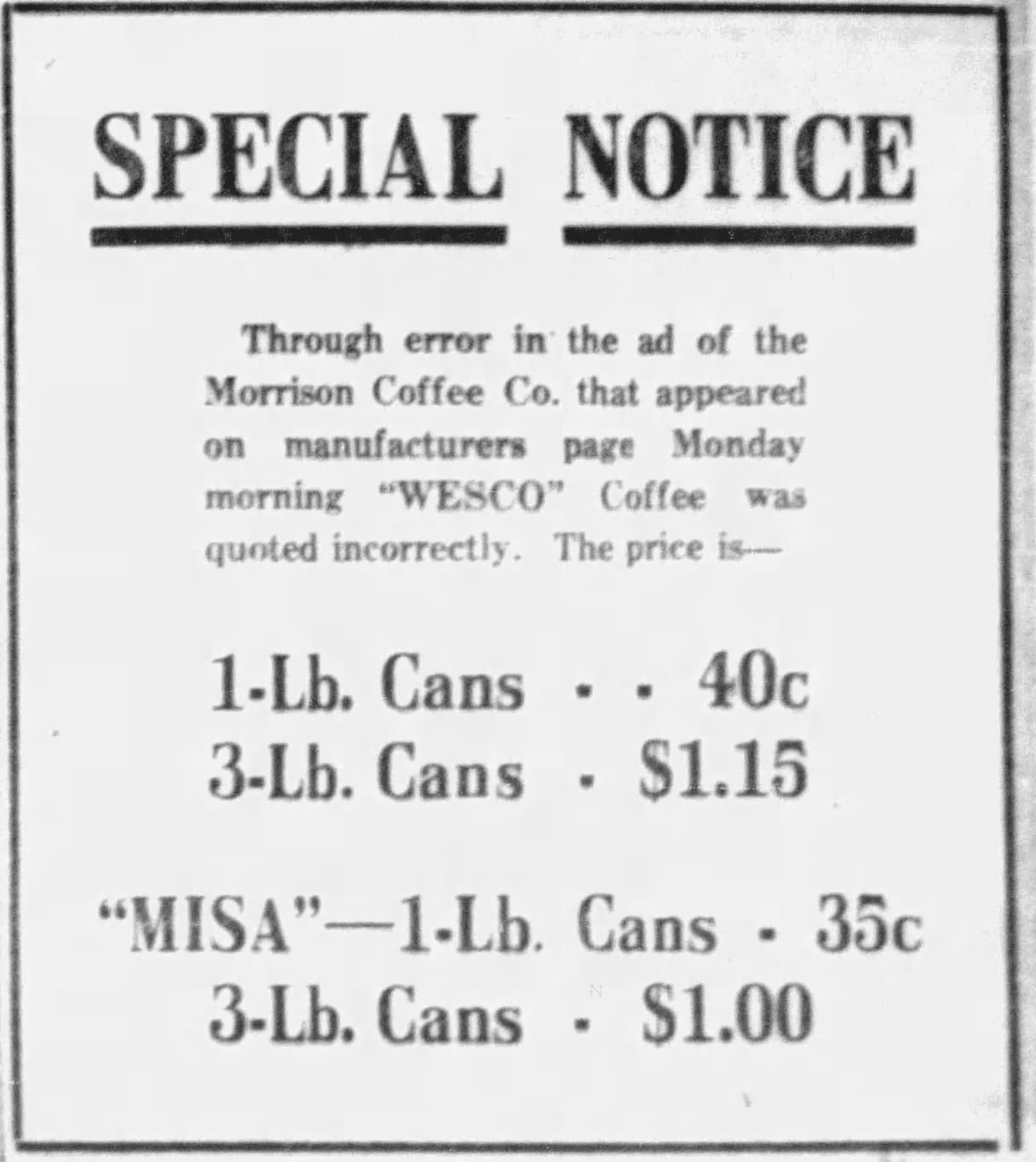
The collection holds no Misa pack. The clearest type-forward Misa price reference is the 21 March 1916 Express-News Morrison Special Notice that quotes “MISA” 1-lb. and 3-lb. can pricing verbatim after correcting a manufacturers-page misprint. The 13 December 1914 Morrison page-44 montage adds Misa Brand Coffee as visible pack art in the Morrison cluster.
Origin — Morrison Coffee Company brand (no pre-1914 documentation)
Unlike Wesco, Broncho, Border, and Juanita — all of which appear in the 24 August 1912 Express-News sugar-and-coffee market column — Misa is not quoted in either the 1912 or 4 May 1915 market columns. Its earliest documented appearance is the 13 December 1914 Express-News Morrison page-44 display, where Misa Brand Coffee appears in the visible pack montage alongside Wesco, Texco, Broncho, Juanita, and Harvest Jubilee. This suggests Misa may have been a later Morrison addition to the line (introduced between Aug 1912 and Dec 1914), not part of the original Morrison portfolio quoted in the 1912 retailer market columns.
March 1916 — verbatim “MISA” can pricing
The 21 March 1916 San Antonio Express-News boxed “Special Notice” from Morrison Coffee Co. corrects a 20 March manufacturers-page misprint for “WESCO” list pricing, then restates Misa lines in the same 1-lb. / 3-lb. can ladder. This is the only verbatim Morrison-Misa price quote on the site:
“MISA” — 1-Lb. Cans . 35c
“MISA” — 3-Lb. Cans . $1.00
The notice’s typographic prominence — uppercase brand in quotation marks, period-spaced cents notation — is consistent with broader Morrison house style for WESCO in the same piece.
January–April 1917 — named in the acquisition, then flagship-tier billing
The 28 January 1917 Express Hoffmann-Hayman acquisition announcement names MISA explicitly in the five-brand list H&H committed to continue packing after the 1 February 1917 effective date. Three months later the 29 April 1917 Express-News Sunday feature “That Morning’s Cup of Coffee” lists just four “popular brands”:
Its popular brands, “H & H,” “Wesco,” “Misa” and “Texco” are ready sellers in Southwest Texas.
Notably the article omits Broncho and Juanita (both in the formal Jan 1917 acquired list) and places Misa coequal with the H&H house mark. Misa was therefore not a back-catalog Morrison line being run out gracefully — it was named as one of the firm’s four flagship brands in the company’s most detailed April 1917 profile.
August 1917 disappearance
The 19 August 1917 San Antonio Express wholesale roster — printed under the consolidated firm’s 307 N. Medina address — inventories pack architecture for Wesco, H. & H., Texco, Double H, Border, Broncho, Juanita, Big Dime, and Fancy Peaberry. Misa is absent. The 19 October 1917 San Antonio Light Liberty Loan sponsor cell narrows the H&H line further to just three names (“H. & H. Blend—Wesco—Texco”) — again no Misa. The 28 November 1926 Light “Largest Coffee Plant” feature similarly omits Misa from the H&H high-grade coffee roster (H AND H BLEND, SAM HOUSTON, BRONCHO, BORDER, MENGER PEABERRY, TEXCO).
The four-month gap between April and August 1917 — during which Misa moved from flagship listing to wholesale absence — is documented but not explained in the primary sources. Possible explanations include:
- Quiet discontinuation during the consolidation at 307 N. Medina (Morrison plant operations transferred there over the first 30 days post-acquisition, with line rationalization during the move).
- Rebrand into another H&H line — but no documented successor brand shares Misa’s wordmark or trade dress.
- War-board supply pressure — the U.S. entry into WWI on 6 April 1917 may have accelerated H&H line consolidation, but Wesco, Texco, Broncho, Juanita, and Big Dime all survived the same window.
- OCR / transcription gap — possible but unlikely, given Misa’s prominence in the April 1917 piece and its uppercase styling elsewhere.
A surviving Morrison-era or early-H&H Misa pack, or a 1917 trade-press item explaining the line consolidation, would close this question.
Products
- Misa — 1-pound cans (Morrison-era retail: 35¢ per the 21 Mar 1916 correction notice)
- Misa — 3-pound cans (Morrison-era retail: $1.00 per the same notice)
Packaging
No museum object is catalogued. The 1914 facsimile shows Misa Brand Coffee lettering and carton treatment in newspaper line art; the 1916 notice quotes “MISA” with the can ladder Morrison wanted retailers to use after the manufacturers-page error.
Advertising
- Morrison Coffee — 13 Dec 1914 — ink drawings of Misa, Wesco, Texco, and allied Morrison packs.
- Morrison — Wesco and Misa price correction, 21 Mar 1916 — full Special Notice facsimile and transcription.
- H&H acquires Morrison — 28 Jan 1917 — MISA named in the formal continued-brands list.
- “That Morning’s Cup of Coffee” — 29 Apr 1917 — Misa listed as an H&H flagship beside H&H, Wesco, and Texco.
Collection posts
- 13 Dec 1914 Morrison clip — halftone product display with Misa Brand Coffee carton.
- 21 Mar 1916 Special Notice — verbatim “MISA” 1-lb. / 3-lb. can prices.
- 28 Jan 1917 Morrison notice (part 1) — Morrison-to-H&H acquisition with MISA in the named list.
- “That Morning’s Cup of Coffee” — 29 Apr 1917 — Misa among the four April 1917 H&H “popular brands.”
Reference photography
No Misa pack is in Our Collection; 1914 line art and 1916 price notice are the only visual references on the site.
Newspaper & period branding
1914 illustrated Morrison cluster and 1916 MISA price correction under Packaging; acquisition notice and April 1917 flagship feature under Advertising. Indexes: Newspaper ads · Branding in Newspapers.
Related lines
- Wesco Coffee — paired with Misa in both the 1916 price-correction notice and the April 1917 “popular brands” sentence.
- Texco Coffee — co-listed with Misa in the April 1917 flagship sentence; survived the August 1917 wholesale roster where Misa disappeared.
- Broncho Coffee · Juanita Coffee — also named in the 28 Jan 1917 acquisition announcement; both survived past August 1917.
- Morrison Coffee Company — predecessor firm; Misa was among the five brands H&H committed to continue in the 28 Jan 1917 acquisition notice, and the earliest to disappear (gone from the August 1917 wholesale roster, four months after acquisition).
- Hoffmann-Hayman Coffee Company — corporate hub.
- H and H Product Line — product-family index.
Open questions
- August 1917 disappearance. Misa was a named flagship in April 1917 and gone from the August 1917 wholesale roster. Was it quietly discontinued during the 307 N. Medina consolidation, rebranded into another line, or pulled under WWI supply pressure? No documented successor; no formal discontinuation notice has surfaced.
- Pre-1914 Morrison origin. Misa is absent from the 1912 and 1915 sugar-and-coffee market columns where Wesco, Broncho, Border, Juanita, Auto Blend, El Merito, and Metropolis appear. Was Misa introduced between Aug 1912 and Dec 1914 — and if so, why was it elevated to flagship tier by April 1917 only to vanish four months later?
- “Misa Brand Coffee” trade dress. The 1914 page-44 caption pairs the brand with cartouche lettering visible in the line art. An in-hand Morrison or early-H&H Misa pack would document the actual trade dress.
Wanted
Misa is on Wanted until packaging or ephemera can be photographed. Particularly sought:
- Any Morrison-era Misa can (1914–Jan 1917) — would document the cartouche trade dress directly.
- April–August 1917 evidence of any kind — would help bracket the documented disappearance window.
- Trade-press items, distributor circulars, or H&H internal records that explain Misa’s consolidation status post-merger.
Contact with leads.