Menger Hotel Coffee
Menger Hotel Coffee is listed as a brand on the site’s Brands roster (item 14 under Coffees) and on the Wanted page as a “Hotel sub-brand” one-pound litho tin — but no on-site primary source documents the “Menger Hotel Coffee” wordmark. The closest documented attestation is the 5 March 1932 The News (San Antonio) “H and H Coffee Co. Sees ‘32 Banner Year” feature, which names “Menger Brand” (not “Menger Hotel Coffee”) among the firm’s leading brands alongside H and H Coffee, H and H Blend, H and H Orange Pekoe Tea, and Sam Houston — characterized as among San Antonio’s “first sellers.” The wordmark “Menger Brand” also appears in the 21 December 1932 Express-News Delaware Street plant-opening copy as “Menger Brand Peaberry” (paired with the Menger Peaberry Coffee line — see that page’s Fancy Peaberry → Menger Peaberry wordmark transition section). The 1916 Express ad cited in this page’s sources mentions the Menger Hotel as a venue (“a Card Party at the Menger Hotel”), not as a coffee brand or H&H customer.
The page is therefore best read as a research stub anchored on editorial inference rather than primary documentation. Reliability is set to unverified and the period to undocumented until a labeled “Menger Hotel Coffee” tin, a period ad naming the wordmark, or a corporate sales sheet enumerating “Menger Hotel” as a distinct SKU surfaces.
The Menger family — Menger Hotel connection (well-documented)
The family connection between the H&H Menger family and the Menger Hotel is itself well-documented and not in doubt:
- William A. Menger (1827–1871) — founder of the Menger Hotel in San Antonio, opened 1859.
- Catherine Menger — daughter of William A. Menger; mother of the H&H Menger generation.
- Dr. Rudolph Menger — Catherine’s husband; East Commerce Street household.
- Their children running Hoffmann-Hayman: Wilhelmina (“Minnie”) Menger Hoffmann (co-founder, VP, and director), Gus P. Menger (president 1932+), Rudolph W. Menger, T. J. Menger, Louis B. Menger, Albert G. Menger (president May 1960+).
So the H&H Menger family is genuinely two generations removed from the Menger Hotel founder — a real San Antonio family-business lineage that ties the coffee company to the hospitality dynasty. What’s not documented is that this family connection extended to a specific “Menger Hotel Coffee” retail wordmark. The connection more likely manifests in two other ways (see hypotheses below).
Three hypotheses for what “Menger Hotel Coffee” is
The single-source-listing footprint (Brands index + Wanted list, no primary citation) admits three readings, all consistent with the documented family-business overlap:
Hypothesis 1 — Editorial misclassification: there was no “Menger Hotel Coffee” wordmark
The “Menger Hotel Coffee” item on the Brands index is editorial inference — built either by reading “Menger” + “Hotel” as a compounded wordmark when the actual H&H wordmarks were “Menger Brand” (1932 News) and “Menger Brand Peaberry” / “Menger Peaberry” (1923–1932), or by conflating “the Menger Hotel’s H&H coffee” with a separate retail SKU. Under this hypothesis the page should ultimately be folded into the Menger Peaberry entry as a wordmark variant of “Menger Brand,” with the Brands-index slot removed or annotated. Parallel structural case: H and H Instant Coffee — another brand asserted in the site’s editorial structure but not documented in primary sources, where the actual H&H instant line was always Master Chef Instant.
Hypothesis 2 — Institutional H&H coffee served at the Menger Hotel (named for its customer venue)
Just as Master Chef Coffee was the H&H hotel/café-trade brand documented at Mi Tierra Café in San Antonio (1951 photograph; see Master Chef Coffee § Mi Tierra and the Cortez family), an H&H coffee may have been served at the Menger Hotel as part of the family connection — but the coffee itself may have been standard H and H Blend or Master Chef Coffee, named informally as “Menger Hotel Coffee” because of where it was served, not because a separate wordmark existed. Under this hypothesis the “brand” is a customer-relationship signifier rather than a retail wordmark. The 1916 Express ad’s mention of “a Card Party at the Menger Hotel” (a venue reference, not a coffee brand reference) is consistent with this reading: the hotel and the coffee company existed in the same family network but didn’t necessarily share a wordmark.
Hypothesis 3 — Real but undocumented retail wordmark
H&H may have packed a distinct “Menger Hotel Coffee” retail tin sometime in the 1912–1932 window as a family-branding move, parallel to or alongside “Menger Peaberry Coffee” — but the wordmark hasn’t surfaced in surviving advertising or labeled retail pieces on this site. Under this hypothesis a future-finding labeled tin would confirm the wordmark. The Wanted-list entry (“Menger Hotel Coffee 1 pound Tin — Hotel sub-brand; one-pound litho tin with Menger Hotel copy”) commits to this reading.
Resolution requires: (a) any labeled “Menger Hotel Coffee” pack with explicit wordmark; (b) a 1912–1942 H&H ad or sales sheet naming the wordmark; (c) a Menger Hotel menu, stationery, or invoice referencing “Menger Hotel Coffee” as a specific product; (d) a USPTO or Texas Secretary of State trademark filing.
June 1930 — “Menger Coffee” in the $1,000 Label Contest
The News (San Antonio), 12 June 1930: $1,000 Label Contest run by H&H names “Menger Coffee” (not “Menger Hotel Coffee” or “Menger Peaberry”) as an enterable brand with two container sizes:
- Large (Menger Coffee)
- 1-pound (Menger Coffee)
The same contest also confirms H and H Coffee (½, 1, 3 lb), H and H Tea (¼, ½, 1 lb), and Sam Houston (½, 1, 3 lb) as simultaneously active brands. The use of “Menger Coffee” without qualifiers (“Peaberry,” “Hotel,” or “Brand”) is a third wordmark variant alongside “Menger Brand” (1932) and “Menger Brand Peaberry” (1932). Whether these are different products or the same product under variant labeling is unresolved, but the 1930 Label Contest entry is the only known primary source naming a “Menger Coffee” container with defined size tiers. Source: Raw Sources Registry.
What is “Menger Brand” (1932)?
The 5 March 1932 The News “Banner Year” feature names “Menger Brand” as one of H&H’s leading brands. The wordmark appears without “Hotel,” “Peaberry,” or any other modifier — just “Menger Brand.” Two readings are possible:
- “Menger Brand” is a generic family-name designation that H&H applied to multiple coffees under the Menger family umbrella — including Menger Peaberry, perhaps Menger Hotel Coffee if Hypothesis 3 holds, and possibly other unnamed Menger-family SKUs in the institutional channel.
- “Menger Brand” is the 1932-era retail wordmark that the 1923 Light products spread illustrated as “Menger Peaberry Coffee” and the 21 Dec 1932 plant-opening copy renders as “Menger Brand Peaberry” — i.e., the same brand, three wordmark variations across the decade.
The Menger Peaberry page (see its wordmark transition section) covers the “Fancy Peaberry → Menger Peaberry → Menger Brand Peaberry” rebrand chain. Whether “Menger Brand” in 1932 was a deliberately ambiguous family-umbrella designation that could encompass both Menger Peaberry retail and a separate Menger Hotel Coffee SKU, or whether “Menger Brand” simply meant “Menger Peaberry under a 1932 rebrand,” is undocumented.
Sibling brand: Menger Peaberry
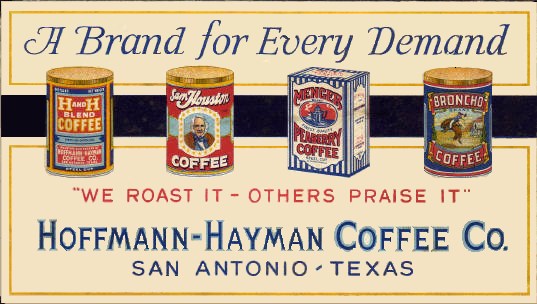
Menger Peaberry Coffee is the only documented Menger-named coffee wordmark on this site. Its documented run is 1917 (as “Fancy Peaberry”) through 1932 (as “Menger Brand Peaberry”), with the rename to “Menger Peaberry” plausibly tied to Gus P. Menger’s January 1920 takeover of the firm. The postcard quartet (Blend / Sam Houston / Menger Peaberry / Broncho) shows Menger Peaberry — not “Menger Hotel” — so the surviving advertising art does not corroborate a separate Menger Hotel wordmark.
Family & company context
The Menger family network connects the H&H roastery directly to the hospitality dynasty, even if a specific “Menger Hotel Coffee” retail wordmark is not primary-sourced:
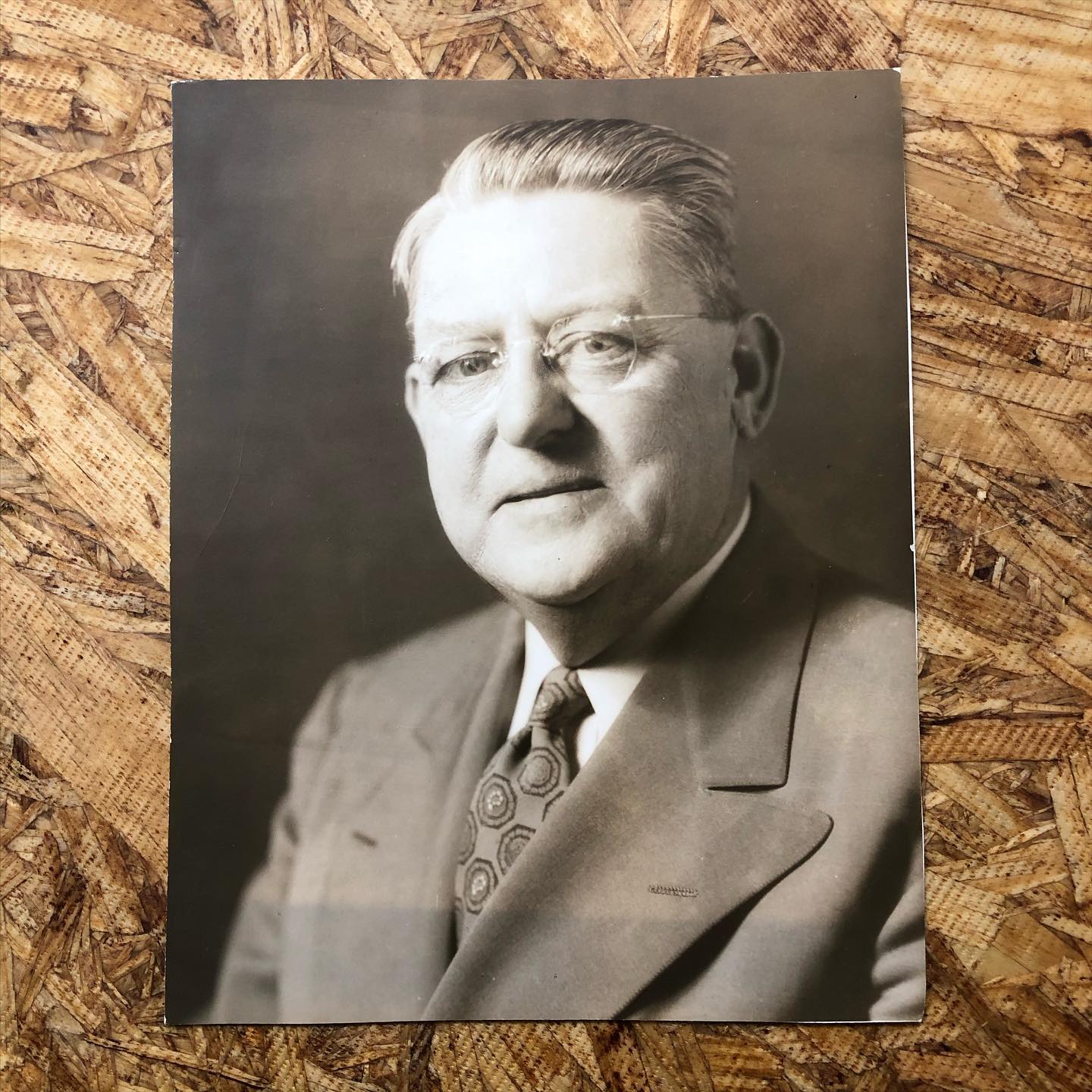
- Gustav P. Menger — president 1932+ (per the 1932 News “Banner Year” feature); presidential portrait era.
- Hoffmann-Hayman company letterhead — officer line with G. P. Menger, R. W. Menger, T. J. Menger.
- Minnie Menger Schlosser (formerly Minnie Menger Hoffmann) — co-founder and long-serving VP/director; the bridge between the founding Hoffmann family (William R. Hoffmann’s first marriage) and the Menger family lineage.
- Very special tour — visit with a Rudolph Menger granddaughter; family memory context.
Documented absence after 1932
The brand drops out of the on-site primary record entirely after the 5 March 1932 News “Banner Year” mention of “Menger Brand”:
- 2 March 1942 H&H wholesale package and bulk price sheet — package SKUs: H AND H, SAN ANTONIO, TEXAS GIRL, ANITA, TEXCO, BIG VALUE, M. CHEF. No Menger Hotel, no Menger Brand.
- 1942–43 Flav-O-Tainer ad campaign — H and H Drip Grind only. No Menger Hotel.
- 1957 SA Express Master Chef Instant launch — No Menger Hotel.
- 1959 Valley Morning Star Burpee promo — No Menger Hotel.
- 5 May 1960 SA Express-News Albert Menger president corporate product roster — “Master Chef Coffee, Master Chef Instant Coffee, H and H Coffee, Texas Girl Coffee and other consumer and [institutional] coffee.” No Menger Hotel (could be inside the “other consumer … coffee” residual but not named — notable given that Albert Menger himself was the new president).
- 1964 Fredericksburg Standard grocery ad — No Menger Hotel.
Even under Hypothesis 3 (real but undocumented retail wordmark), the post-1932 silence on “Menger Hotel” or “Menger Brand” parallels the Menger Peaberry attrition 1932–1942 window. If a Menger Hotel wordmark existed, it would have been retired in roughly the same window.
Further reading
- The History and Mystery of the Menger Hotel — popular background on the hotel itself (verify facts against primary sources).
Related lines
- Menger Peaberry Coffee — the documented Menger-named H&H wordmark; the Menger Peaberry / Menger Hotel pair is the editorial-inference cluster that the Brands index currently lists as two slots.
- Master Chef Coffee — the H&H hotel/café-trade brand with documented institutional customers (Mi Tierra 1941; M. Chef Blends A & B on the 1942 hotel/café-trade price sheet). Master Chef is the primary-sourced parallel to whatever undocumented hotel-trade Menger-named coffee may have existed.
- Hoffmann-Hayman Coffee Company — corporate hub; the Menger family takeover (1920) is the corporate event that makes a Menger-named retail wordmark structurally plausible.
- H and H Product Line — product-family index.
Open questions
- Did “Menger Hotel Coffee” ever exist as a retail wordmark? No on-site primary source documents it. Hypotheses 1 (editorial misclassification) and 2 (institutional coffee at the Menger Hotel, not a distinct retail wordmark) are currently best-supported; Hypothesis 3 (real but undocumented) remains live until a labeled retail tin surfaces.
- What was the H&H coffee actually served at the Menger Hotel? A Menger Hotel menu, breakfast-card, room-service-sheet, or stationery referencing H&H coffee specifically (parallel to the 1951 Mi Tierra storefront photograph showing the Master Chef sign) would document the customer relationship. This is the strongest discriminator between Hypothesis 2 and Hypothesis 3.
- What is “Menger Brand” in the 1932 News feature? The wordmark appears once in primary copy without “Hotel” or “Peaberry” qualifier. Was this a generic family-umbrella designation that included both Menger Peaberry retail and a separate Menger Hotel Coffee SKU? Or was “Menger Brand” a 1932-era rebrand of just Menger Peaberry? A 1933 H&H ad or sales sheet would discriminate.
- Is there a Menger Hotel trademark filing for coffee? No on-site evidence. A USPTO or Texas Secretary of State search for “Menger Hotel” or “Menger Brand” as coffee/beverage trademarks would document any formal filings.
- Should the Brands-index slot be retained? If Hypothesis 1 or 2 holds, item 14 (“Menger Hotel Coffee”) on Brands is editorial inference rather than primary record. The slot may warrant annotation, removal, or merging into the Menger Peaberry entry as a wordmark variant.
Wanted
- Any labeled “Menger Hotel Coffee” pack (tin, bag, carton, label) — would settle Hypothesis 3 with one source.
- Menger Hotel menus, breakfast cards, room-service sheets, or stationery referencing H&H coffee specifically — would document the customer relationship and discriminate Hypothesis 2 vs. Hypothesis 3 (parallel to the 1951 Mi Tierra Master Chef storefront photograph).
- A 1933–1942 H&H ad, sales sheet, or jobber’s catalog clarifying what “Menger Brand” meant in the 1932 News feature (a family-umbrella designation, a 1932 rebrand of Menger Peaberry, or a separate Menger Hotel SKU).
- USPTO or Texas Secretary of State trademark filings for “Menger Hotel,” “Menger Brand,” or related Menger-named coffee marks.
- A photograph of the Menger Hotel coffee service (1910s–1960s) with H&H tins, packs, or signage visible — would document the customer-venue relationship.
Contact with leads.