Border Coffee
Border Coffee is a Hoffmann-Hayman line documented in the on-site primary record from 24 August 1912 (Morrison-era wholesale market quotation) through 28 November 1926 (San Antonio Light “Largest Coffee Plant” feature listing BORDER in the six-brand high-grade roster alongside H AND H BLEND, SAM HOUSTON, BRONCHO, MENGER PEABERRY, and TEXCO). The Welcome roster names Border alongside the rest of H&H’s marks as if the brand persisted through 1972, but no on-site primary source documents Border after 1926 — the brand is absent from the 2 March 1942 wholesale package and bulk price sheets, the 1942–43 Flav-O-Tainer ad campaign, and every 1957–1964 retail source. The post-1926 lifespan is therefore an open question (see Documented absence below). The Brands overview highlights Border as a line sold in three-and-a-half or four-pound pails, in versions with or without premiums — a format that distinguished it from many one-pound retail packages elsewhere on the site. The 1923 Light products spread (with the corrected ten-column transcription) describes the trade dress explicitly: “Three pounds of pure coffee and an imported cup and saucer as a premium is packed in a lithographed bucket, and is sold by grocers throughout the territory.” (Earlier on-site rendering of this quote misread the pack size as “this pound” / one-pound; PDF verification of the Light page 66 on 2026-05-16 confirms three pounds.) The museum holds a three-pound tin in Border livery; larger pails and the “cup & saucer” premium variant are still thin or documented only from reference photography (see below).
Origin — Morrison-era roster, formal acquisition unclear
Border appears in the 24 August 1912 San Antonio Express-News sugar-and-coffee market column at the wholesale level, alongside other Morrison-era house names (Broncho, Wesco, Auto Blend, Juanita Blend, El Merito, Metropolis): “Border Brand, 4-lb. pails with premium, $1.10; Border Brand, 3½-lb. net, $1.00…” The same line architecture continues in the 4 May 1915 Express-News market column. The 1912 column’s framing groups Border with the Morrison roster.
Caveat — Border is not named in the January 1917 Morrison acquisition announcement. The 28 January 1917 San Antonio Express Hoffmann-Hayman acquisition notice — the definitive transfer document — lists the Morrison brands H&H committed to continue packing as: “WESCO,” “MISA,” “BRONCHO,” “TEXCO” and “JUANITA”. Border is not in that list. Possible explanations:
- Border may have been a separately-owned San Antonio brand that happened to be quoted in the 1912 wholesale market alongside Morrison’s brands, not a Morrison brand itself.
- Border may have been a Morrison brand the 28 Jan 1917 announcement happened to omit (the announcement says “including” but doesn’t claim to be exhaustive).
- Border may have already been transferred to Hoffmann-Hayman before the formal February 1917 Morrison acquisition.
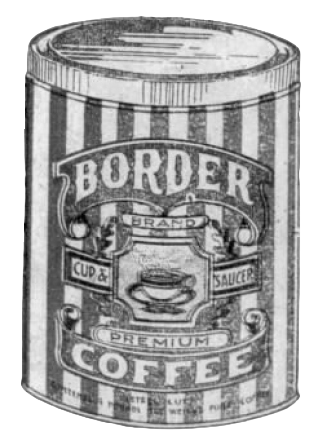
Either way, by the 19 August 1917 Express Hoffmann-Hayman wholesale roster (307 North Medina), Border is firmly in the H&H line. After that, surviving Border packaging carries Hoffmann-Hayman Coffee Co. markings (typically on the side cartouche) while retaining the “BORDER BRAND” word mark and the “CUP & SAUCER PREMIUM” pail variant trade dress. By 1926 the San Antonio Light “Largest Coffee Plant” feature still lists BORDER among the firm’s high-grade roasted coffees alongside H and H Blend, Sam Houston, Broncho, Menger Peaberry, and Texco. The brand persists into the 1923 Light products grid and the project’s reference photography (Witte Museum cup-and-saucer pails and the 2023 Alamy stock photograph) through the later 1970s window the Brands page records.
Open question: resolve Border’s pre-1917 ownership via Texas Secretary of State trademark filings, Morrison’s surviving advertising, or a closer reading of the 1914–1916 Morrison-era Express-News clips.
Products
- Border Coffee in three-and-a-half or four-pound pails (with or without premiums)
- Other Border retail formats from the period (bags, smaller tins, and so on) are not yet summarized in detail here
Packaging
- Border Coffee three-pound tin (front)
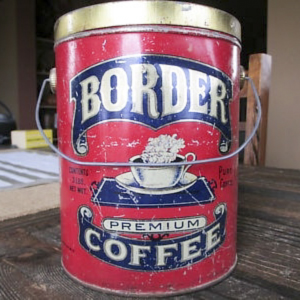
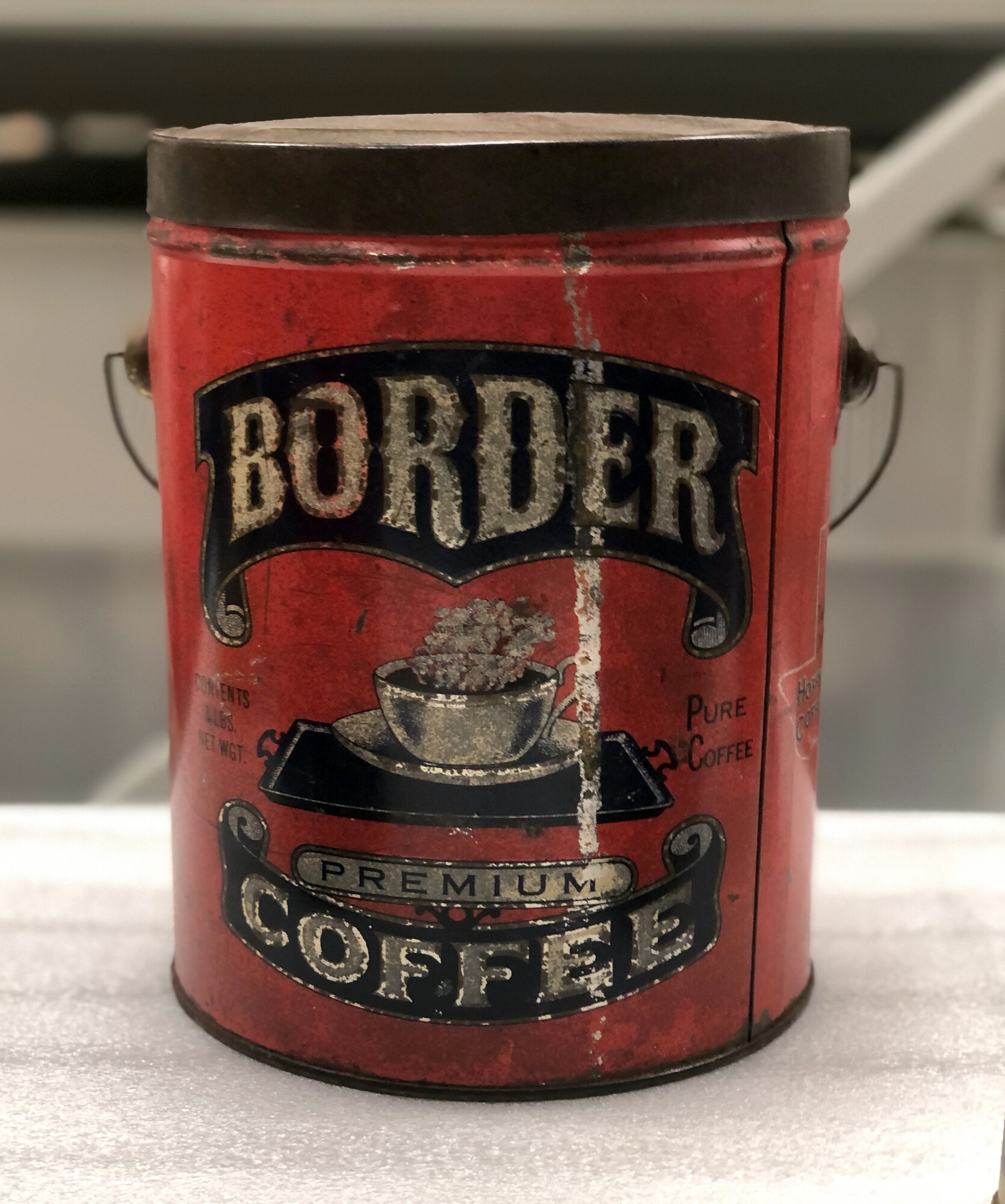
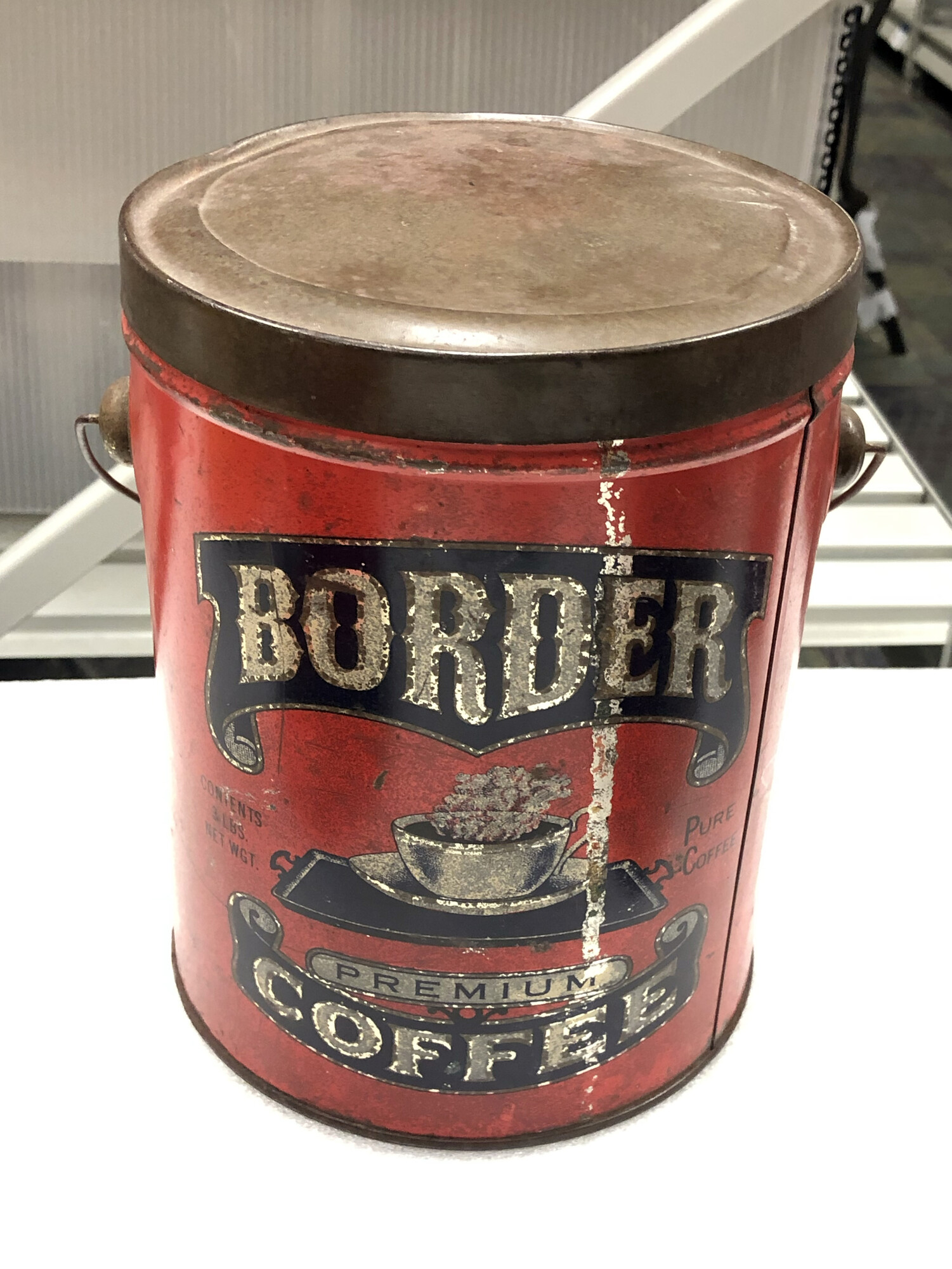
Reference — Border Premium pails (Witte Museum)
Cup-and-saucer premium cylindrical pails (3 lb and 4 lb) photographed 15 October 2019 during the Witte Museum Hoffmann-Hayman visit — institutional reference, not held in Our Collection. Same Border banner, cup-and-saucer vignette, and Premium Coffee stack as the brands overview; the four-pound frame is the clearest match to the large pail story on Brands.
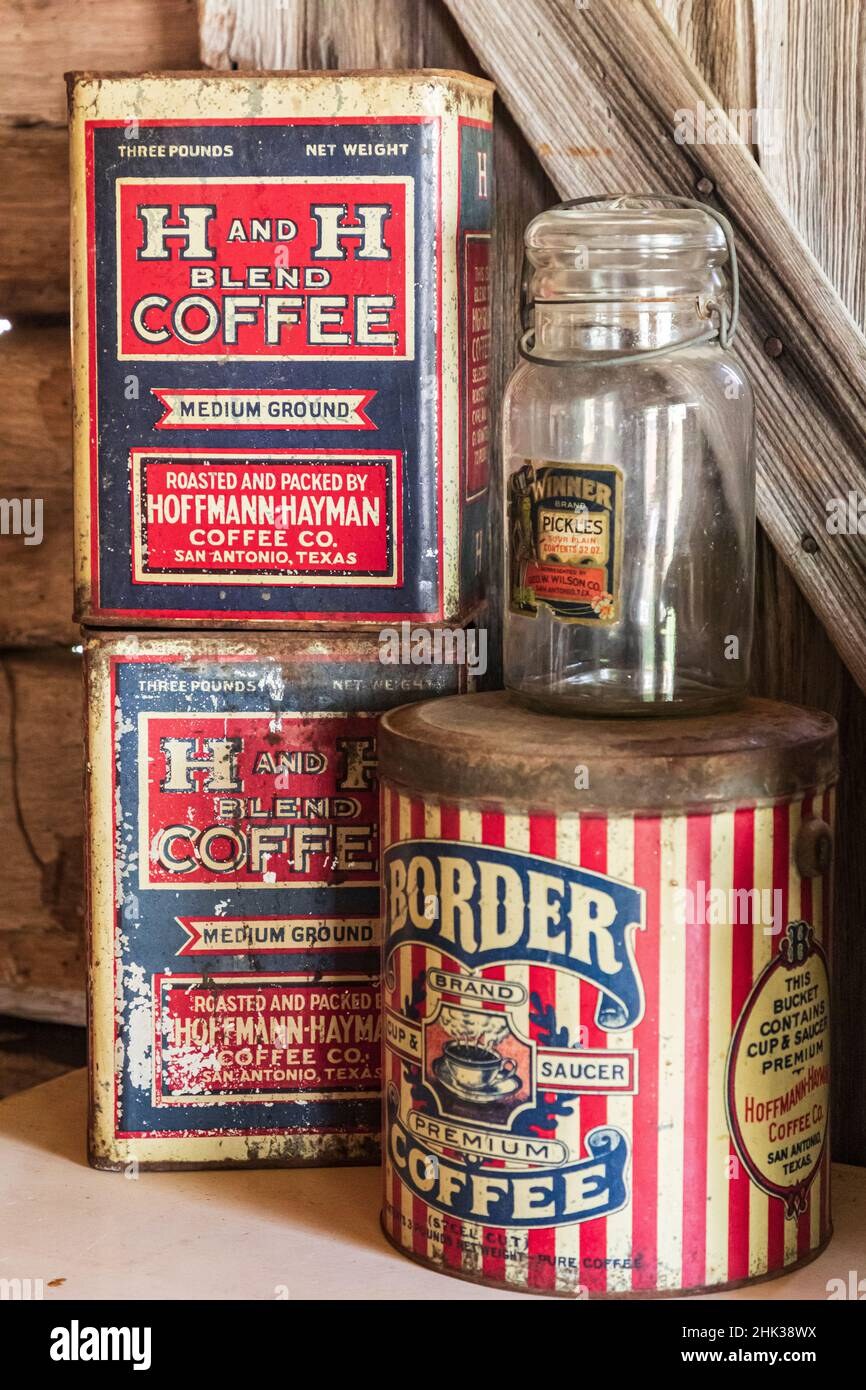
Reference — shelf display (Alamy stock)
Documented 25 February 2023 as a stock photograph of stacked H and H Blend tins beside a Border Brand Premium pail — side cartouche THIS BUCKET CONTAINS CUP & SAUCER PREMIUM / Hoffmann-Hayman Coffee Co., San Antonio, Texas. Full discussion in Alamy shelf display — Blend and Border “cup & saucer premium” pail; also indexed in Reference.
Reference photography
Witte Museum pails and Alamy shelf stock appear under Packaging; additional reference-only photography is indexed in Reference (vs. Our Collection).
Newspaper & period branding
Illustrated Border pack art from the 26 Aug 1923 San Antonio Light products grid — isolates trade dress beside H and H Blend and neighbors on the full page (transcription).
Collection posts & reference photography
- In-hand tin — gallery photography on this page under Packaging (no separate blog post for the three-pound tin yet; context for H and H pail-and-tin retail lives on Broncho Coffee and H and H Blend).
- Witte Museum visit — Border Premium 3 lb and 4 lb pails (images under Packaging).
- Alamy shelf display — Blend and Border “cup & saucer premium” pail — same scene as the reference image above; the physical premium pail remains a Wanted gap.
- Newspaper ads — regional clippings that may name Border as the index grows.
Related lines
- H and H Blend Coffee — often merchandised next to Border in shelf and reference photography; the 2023 Alamy stock photograph stacks H and H Blend tins beside a Border Premium pail in deliberate co-merchandising context.
- Broncho Coffee — parallel large-format pail brand in the same Morrison-era documentary cluster; the 1923 Light products ad documents Broncho with an analogous cup-and-saucer-with-gold-band-design premium packed in each can, the same business model Border uses with its imported cup-and-saucer premium pail. The pair represent H&H’s premium-pail-with-giveaway retail model in the mid-1920s.
- Texas Girl Coffee — another pail- and household-scale line in the 1930s–40s press; one of the four 1960 corporate-roster survivors, where Border is not.
- Sam Houston Coffee · Anita Coffee — sibling brands with parallel mid-decade-to-1942 documented retirement windows. The three together (Border 1926+, Sam Houston 1935+, Anita 1942+) trace the H&H mid-century brand attrition pattern.
- Hoffmann-Hayman Coffee Company — corporate hub.
- H and H Product Line — product-family index.
Pail-and-premium business model (1923)
The 1923 San Antonio Light “H AND H Products earn the Praise of the Housewife Everywhere” full-page spread (page 66) documents three H&H brands with explicit retail-premium giveaways packed in the package itself:
| Brand | Format | Premium | 1923 ad copy |
|---|---|---|---|
| Border | Lithographed bucket, three pounds coffee | Imported cup-and-saucer | “Three pounds of pure coffee and an imported cup and saucer as a premium is packed in a lithographed bucket” |
| Broncho | Three-pound lithographed pail | Imported cup-and-saucer with gold band design | “This lithographed pail contains three pounds of good quality coffee with an imported cup and saucer with gold band design premium packed in each pail” |
| Spoon | Paper-lined carton, one pound 100% pure coffee | Tea-spoon | “A tea-spoon as a premium is packed in each carton” |
The three premium-giveaway brands in the same 1923 campaign represent roughly a third of the ten labeled product columns (the others being H and H Coffee, Texco, Menger Peaberry, H and H Cocoa / Spices / Tea / Extracts). Border and Broncho both survive the 1920s in the documented record; Spoon does not (single-source 1923-only documentation). The lithographed-bucket / cup-and-saucer trade dress is therefore a documented H&H mid-1920s retail signature rather than a one-off campaign — it carries Border into the 1926 Largest Coffee Plant feature, even though no on-site primary source documents the premium-pail format beyond 1926. Note also that Border and Broncho share the three-pound pail format in 1923, which matches the museum’s surviving Broncho three-pound pail and the Witte’s surviving Border three- and four-pound premium pails — the pack-size architecture is consistent across surviving artifacts and 1923 ad copy. (Earlier renderings of this table misread both pack sizes as one-pound; corrected from PDF verification 2026-05-16.)
Documented absence after 1926
The brand drops out of the on-site primary record after the 28 November 1926 Light “Largest Coffee Plant” feature:
- 2 March 1942 H&H wholesale package and bulk price sheet (“FOR TEXAS ONLY”) — package SKUs: H AND H, SAN ANTONIO, TEXAS GIRL, ANITA, TEXCO, BIG VALUE, M. CHEF. Bulk lines: Economy Blend Cereal and Coffee, Good Rio, Big Gum, Arrow Peaberry, Standard Peaberry, Perfection Peaberry, Blue Bird, Anita Peaberry Blend, Good Value, O.S.T. Fancy Santos Peaberry. No Border in either tier.
- 23 December 1942 – 23 July 1943 Flav-O-Tainer ad campaign — H&H Drip Grind wartime cellophane-bag ads. No Border.
- 7 November 1957 San Antonio Express Master Chef Instant Coffee launch. No Border.
- 20 February 1959 Valley Morning Star (Harlingen) p. 20 Burpee Flower Garden coupon (accepts H AND H or Texas Girl Coffees; Master Chef strip; Master Chef Instant label). No Border.
- 5 May 1960 San Antonio Express-News — Albert Menger president corporate product roster: “Master Chef Coffee, Master Chef Instant Coffee, H and H Coffee, Texas Girl Coffee and other consumer and [institutional] coffee.” No Border (could be inside the “other consumer … coffee” residual but not named).
- 27 May 1964 Fredericksburg Standard p. 3 grocery price block. No Border.
Border’s exit window is therefore between November 1926 and March 1942 — a 16-year retirement gap in the on-site record. The Welcome-roster framing of Border as a 1972-period brand is editorial extrapolation based on the corporate operating lifespan (Hoffmann-Hayman Coffee Co. ran until 1972), not a direct primary-source attestation for Border specifically. The brand may have:
- been retired around the same WWII-era portfolio reshape that retired Sam Houston (1935–1942) and Anita (1942–1957)
- transitioned to bulk-only or commercial-supply distribution that doesn’t surface in retail ads
- continued in retail in a packaging format that wasn’t captured by the surviving 1942–1964 H&H press placements on this site
A 1927–1972 primary source naming Border specifically would resolve. The Witte Museum Border Premium pails and the 2023 Alamy stock photograph document trade dress but don’t carry production-date evidence on their face.
Wanted
- Additional views of Border packaging (reverse, lid, seams, bottom marks)
- Three-and-a-half or four-pound pail examples called out on the Brands page, especially premium and non-premium variants — reference photography on this page and in Reference documents cup & saucer premium trade dress, but we do not yet hold a premium pail in the museum collection
- Period advertisements, price cards, or photographs naming Border Coffee