Crystalvac Jars
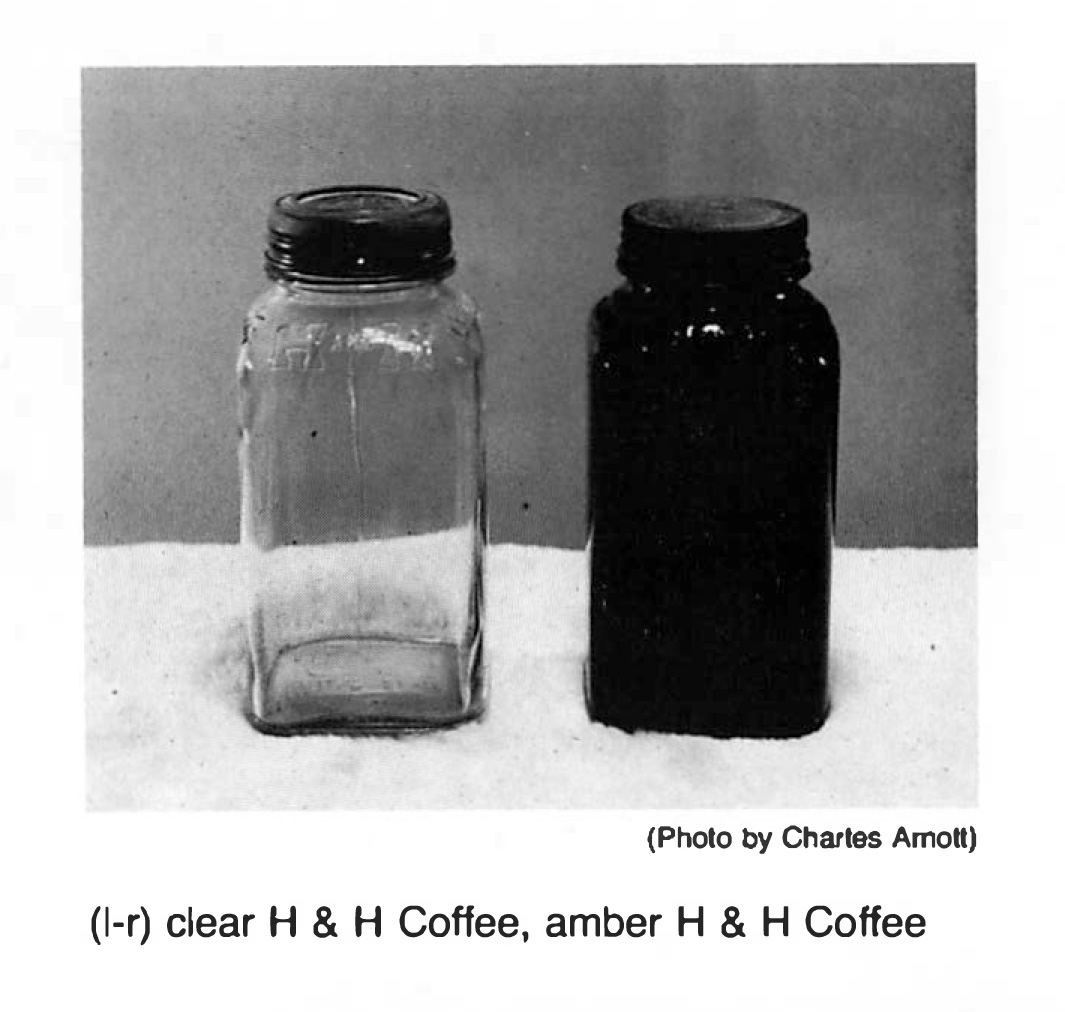
Crystalvac was Hoffmann-Hayman’s vacuum-packed glass retail line for coffee, introduced in 1932 as tin prices rose. The jars were blown for H and H by Three Rivers Glass Company in Three Rivers, Texas—square in plan like fruit-packers’ jars so cases shipped with less breakage—while mouths and threads stayed compatible with standard Kerr and Mason–Ball closures. The plant sat where water, quartzose sand, and fuel came together for South Texas glassmaking; Michael David Smith’s Texas Glass (1989) remains the standard illustrated reference, including the page reproduced below. A longer narrative of the factory visit and dealer network appears in Three Rivers visit; Smith’s book is summarized on Texas Glass, and this site’s bottle index from his price list lives under Three Rivers glass bottles.
Three Rivers Glass was reorganized under Ball interests in December 1936 and the Texas corporation was dissolved in January 1937; in 1947 Ball Brothers divested the plant after antitrust action. That corporate trail is why many Crystalvac blanks carry Owens-Illinois mold marks instead of the Three Rivers star.
Corrected 2026-07-21 — Owens-Illinois is not “later.” This paragraph previously described O-I marks as appearing on later blanks, implying the Three Rivers star came first and O-I followed. Collection specimens now date O-I supply to 1936–1939 (see § Glass marks), overlapping the Three Rivers period rather than succeeding it. Three Rivers had been in receivership since 1932 — the very year Crystalvac launched with a 250,000-jar order — so H&H was almost certainly dual-sourcing through the 1930s. An Owens-Illinois base mark therefore says nothing about a jar being late.
Glass marks
The base of a Crystalvac jar usually tells you which glasshouse ran the mold.
Three Rivers Glass Company
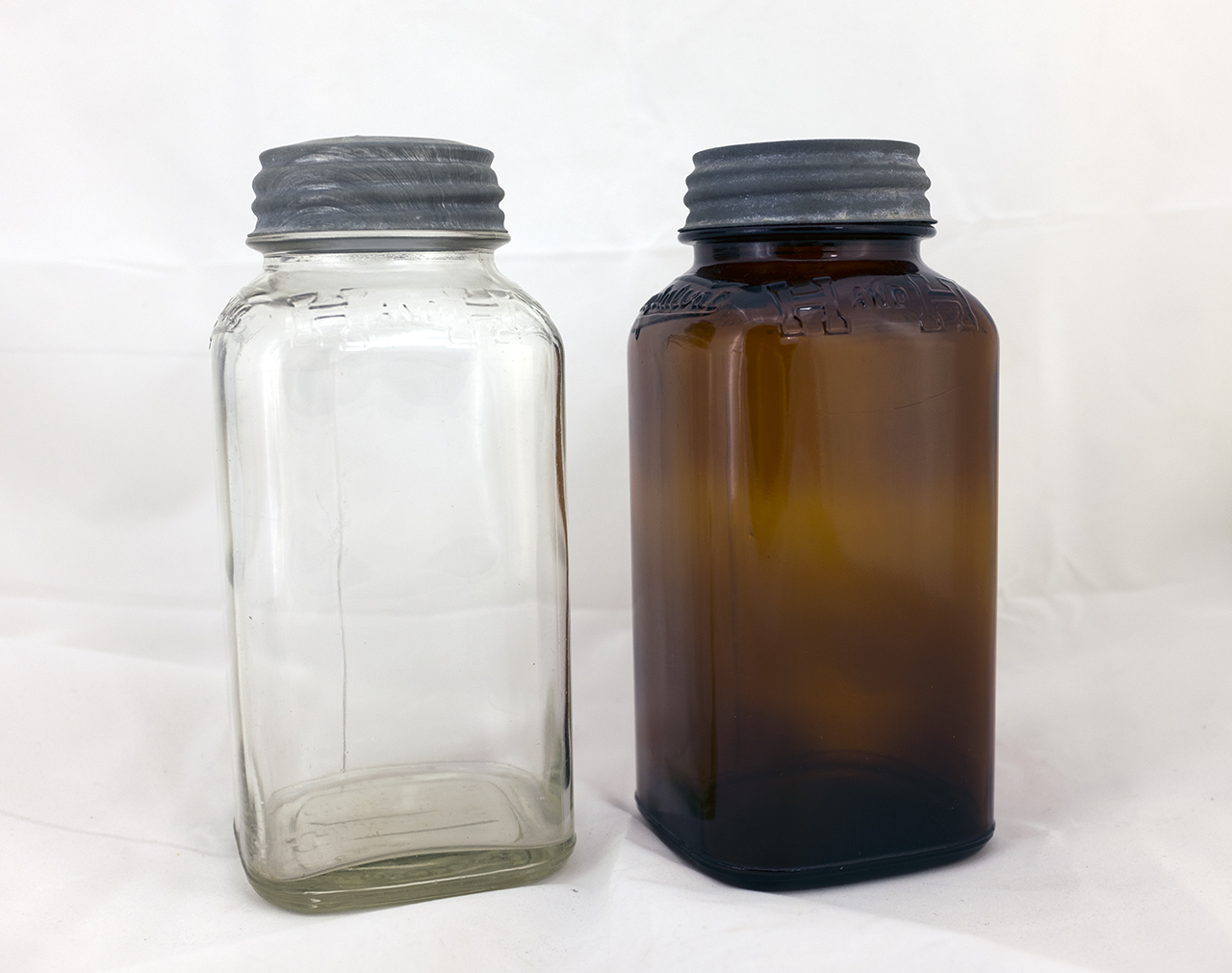
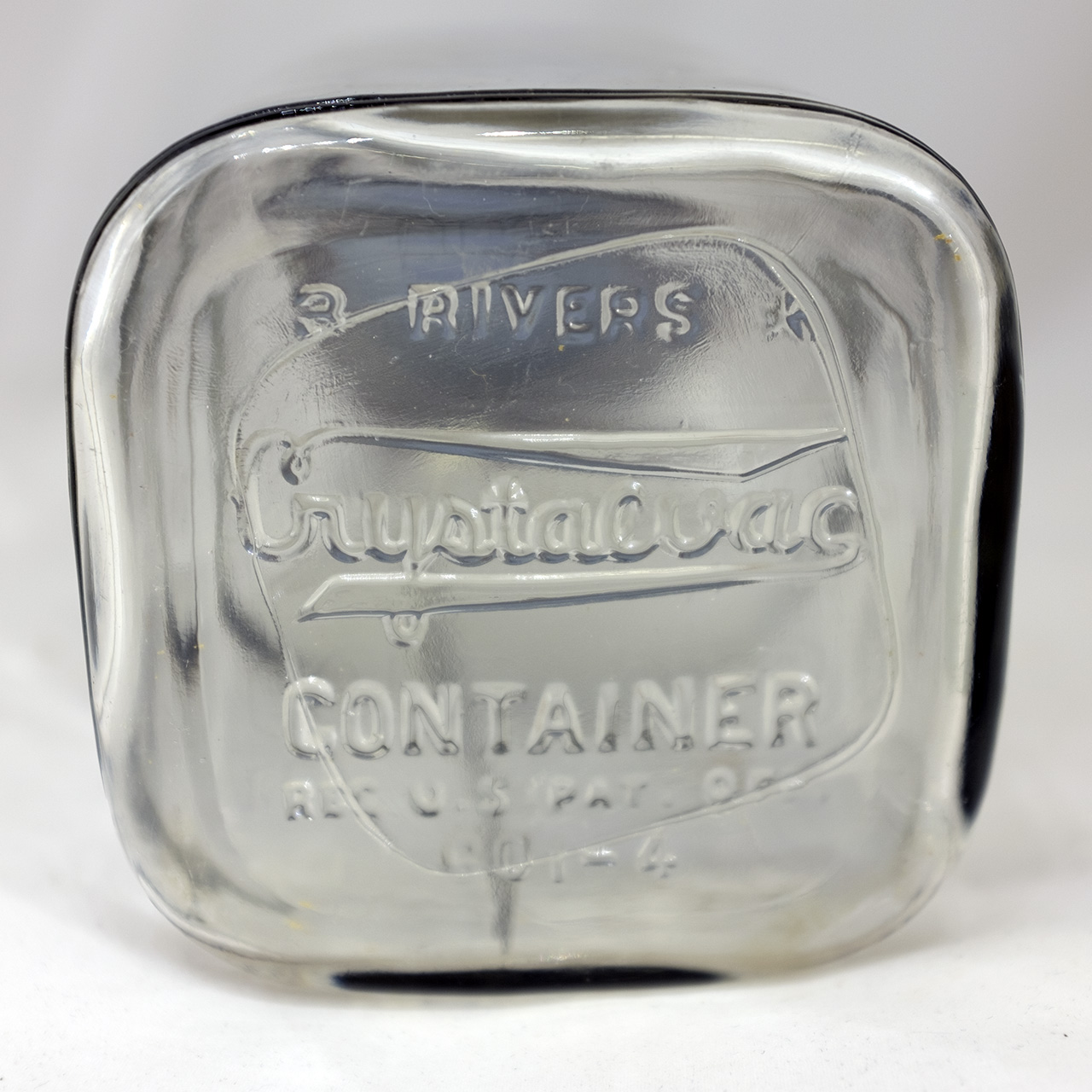
Three Rivers produced one-pound Crystalvac jars in clear and amber from 1932 into the Ball ownership transition. The small clear jar here shows the “3 Rivers” star mark with 601-4 in the patent stack.
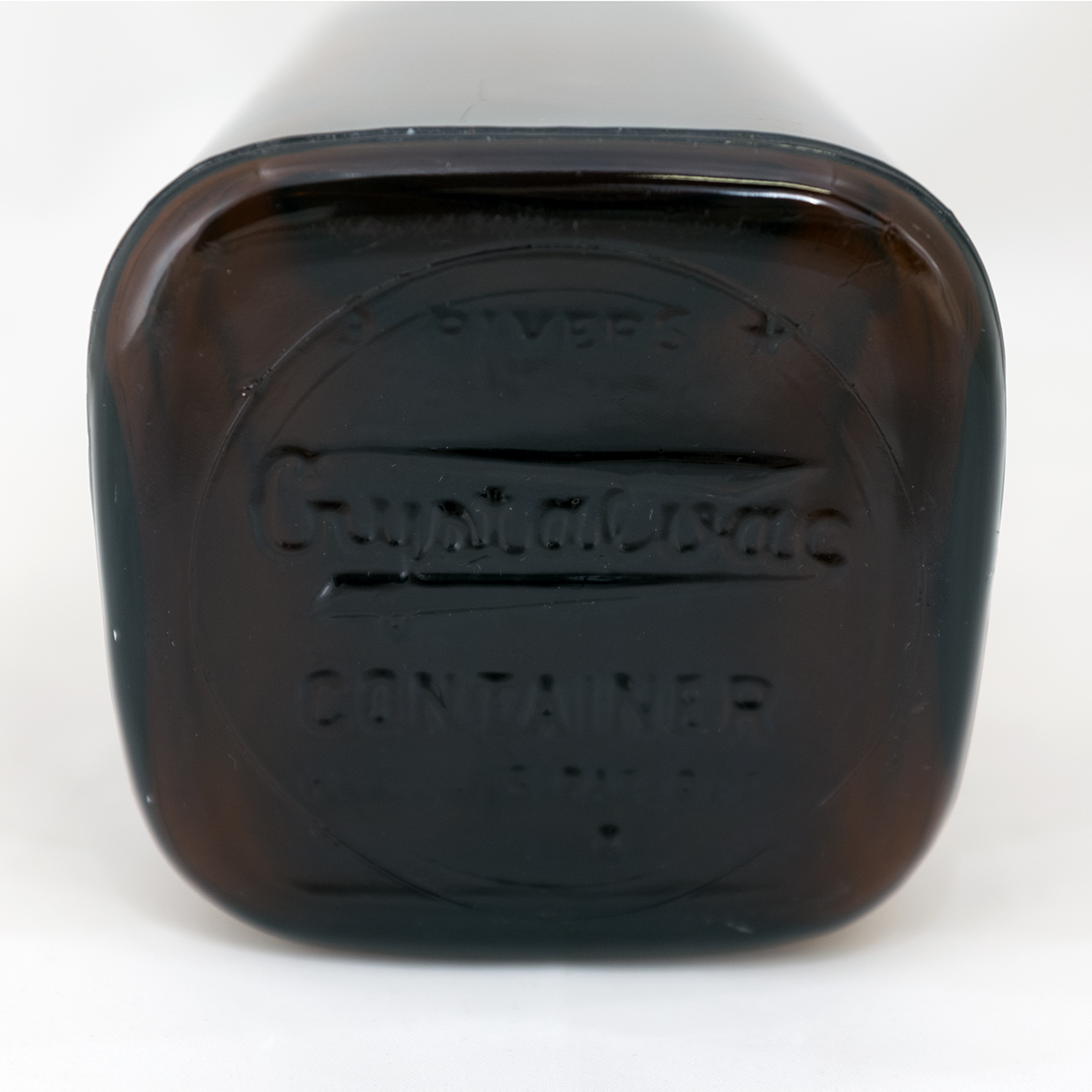
The amber example is similar, with a slightly rounded mold impression and 601-5 on the base.
Patent numbers track running changes to the mold. Examples represented in this collection include:
- 601-1, one-pound, clear glass
- 601-3, one-pound, clear glass
- 601-4, one-pound, clear glass
- 601-5, one-pound, amber glass
- 601-7, one-pound, clear glass
Owens-Illinois Glass Company
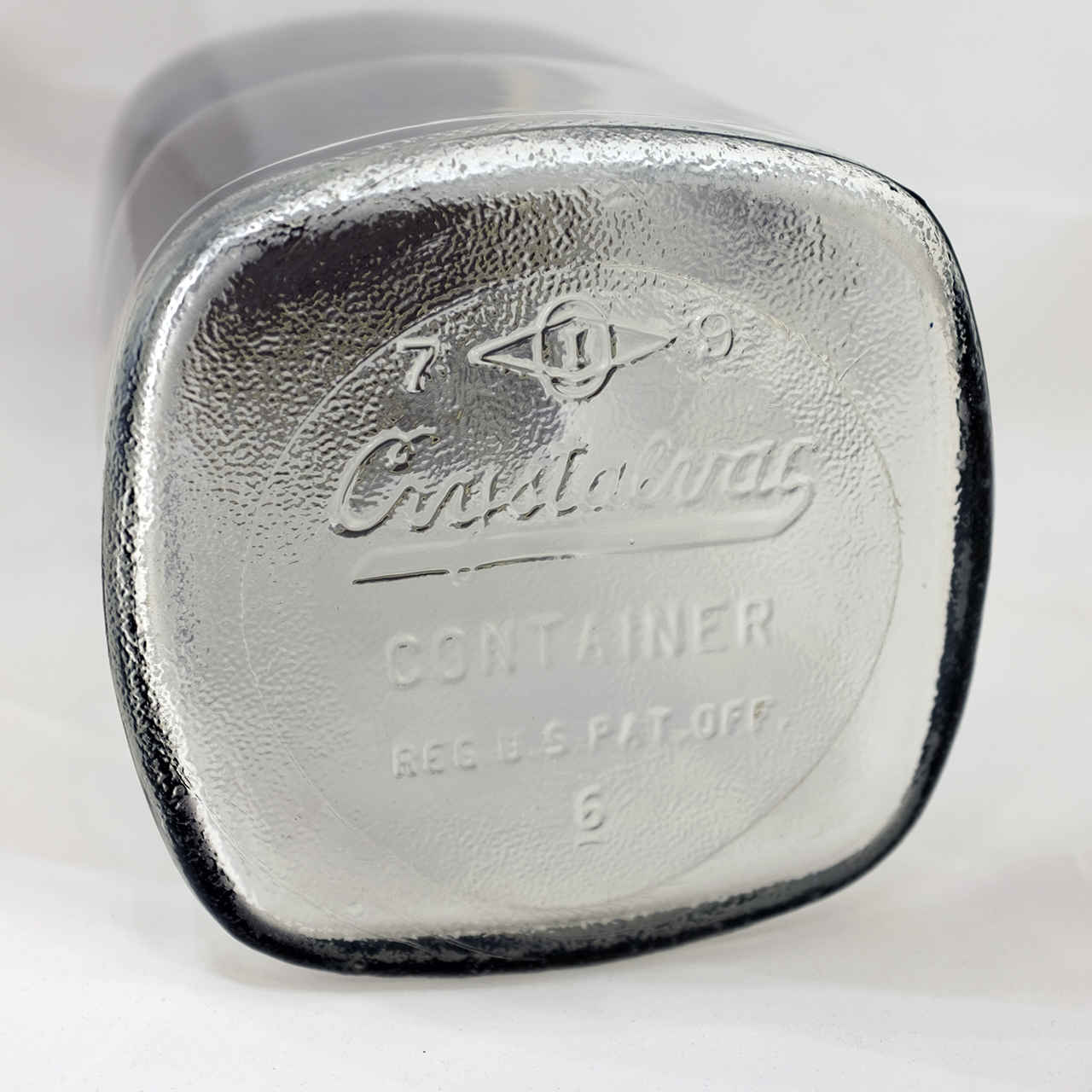
Both large three-pound and small one-pound clear jars in the collection show the diamond–oval–I Owens-Illinois mark. The plant digit to the left of the mark is the factory code (7 = Alton, Illinois); every dated H&H specimen so far is plant 7. The date code to the right is a single digit for the 1930s decade—the illustrated large-jar base reads 1939.
Documented plant-7 date run (updated 2026-07-21). Four one-pound smooth-body jars accessioned in July 2026 extend the O-I window back three years:
| Accession | Date code | Year | Label state |
|---|---|---|---|
| HH-BOTTLE-2026-0003 | 6 | 1936 | none |
| HH-BOTTLE-2026-0002 | 7 | 1937 | ~85% lost |
| HH-BOTTLE-2026-0005 | 7 | 1937 | near-pristine |
| HH-BOTTLE-2026-0004 | 8 | 1938 | reassembled composite |
| Victoria TX large jar | 9 | 1939 | — |
That is a continuous 1936–1939 plant-7 run. Two consequences for dating: an O-I mark does not imply a post-1940 jar, and smooth body walls do not either — all four of the above are smooth-bodied. Read the date code, not the wall texture. The Crystalvac Jar item guide Quick ID was corrected accordingly on the same date.
Caveat: O-I single-digit codes are ambiguous by decade (1936 vs 1946). The tight 6/7/7/8/9 clustering and the Three Rivers dissolution timing both favour the 1930s reading, but a jar dated on a single digit alone should be reported with that qualifier. Some collector literature attributes the large-jar body design to Dr. J. H. Toulouse; this site has not pinned that down to a primary source—treat it as tradition, not fact, until a citation is added.
Reference photography
Crystalvac specimens outside Our Collection — labeled jars on dealers’ tables, book plates, and supplier-site documentation — are indexed in Reference. On-page collection photography appears above under Glass marks and in Collection posts.
Newspaper & period branding
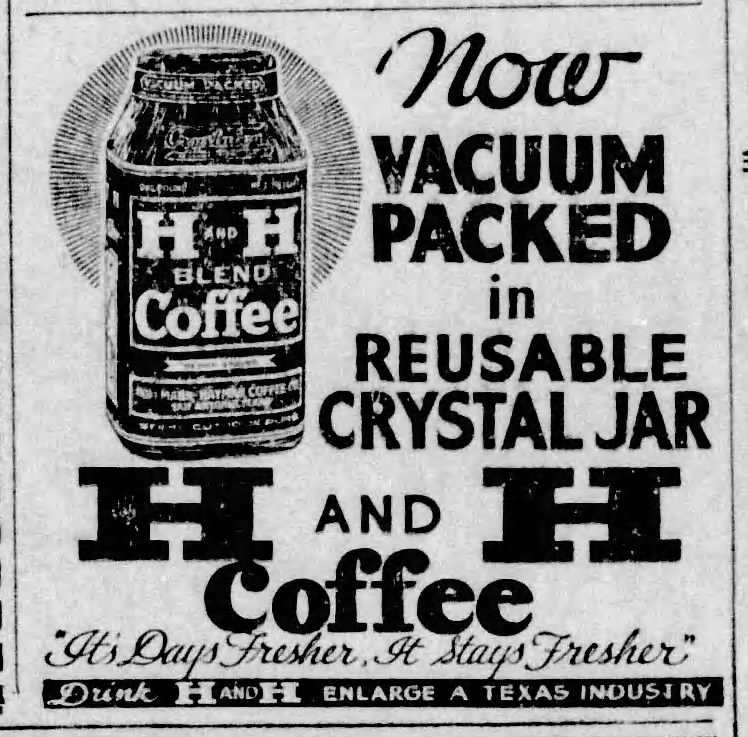
1932 display copy for H and H Blend in square glass Crystalvac jars — period press showing vacuum-pack positioning as tin prices rose (gallery index).
Collection posts
These entries walk individual specimens (handles, lids, labels, auction provenance):
- Large Crystalvac jar (Victoria, TX) — early large three-pound example; Owens-Illinois base marks and the 1939 date code are worked through in the text.
- Three-pound Crystalvac with wire handle and original red lid — red vacuum lid with embossed rim motto and Crystalvac script on lid and body.
- Second three-pound Owens-Illinois Crystalvac (clear) — companion large jar, different seller.
- H and H coffee three-pound jar — research note on square jars, mold marks, and the relationship between Three Rivers and Owens-Illinois production.
- 601-1 Crystalvac jar — second one-pound 601-1 mold acquisition.
- Crystalvac jars (Comfort, TX) — picking up small and large jars from an antique mall run tied to this research page.
- H and H Crystalvac jar (KimmysKicks) — Bowie, Texas; Etsy provenance.
- One-pound 601-1 Crystalvac (Chappell Hill) — Three Rivers base shot and 601-1 mold note.
- Large Victoria Crystalvac — wire handle, plain lid, H and H + Crystalvac body lettering.
- Embossed “We roast it” lid — period vacuum lid motto tied to other H and H slogans.
- Clear Crystalvac quart jar, mold 601-1 — Three Rivers Glass base embossing stack, mold 601-1.
- One-pound Crystalvac jar, mold 601-7 — sibling mold to 601-1, filling in another point in the 601-series Three Rivers run.
- H and H Blend three-pound Crystalvac jar (paper label) — Hoffmann-Hayman wrap label on clear glass; one of the collection’s paper-labeled Crystalvacs.
- H and H aqua Crystalvac jar — Owens-Illinois-era aqua-tinted example with wire-bail wooden-handle lid, matching the bail profile in the 23 Dec 1932 San Antonio Light Crystalvac special-offer ad.
Collecting criteria
Glass color — Clear or amber. Amber is scarcer in the wild.
Size — One pound (small, about 8½ in. tall) or three pounds (large, about 10¼ in. tall).
Glass manufacturer — Three Rivers or Owens-Illinois. Many collectors favor Three Rivers–marked examples for factory provenance.
Jar condition — Chips, scratches, cracks, clarity vs. haziness.
Label — Paper labels rarely survive; a few pieces in the collection retain partial paper.
Lid — Original vs. replacement; jars were sold to accept standard mason lids.
Lid design — Plain metal vs. embossed logo and brand. At least one embossed Crystalvac / H and H lid is in the collection.
Disc — Large jars could be sold with a resealing disc for home canning—embossed with name and price, or plain.
Handle — Large jars may carry a wire bail; wooden grips and aftermarket wire wraps turn up—document what you have.
Collectibility — Glass breaks; wire and lids rust; paper tears. Even so, Crystalvacs often outlast tins and paper bags.
Price (anecdotal) — Large clear jars in this collection have ranged about $25–$125; small clear jars about $30–$60; small amber jars about $75–$150—auction and venue dependent.
Open questions
- Dr. J. H. Toulouse attribution — collector literature attributes the large three-pound jar body design to Dr. J. H. Toulouse, but no primary-source citation has been tied to that claim. Currently flagged inline (under Owens-Illinois Glass Company above) as “tradition, not fact” pending a citation.
- 601-mold sequence gaps (partially closed 2026-05-16) — the patent-stack mold numbers now documented in the collection run 601-1, 601-3, 601-4, 601-5, 601-7, 601-8 (the 2016-02-17 amber Crystalvac specimen, accession HH-PACKAGING-2016-0004, is the 601-8 example, surfaced during the DEBT-4 narrative-bucket-matching pass). 601-2 and 601-6 remain unsurfaced. Worth noting: the 601-8 amber jar carries a clean circular base imprint rather than the offset rounded-square imprint used on the 601-1/3/4/5/7 clear specimens, suggesting circular = later production-engineering change. Whether 601-2 and 601-6 are real molds not yet collected, never produced, or assigned to other Three Rivers products is unresolved.
- Production endpoint — the 1947 period upper bound matches Ball Brothers’ divestment of Three Rivers Glass after antitrust action; Owens-Illinois blanks were molded for Crystalvac across a documented 1936–1939 run and continued after (see § Glass marks). Note the endpoint question is now genuinely open at both ends: the O-I start is earlier than this page previously assumed, so the 1947 upper bound deserves the same scrutiny. When Crystalvac glass-jar production as a whole actually stopped — and whether mid-century H&H “vacuum can” references (e.g. the 1961 Broggi disc) mark a deliberate transition from glass to metal — is undocumented.
- Lid design chronology — multiple lid types are catalogued (plain metal; embossed “WE ROAST IT” / Crystalvac VACUUM PACKED / “OTHERS PRAISE IT”; red enamel with Crystalvac script). The chronological sequence — which lid design is earliest, when they overlapped, and whether specific lid designs map to specific jar sizes — is not pinned down.
- 1934 five-ounce (pint) variant — referenced in dealer literature on the Wanted list but not photographed in the collection; its existence, capacity, and trade dress are unconfirmed.
- 1932 factory-roof replica Crystalvac — period accounts mention a large replica Crystalvac jar installed on the new Delaware Street plant roof at the 1932 opening; no period photograph or modern survey shot has been located.
- Why is “601” the mold-number prefix? The patent-stack mold numbers documented in the collection (see question 2 above for the surfaced/unsurfaced split — 601-1, 601-3, 601-4, 601-5, 601-7, 601-8) all share the 601 prefix, the same number as the factory address (601 Delaware Street). The small Crystalvac jar from Grand Prairie, TX post first flagged the coincidence: was 601 a deliberate Hoffmann-Hayman / Three Rivers Glass design decision tying the customer’s mold sequence to the customer’s street address, or is it numerical coincidence within Three Rivers’ internal mold-numbering scheme? Research angles: compare the mold-prefix numbers stamped on jars Three Rivers produced for other customers (e.g., the Texas Glass identified shelf in the reference materials) — if other Three Rivers customers also get street-address prefixes, the pattern is customer-coded; if Three Rivers used a single ascending counter across customers, 601 is coincidence; the Michael David Smith Texas Glass book and Witte Museum’s Three Rivers Glass holdings are the natural starting points.
-
Handle-form chronology — was the wire-bail-with-turned-wood-grip phased out, or did wood and plain wire coexist? The collection contains both forms: the 2019 aqua jar (Owens-Illinois, post-1938) and the 2015 Colleyville jar (maker not yet confirmed) preserve the wire-bail-with-turned-wood-grip intact, while the 2017-09-12 red-lid three-pound jar (Owens-Illinois, post-1938) and the 2018-04-21 butter-churn body (Owens-Illinois) carry plain wire bails with no wood. The period evidence at the 1932 launch — the 23 Dec 1932 San Antonio Light “Handy Glass Jar” ad and the 19 Dec 1932 Express-News “3-Pound Jars” article — both depict bail-handled jars consistent with the wood-grip form (and the “Handy” framing fits the wood-grip rationale of being easier to carry). But because both surviving wood-grip jars and surviving plain-wire jars are Owens-Illinois era, the data doesn’t support a clean “wood early, plain late” chronology.
Revised 2026-07-21 — this argument needs re-running. The reasoning above treats “Owens-Illinois era” as a single late bucket, and the “(Owens-Illinois, post-1938)” annotations on the 2019 aqua jar and the 2017-09-12 red-lid jar are inferences from the old dating model, not readings of those jars’ own date codes. Owens-Illinois supply is now documented from 1936, so “O-I era” spans at least 1936–1947 — wide enough that two O-I jars could be a decade apart. The premise that both handle forms sit in the same narrow window therefore no longer holds, and the chronology it ruled out is back on the table. Research angle (3) below is likewise stale: an O-I mark no longer “anchors whether the wood-grip predates 1938,” because O-I itself predates 1938. The cheap fix is to read the actual plant/date codes off every bailed jar in the collection and re-tabulate handle form against year — that test was impossible under the old model and is straightforward under the corrected one. Possible readings: (a) the wood grip was the original 1932 retail form and a cheaper plain-wire variant was introduced later (cost-cutting, value-tier, or institutional/bulk SKU); (b) wood and plain wire coexisted throughout production as separate SKUs or premium tiers; (c) survival bias — wood breaks while wire doesn’t, so today’s “plain wire” jars may have originally had wood grips that fell off. The diagnostic for (c): inspect the wire at the top of the bail arch on plain-wire jars — straight wire = never had a grip; paired crimps/bends spaced for a cylindrical grip = wood is lost. Research angles: (1) catalog every Crystalvac jar in the collection against {maker, handle form, lid form, label form} to test whether handle form correlates with any other dating variable; (2) find a period photograph or grocery ad from 1933–1945 that depicts the plain-wire variant in retail use (would rule out survival bias); (3) check the Colleyville jar’s base mark for Three Rivers Star vs Owens-Illinois (would anchor whether the wood-grip predates 1938 in the collection); (4) compare against the 2014-08-13 Bowie/Etsy wire-basket-cage-with-wood-handle form — that’s a different design (cage around the jar rather than wood as a section of the bail arch) and already flagged in its own post as possibly a later aftermarket grocery-carrier addition, not a factory feature.
Tentative findings (2026-05-21 photo-only inspection). The diagnostic (paired crimps / bends at the bail-arch center where a wooden grip would have sat) was applied to the existing gallery photos:
- 2019-08-17 aqua jar — used as the wire-bail-with-wood reference. The dedicated
*-bail.jpgclose-up shows the wire entering a turned-wood cylinder at the top of the arch; the wire and wood are integral. - 2018-04-21 butter-churn jar (plain wire) — best side view of any plain-wire bail in the current photo set. The bail is visible across the front of the jar in rest position. The wire appears smooth and uniform, with no flattened section, paired bends, or crimps at the center. Initial reading: this jar’s bail looks like it was always plain wire (i.e., not a survival-bias artifact of a lost wood grip). Caveat: this jar has been retrofitted as a butter-churn body, so the original lid was replaced and the bail itself may also have been replaced or modified during the conversion — treat as suggestive, not definitive.
- 2017-09-12 red-lid three-pound jar (plain wire) — top-down photo only; the bail is visible looping over the right side of the lid but no clean side profile is photographed. Inconclusive from existing images. This is the cleanest unmodified plain-wire jar in the collection and is the priority target for a dedicated side-angle bail close-up the next time the jar is in hand.
- 2019-10-04 paper-label H&H Blend three-pound (plain wire) — front-on shot of the paper label; bail not adequately visible. Inconclusive from existing images.
Photo task to close survival-bias question: pull the 2017-09-12 red-lid jar and the 2019-10-04 paper-label jar, photograph each bail arch straight-on from the side with even lighting, and look for (a) paired bends or crimps at the wire’s center spaced for a cylindrical grip, (b) wire-diameter or surface-finish discontinuity at the center vs the ends (oxidation difference where wood would have shielded the wire), (c) bail length comparison against the 2019-08-17 aqua jar’s intact wood-bail arch (matching arch length but missing wood = grip was there and is lost; shorter arch = bail was always plain). If both jars show smooth uniform wire with no center crimps and identical arch length to the wood-bail jars, the plain-wire form is real and (c) survival bias is ruled out — pointing to either (a) cheaper later variant or (b) parallel SKUs.
- 2019-08-17 aqua jar — used as the wire-bail-with-wood reference. The dedicated
Wanted
High-priority gaps also appear on the site-wide Wanted list:
- Large clear Crystalvac with wire handle, embossed lid, and legible paper label (ideal “complete” retail look).
- Small Three Rivers amber jar with paper label documentation.
- 1934 five-ounce (pint) Crystalvac called out in the reference lists—any clear photos or a physical example.
- Photographs of the replica Crystalvac installed on the factory roof in 1932 (period or modern survey shots).
- Additional clear one-pound and clear three-pound variants for comparison where mold or base marks differ from pieces already on the site.
Packaging-technology sibling: Flav-O-Tainer (1942)
Crystalvac (1932 glass) and Flav-O-Tainer (1942 cellophane-lined paper bag) are the two H&H packaging-technology wordmarks documented on this site — wordmarks that brand the package itself rather than the coffee inside. Crystalvac was a peacetime-modernization durables-glass brand built around reuse-economy and Three Rivers supplier integration; Flav-O-Tainer was a wartime-substitution disposable-paper brand built around tin-conservation during WWII metal rationing. The two represent opposite ends of H&H’s packaging-tech wordmark arc, ten years apart. The contrast table is at the Crystalvac launch page § Packaging-technology wordmark precedent.
See also
Companies
- Ball Brothers Glass Manufacturing Company
- Hoffmann-Hayman Company
- Owens-Illinois Glass Company
- Three Rivers Glass Bottles
- Three Rivers Glass Company — supplier of the one-pound Crystalvac jars
Brands
- Crystalvac — the launch and marketing of the vacuum-pack brand
- Flav-O-Tainer — H&H’s second packaging-technology wordmark (1942 cellophane-lined paper bag for wartime metal-rationing); contrasts with Crystalvac glass at the Crystalvac launch page
- H and H Product Line
Items
People
Synthesis
- 1937 — H&H Inflection Year
- Jar Supplier Transition — Three Rivers → Owens-Illinois