Double H Coffee
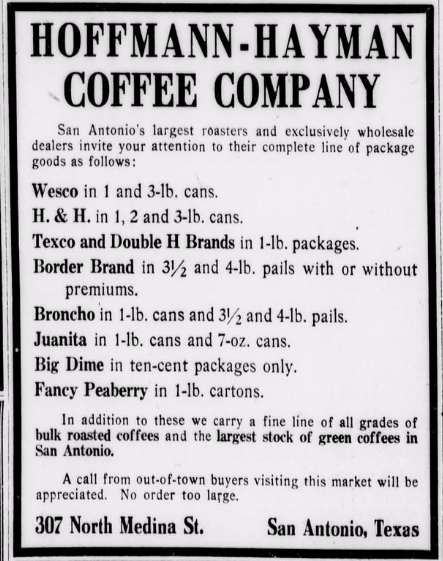
Double H is a Hoffmann-Hayman wholesale mark documented in exactly one primary source on this site — the 19 August 1917 San Antonio Express wholesale roster (Vol. 52, No. 231) — where it appears paired with Texco in a single line item: “Texco and Double H Brands in 1-lb. packages.” The same roster sets H. & H. apart in cans, so Double H is a distinct wordmark from the main H. & H. label, not an alternate spelling. The roster pitches the consolidated post-Morrison plant at 307 North Medina Street and inventories nine package lines (Wesco, H. & H., Texco, Double H, Border, Broncho, Juanita, Big Dime, Fancy Peaberry).
After August 1917 the brand drops out of the documented record. Double H is not named in the 28 January 1917 Morrison acquisition announcement (which names only Wesco, Misa, Broncho, Texco, Juanita), not in the 29 April 1917 “That Morning’s Cup of Coffee” feature (which names H&H, Wesco, Misa, Texco as the four “popular brands”), not in the 19 October 1917 Liberty Loan sponsor cell (“H. & H. Blend—Wesco—Texco”), not in the 26 August 1923 San Antonio Light products grid, not in the 28 November 1926 Light “Largest Coffee Plant” roster, and not on the 2 March 1942 H&H wholesale price sheets. The single-source footprint and the immediate disappearance after Aug 1917 make Double H’s continuity status genuinely uncertain — period correction from the page’s earlier 1914–1923 framing to 1917 reflects what the primary record actually documents.
The collection has no catalogued tin, bag, or label for Double H yet. Period pack art, photographs, or later ads that isolate the wordmark would help separate Double H from H and H Blend in the record — and would discriminate between the hypotheses below.
Three hypotheses for what “Double H” was
The single-source footprint admits several readings:
Hypothesis 1 — “Double H” is the HH-monogram device
The H and H Blend page documents a bulk-size tin in the collection with an “H and H Blend monogram side” panel — the HH circular monogram typography that doubled the company initials into a single mark. The 1917 wholesale copy may have used “Double H Brand” to refer to packages bearing this visual HH monogram (a value-tier 1-lb. retail package paired with Texco) while “H. & H.” referred to the spelled-out wordmark on the firm’s primary 1-, 2-, and 3-lb. cans. Under this reading, Double H is trade-dress shorthand for a specific pack variant, not an entirely separate brand.
Hypothesis 2 — “Double H” is a one-time wholesale formulation that didn’t survive
The pairing “Texco and Double H Brands in 1-lb. packages” may have been a single-roster experiment: an early-H&H attempt to introduce a value-tier 1-lb. retail mark alongside the Morrison-acquired Texco, named for the obvious HH-monogram convenience. The line may have been quietly retired before any subsequent advertising campaign — consistent with the four-month disappearance pattern documented for Misa Coffee (named in the Jan 1917 acquisition and Apr 1917 “popular brands” feature, then absent from the same Aug 1917 roster).
Hypothesis 3 — “Double H” was a Morrison-era line carried forward without naming
The 28 Jan 1917 Morrison acquisition announcement uses “including” rather than “exclusively” when naming the five continued brands, so the list is not exhaustive. Double H may have been a lower-tier Morrison line acquired in the transfer that was not deemed worth naming in the formal announcement but did make the August 1917 wholesale roster under H&H’s masthead. No surviving Morrison advertising on this site names Double H, so this hypothesis would require period Morrison records to confirm.
Resolution requires: (a) any pre-1917 Morrison advertising naming Double H; (b) a 1917–1923 Texas Secretary of State trademark filing for the wordmark; or (c) a surviving Double H pack from any year.
Products
- Double H Brand — one-pound package (per the 19 Aug 1917 wholesale roster: “Texco and Double H Brands in 1-lb. packages”)
Packaging
No museum specimen is catalogued. The 1917 Express wholesale roster is the only primary mention of the name in a full package roster on this site.
Documented absence after August 1917
- 19 October 1917 San Antonio Light Liberty Loan sponsor cell — H. & H. Blend—Wesco—Texco. No Double H.
- 26 August 1923 San Antonio Light products grid — illustrated H&H packs. No Double H.
- 28 November 1926 Light “Largest Coffee Plant” — H AND H BLEND, SAM HOUSTON, BRONCHO, BORDER, MENGER PEABERRY, TEXCO. No Double H.
- 2 March 1942 H&H wholesale package and bulk price sheets — H AND H, SAN ANTONIO, TEXAS GIRL, ANITA, TEXCO, BIG VALUE, M. CHEF; bulk Anita Peaberry Blend, Good Value, O.S.T. Fancy Santos Peaberry. No Double H.
This documented-absence audit is what tightens the page’s period from the prior 1914–1923 framing to 1917 — the brand has exactly one documented year on this site.
Advertising
- Wholesale package line — 19 Aug 1917 — full page, transcription, and “Texco and Double H Brands” block quote.
Collection posts
- 19 Aug 1917 San Antonio Express wholesale line — roster scan and 307 North Medina address.
Newspaper & period branding
Additional Double H hits can be indexed through Newspaper ads as they surface.
Related lines
- H and H Blend Coffee — H. & H. on the same 1917 page as a separate can line from Double H. The HH-monogram bulk tin on that page is the visual basis for Hypothesis 1 above.
- Texco Coffee — paired with Double H in “Texco and Double H Brands” 1-lb. copy; Texco persisted to 1942+ where Double H did not.
- Wesco Coffee · Broncho Coffee — co-listed on the 1917 wholesale card with both Texco and Double H.
- Misa Coffee — parallel case of a brand named in early-1917 H&H copy then vanishing by the next major H&H roster.
- Hoffmann-Hayman Coffee Company — corporate hub.
- H and H Product Line — product-family index.
Open questions
- Was “Double H” the HH-monogram device or a distinct wordmark? The HH monogram on the surviving bulk tin documented on the H and H Blend page is the visual candidate; a labeled “Double H” pack would settle this.
- Why did Double H disappear after Aug 1917 while paired-partner Texco continued through 1942? The Texco-and-Double-H 1-lb. line was a single roster entry; only Texco’s half survived into the next H&H advertising window.
- Was Double H a Morrison-era line? Not named in the 28 Jan 1917 acquisition announcement but may have been part of the “including” hedge. Period Morrison advertising or trademark records would discriminate.
- Was Double H a separately-priced value-tier of H and H Blend? The 1-lb. format and pairing with Texco (positioned as a price-point line in the same roster) is consistent with a value-tier reading, but no per-pound pricing for Double H survives on this site.
Wanted
- Any Double H pack (tin, bag, carton, label) — would document the wordmark vs. monogram question and the per-pound pricing.
- 1917–1923 advertising naming Double H — would close the documentary gap between the August 1917 roster and the brand’s apparent disappearance.
- A Morrison-era reference to Double H — would discriminate between the H&H-introduction reading (Hypotheses 1–2) and the Morrison-acquired reading (Hypothesis 3).
- Texas Secretary of State trademark filings for “Double H” or any HH-monogram device by Hoffmann-Hayman or Morrison Coffee Co.
Contact with leads.
See also
- Hoffmann-Hayman Company — corporate hub