
Hoffmann-Hayman ‘pioneer concern’ — San Antonio Light, 14 Aug 1921
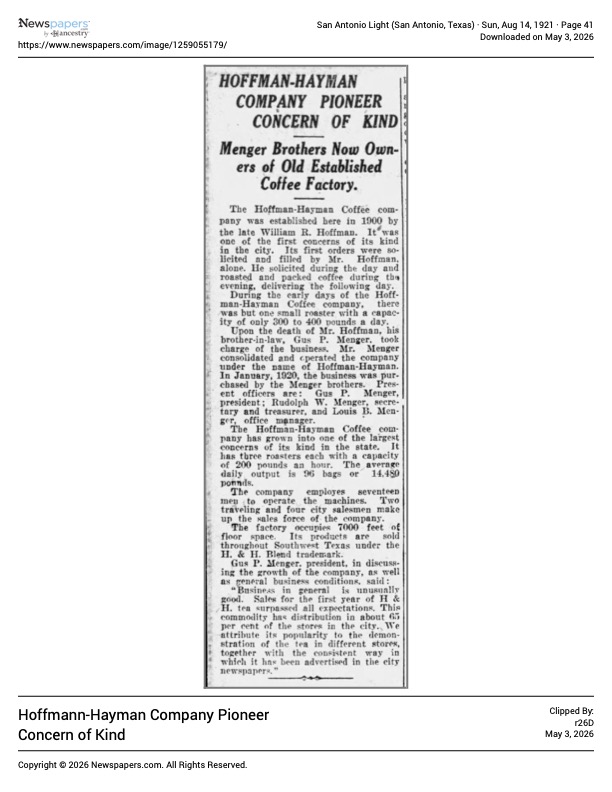
Sunday Rotogravure-style profile of the company under the Menger brothers: capacity, brands (H. & H. Blend), and branch distribution — primary narrative evidence for early-1920s scale.
HOFFMAN-HAYMAN COMPANY PIONEER CONCERN OF KIND Menger Brothers Now Own- ers of Old Established Coffee Factory. The Hoffman-Hayman Coffee com- pany was established here in 1900 by the late William R. Hoffman. It was one of the first concerns of its kind in the city. Its first orders were soli- cited and filled by Mr. Hoffman, alone. He solicited during the day and roasted and packed coffee during the evening, delivering the following day. During the early days of the Hoff- man-Hayman Coffee company, there was but one small roaster with a capa- city of only 300 to 400 pounds a day. Upon the death of Mr. Hoffman, his brother-in-law, Gus P. Menger, took charge of the business. Mr. Menger consolidated and operated the company under the name of Hoffman-Hayman. In January, 1920, the business was pur- chased by the Menger brothers. Pres- ent officers are: Gus P. Menger, president; Rudolph W. Menger, secre- tary and treasurer, and Louis B. Men- ger, office manager. The Hoffman-Hayman Coffee com- pany has grown into one of the largest concerns of its kind in the state. It has three roasters each with a capacity of 200 pounds an hour. The average daily output is 96 bags or 14,480 pounds. The company employs seventeen men to operate the machines. Two traveling and four city salesmen make up the sales force of the company. The factory occupies 7000 feet of floor space. Its products are sold throughout Southwest Texas under the H. & H. Blend trademark. Gus P. Menger, president, in discuss- ing the growth of the company, as well as general business conditions, said: “Business in general is unusually good. Sales for the first year of H & H. tea surpassed all expectations. This commodity has distribution in about 65 per cent of the stores in the city. We attribute its popularity to the demon- stration of the tea in different stores, together with the consistent way in which it has been advertised in the city newspapers.”
Source
- San Antonio Light (San Antonio, Texas), Sunday 14 August 1921, p. 41, “Hoffmann-Hayman Company Pioneer Concern of Kind.”
- Digital clip: Newspapers.com image 1259055179 (accessed 3 May 2026).
- Archived PDF: /assets/pdfs/1921-08-14-san-antonio-light-hoffmann-hayman-pioneer-concern.pdf.
- Gallery: Newspaper Clippings (HH-CLIP-1921-0006).

