
‘The Story of Coffee’ — roastmaster feature (Express-News, 19 Sep 1954)
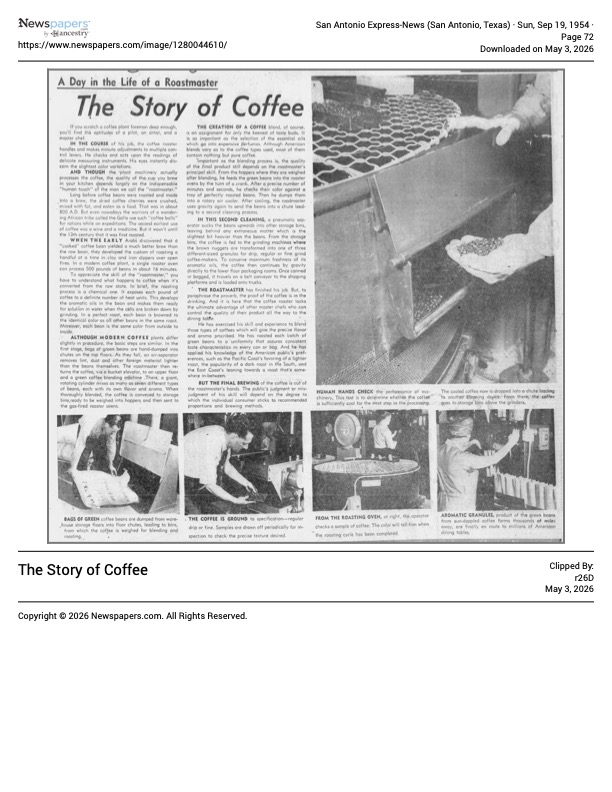
Magazine-style spread on industrial roasting — green bean intake, blending cylinders, gas ovens, cooling, grinding — useful general-period context for reading Hoffmann-Hayman plant operations.
A Day in the Life of a Roastmaster
The Story of CoffeeIf you scratch a coffee plant foreman deep enough, you’ll find the aptitudes of a pilot, an artist, and a master chef.
IN THE COURSE of his job, the coffee roaster handles and makes minute adjustments to multiple control levers. He checks and acts upon the readings of delicate measuring instruments. His eyes instantly discern the slightest color variations.
AND THOUGH the plant machinery actually processes the coffee, the quality of the cup you brew in your kitchen depends largely on the indispensable “human touch” of the men we call the “roastmaster.”
Long before coffee beans were roasted and made into a brew, the dried coffee cherries were crushed, mixed with fat, and eaten as a food. That was in about 800 A.D. But even nowadays the warriors of a wandering African tribe called the Galla use such “coffee balls” for ration while on expeditions. The second earliest use of coffee was a wine and a medicine. But it wasn’t until the 13th century that it was first roasted.
WHEN THE EARLY Arabs discovered that a “cooked” coffee bean yielded a much better brew than the raw bean, they developed the custom of roasting over open fires. In a modern coffee plant, a single roaster oven can process 500 pounds of beans in about 16 minutes.
To appreciate the skill of the “roastmaster,” you have to understand what happens to coffee when it’s converted from the raw state. In brief, the roasting process is a chemical one. It exposes each pound of coffee to a definite number of heat units. This develops the aromatic oils in the bean and makes them ready for solution in water when the cells are broken down by grinding. In a perfect roast, each bean is browned to the identical color as all other beans in the same roast. Moreover, each bean is the same color from outside to inside.
ALTHOUGH MODERN COFFEE plants differ slightly in procedure, the basic steps are similar. In the first stage, bags of green beans are hand-dumped into chutes on the top floors. As they fall, an air-separator removes lint, dust and other foreign material lighter than the beans themselves. The roastmaster then returns the coffee, via a bucket elevator, to an upper floor and a green coffee blending machine. There, a giant rotating cylinder mixes as many as seven different types of beans, each with its own flavor and aroma. When thoroughly blended, the coffee is conveyed to storage bins, ready to be weighed into hoppers and then sent to the gas-fired roaster ovens.
THE CREATION OF A COFFEE blend, of course, is an assignment for only the keenest of taste buds. It is as important as the selection of the essential oils which go into expensive perfumes. Although American blends vary as to the coffee types used, most of them contain nothing but pure coffee.
Important as the blending process is, the quality of the final product still depends on the roastmaster’s principal skill. From the hoppers where they are weighed after blending, he feeds the green beans into the roaster ovens by the turn of a crank. After a precise number of minutes and seconds, he checks their color against a tray of perfectly roasted beans. Then he dumps them into a rotary air cooler. After cooling, the roastmaster uses gravity again to send the beans into a chute leading to a second cleaning process.
IN THIS SECOND CLEANING, a pneumatic separator sucks the beans upwards into other storage bins, leaving behind any extraneous matter which is the slightest bit heavier than the beans. From the storage bins, the coffee is fed to the grinding machines where the brown nuggets are transformed into one of three different-sized granules for drip, regular or fine grind coffee-makers. To conserve maximum freshness of its aromatic oils, the coffee then continues by gravity directly to the lower floor packaging rooms. Once canned or bagged, it travels on a belt conveyor to the shipping platforms and is loaded onto trucks.
THE ROASTMASTER has finished his job. But, to paraphrase the proverb, the proof of the coffee is in the drinking. And it is here that the coffee roaster lacks the ultimate advantage of other master chefs who can control the quality of their product all the way to the dining table.
He has exercised his skill and experience to blend those types of coffees which will give the precise flavor and aroma prescribed. He has roasted each batch of green beans to a uniformity that assures consistent taste characteristics in every can or bag. And he has applied his knowledge of the American public’s preferences, such as the Pacific Coast’s favoring a lighter roast, the popularity of a dark roast in the South, and the East Coast’s leaning towards a roast that’s some-where in-between.
BUT THE FINAL BREWING of the coffee is out of the roastmaster’s hands. The public’s judgment or mis-judgment of his skill will depend on the degree to which the individual consumer sticks to recommended proportions and brewing methods.
BAGS OF GREEN coffee beans are dumped from warehouse storage floors into floor chutes, leading to bins, from which the coffee is weighed for blending and roasting.
THE COFFEE IS GROUND to specification—regular drip or fine. Samples are drawn off periodically for inspection to check the precise texture desired.
FROM THE ROASTING OVEN, at right, the operator checks a sample of coffee. The color will tell him when the roasting cycle has been completed.
HUMAN HANDS CHECK the performance of machinery. This test is to determine whether the coffee is sufficiently cool for the next step in the processing.
The cooled coffee now is dropped into a chute leading to another cleaning device. From there, the coffee goes to storage bins above the grinders.
AROMATIC GRANULES, product of the green beans from sun-dappled coffee farms thousands of miles away, are finally en route to millions of American dining tables.
Source
- San Antonio Express-News (San Antonio, Texas), Sunday 19 September 1954, p. 72, “The Story of Coffee.”
- Digital clip: Newspapers.com image 1280044610 (accessed 3 May 2026).
- Archived PDF: /assets/pdfs/1954-09-19-san-antonio-express-news-story-of-coffee.pdf.
- Gallery: Newspaper Clippings (HH-CLIP-1954-0004).

