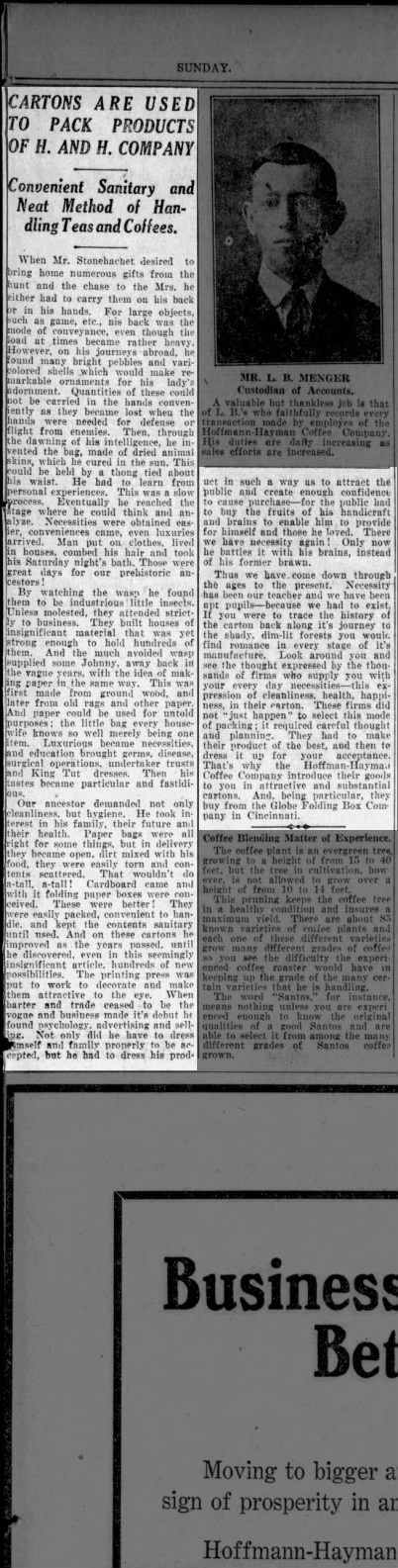

Cartons are used to pack products of H and H Company — San Antonio Light, 26 Aug 1923
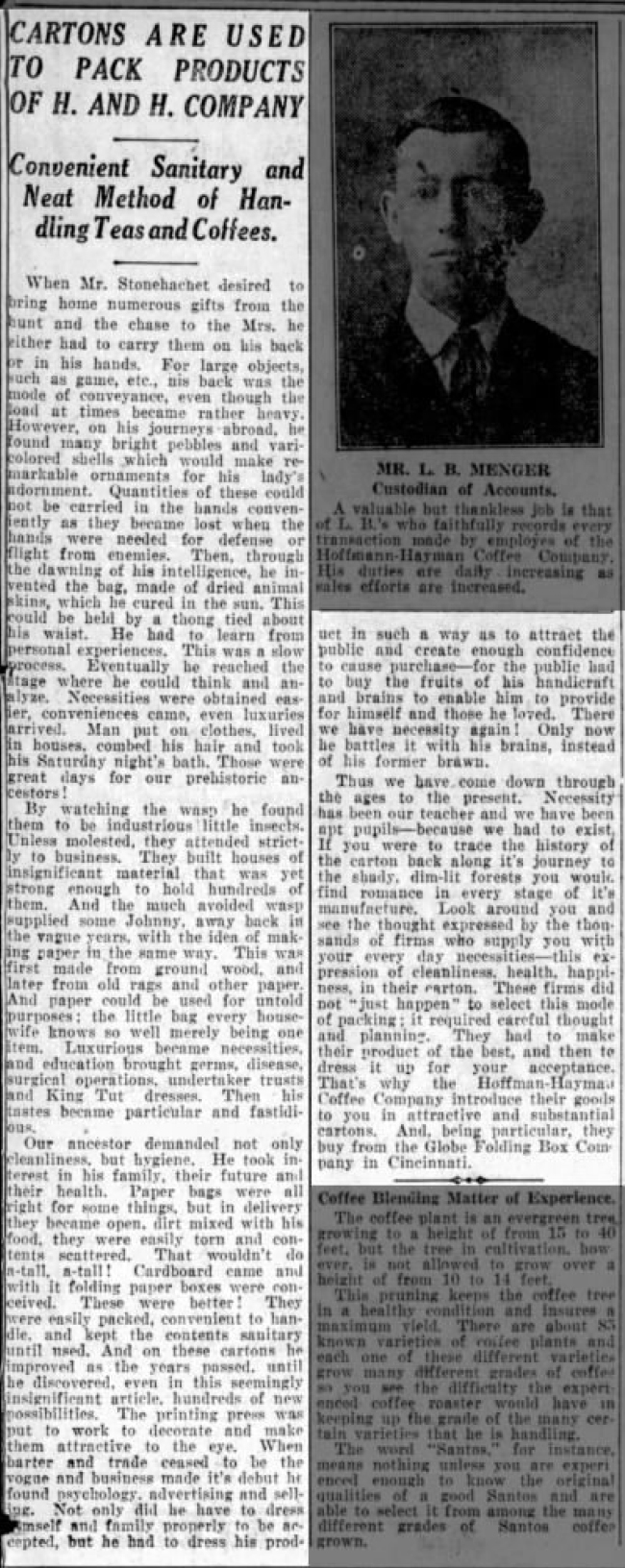
This San Antonio Light feature (page 63, 26 August 1923) explains folding cartons for Hoffmann–Hayman teas and coffees, with a Globe Folding Box Company (Cincinnati) attribution and a portrait of L. B. Menger, custodian of accounts. Same hosted page image as other 1923-08-26 page 63 Light crops in this series: different clip selection on one Newspapers.com page image.
Transcription
CARTONS ARE USED TO PACK PRODUCTS OF H. AND H. COMPANY
Convenient Sanitary and Neat Method of Handling Teas and Coffees.
When Mr. Stonehatchet desired to bring home numerous gifts from the hunt and the chase to the Mrs., his father had to carry them on his back or in his hands. For large objects, such as game, etc., his back was the mode of conveyance, even though the load at times became rather heavy. However, on his journeys he usually found many bright pebbles and varicolored shells which would make remarkable adornments for his lady’s adornment. Quantities of these could not be carried in the usual convenient manner as they became lost when the hands were needed for defense or flight from enemies. Then, through the dawning of his intelligence, he invented a bag, made of dried animal skins, which he cured in the sun. This was to be held by a thong tied about his waist. This was the result of personal experiences. This was a slow process. Eventually he needed a village where he could think and analyze. As civilization blossomed and grew, conveniences came, even luxuries arrived. Man put on clothes, lived in houses, turned his tub instead of his Saturday night’s bath. Those were great days for our prehistoric ancestors!
By watching the wasp he found ways to be industrious with paper. Unless molested, they attended strictly to business. They built houses of insignificant material that was yet strong enough to hold hundreds of them. This same method eventually supplied some Johnny, away back in the ages, with the science of making paper in the same way. This was paper made from ground wood, and later bleached so it is white now. And paper could be used for untold purposes. We find it in the arts—the wife knows so well merely being one of them. Paper became a necessity, and education brought fiction, disease, surgical operations, undertaken trusts, and other luxuries. Gradually our tastes became particular and fastidious.
Our ancestor demanded not only cleanliness, but hygiene. He took its interests of family and the care of their health. Paper bags were all right in many ways, but the moment they became open, dirt mixed with his food, they were easily torn and consequently not so good. Then came—a-tall, a-tall! Cardboard came and with it folding boxes! These were well received. These were better! They were easily packed, convenient to handle and kept the contents sanitary until used. And on these cartons he discovered—there is no telling what he discovered, even in this seemingly insignificant article, hundreds of new possibilities. Manufacturers have used it to work to decorate and make pretty with colors and print. The barter and trade ceased to be the minor considerations that they were but found psychology, advertising and selling. Not only did he have to dress himself attractively before he was accepted, but he had to dress his product in such a way as to attract the public and create enough confidence to cause purchases—for the public had to buy the fruits of his handicraft and brains to enable him to provide for himself and those he loved. There we have necessity again! Only now he wraps it with his brains, instead of his former brawn.
Thus we have come down through the ages to the present. Machinery has been our teacher and we have been our students—because we had to exist. If you were to trace the history of the carton back along its journey to the factory, directly above you would find romance in every stage of its manufacture. Look around you and see the thought expressed by the thousands of forms in which we pack your every day necessities—this is expression of cleanliness, health, happiness in food, and all these H and H did not “just happen” to select this mode of packing; it required careful thought and planning. They had to make their product of the best, and then to dress it to the best advantage. That’s why the Hoffmann-Hayman Coffee Company introduced their goods to you in attractive and substantial cartons. And, being particular, they are made by Globe Folding Box Company in Cincinnati.
MR. L. B. MENGER — Custodian of Accounts
A valuable but thankless job is that of L. B.’s who faithfully records every transaction made by employees of the Hoffmann-Hayman Coffee Company. His duties are daily increasing as sales efforts are increased.
(Portrait of L. B. Menger accompanies the above text on page 63.)
Coffee Blending Matter of Experience (right column, same page)
The coffee plant is an evergreen tree growing to a height of from 15 to 40 feet, but the tree in cultivation, however, is not allowed to grow over a height of from 10 to 14 feet.
This pruning keeps the coffee tree in a healthy condition and insures a maximum yield. There are about 85 known varieties of coffee plants and each one of these different varieties grows many different grades of coffee so you see the difficulty the experienced coffee roaster would have in keeping up the grade of the many certain varieties that he is handling.
The word “Santos,” for instance, means nothing unless you are experienced enough to know the original qualities of a good Santos and are able to select it from among the many different grades of Santos coffee grown.
Source
- Newspaper: San Antonio Light (San Antonio, Texas) — 26 August 1923 — page 63
- Same hosted page image as other 1923-08-26 San Antonio Light page 63 crops (e.g. coffee blending, congratulations ad, “great deal of work”, “cleaned six or seven times”) — same
image/1258680699host id, different clip bounds. - This clip’s viewer URL: Newspapers.com (accessed 27 April 2026)
- Local PDF: 1923-08-26-san-antonio-light-cartons-used-to-pack-products-h-and-h-compnay.pdf