H and H — San Antonio Express page 8, New Year’s Eve 1933
31 December 1933 San Antonio Express page 8—year-end placement in Newspaper Clippings; check the scan for holiday copy or grocer tie-ins beside Hoffmann-Hayman.
Transcription
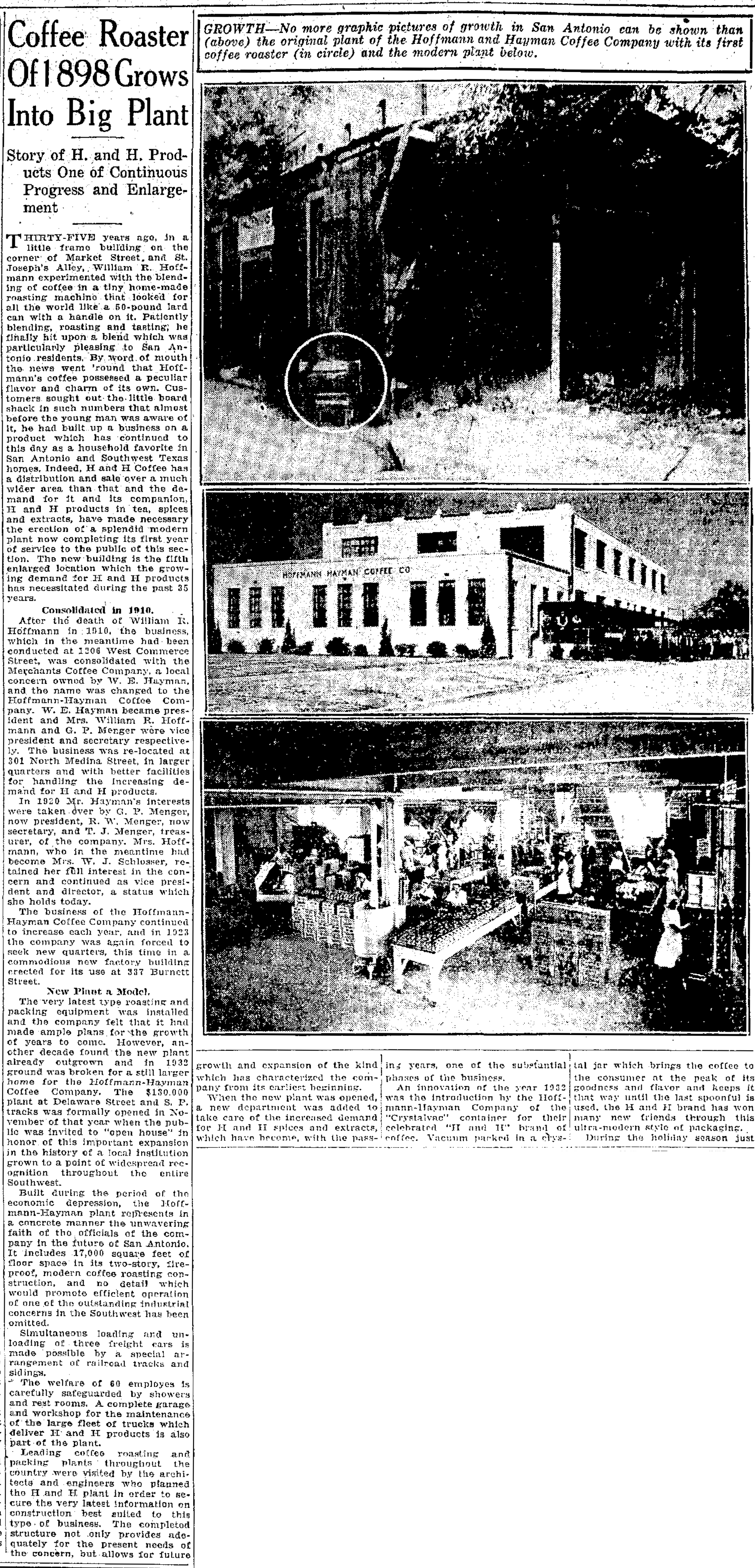
Coffee Roaster Of 1898 Grows Into Big Plant
Story of H. and H. Products One of Continuous Progress and Enlargement
T HIRTY-FIVE years ago, in a little frame building on the corner of Market Street and St. Joseph’s Alley, William R. Hoffmann experimented with the blending of coffee in a tiny home-made roasting machine that looked for all the world like a 50-pound lard can with a handle on it. Patiently blending, roasting and tasting, he finally hit upon a blend which was particularly pleasing to San Antonio residents. By word of mouth the news went ‘round that Hoffmann’s coffee possessed a peculiar flavor and charm of its own. Customers sought out the little board shack in such numbers that almost before the young man was aware of it he had built up a business on a product which has continued to this day as a household favorite in San Antonio and Southwest Texas homes. Indeed, H and H Coffee has a distribution and sale over a much wider area than that and the demand for it and its companion, H and H products in tea, spices and extracts, have made necessary the erection of a splendid modern plant now completing its first year of service to the public of this section. The new building is the fifth enlarged location which the growing demand for H and H products has necessitated during the past 35 years.
Consolidated in 1910. After the death of William R. Hoffmann in 1910, the business, which in the meantime had been conducted at 100 West Commerce Street, was consolidated with the Merchants Coffee Company, a local concern owned by W. E. Hayman, and the name was changed to the Hoffmann-Hayman Coffee Company. W. E. Hayman became president and Mrs. William R. Hoffmann and G. P. Menger were vice president and secretary respectively. The business was re-located at 301 North Medina Street, in larger quarters and with better facilities for handling the increasing demand for H and H products.
In 1920 Mr. Hayman’s interests were taken over by G. P. Menger, now president, R. W. Menger, now secretary, and T. J. Menger, treasurer, of the company. Mrs. Hoffmann, who in the meantime had retained her full interest in the concern and continued as vice president and director, a status which she holds today.
The business of the Hoffmann-Hayman Coffee Company continued to increase each year, and in 1923 the company was again forced to seek new quarters, this time in a commodious new factory building erected for its use at 337 Burnett Street.
New Plant a Model. The very latest type roasting and packing equipment was installed and the company felt that it had made ample plans for the growth of years to come. However, another decade found the new plant already outgrown and in 1939 ground was broken for a still larger home for the Hoffmann-Hayman Coffee Company. The $150,000 plant at Delaware Street and S. P. tracks was formally opened in November of that year, this time in a “certain point of widespread recognition throughout the entire Southwest.”
Built during the period of the economic depression, the Hoffmann-Hayman plant reflects in a concrete manner the unwavering faith of the officials of the company in the future of San Antonio. It includes 17,000 square feet of floor space in its two-story, fireproof, modern coffee roasting construction, and no detail which would promote efficient operation of one of the outstanding industrial concerns in the Southwest has been omitted.
Simultaneous loading and unloading of three freight cars is made possible by a special arrangement of rail tracks and sidings.
“The welfare of 60 employees is carefully safeguarded by showers and rest rooms. A complete garage and workshop for the maintenance of the large fleet of trucks which deliver H and H products is also part of the plant.
Leading coffee roasting and packing plants throughout the country were visited by the architects and engineers who planned the H and H plant in order to secure the very latest information on construction best suited to this type of business. The completed structure not only provides adequately for the present needs of the concern, but allows for future growth and expansion of the kind which has characterized the company from its earliest beginnings.
When an innovation of the year 1939 was introduced by the Hoffmann-Hayman Company of the “Crystalize” container for their “H and H” brand of coffee, which have become, with the pass
During the holiday season just
Source
- San Antonio Express (San Antonio, Tex.), 31 December 1933, p. 8 (per project PNG filename).
- Project scan: Newspaper Clippings (
San Antonio Express (San Antonio, Tex.) 1933-12-31 page 8.png).